For more than a year, the effort to push budget legislation through the divided French Parliament has contributed to one of the most turbulent phases in French politics in half a century. Three successive prime ministers have fallen since last December — including the current prime minister, Sébastien Lecornu, who stepped down in October before being reappointed days later by President Emmanuel Macron.
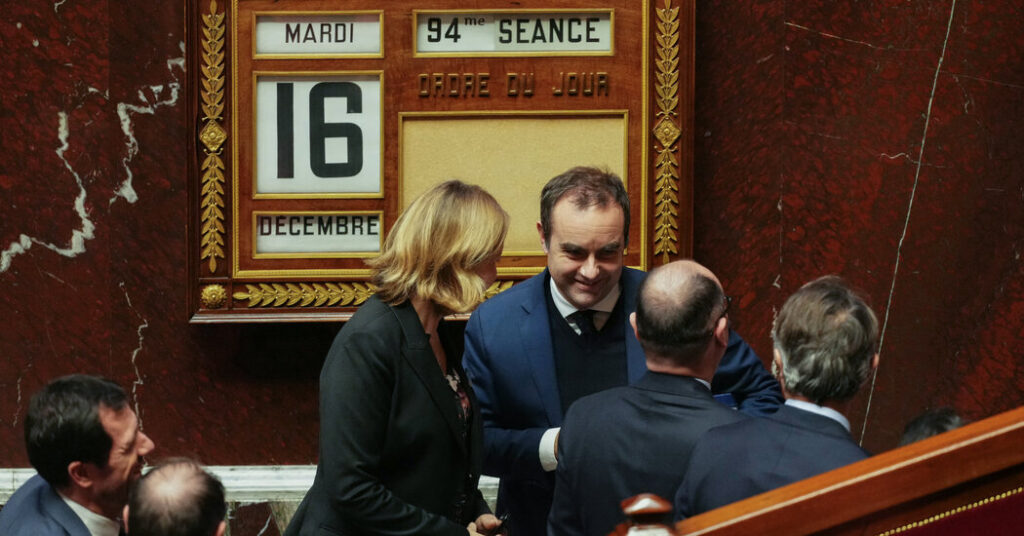
On Tuesday, Mr. Lecornu’s new government restored a semblance of normality to French politics, successfully persuading France’s fractured lower house of Parliament to pass — by 247 votes to 232 — a new budget for the country’s generous social security system.
In ordinary times, such a routine development would hardly seem newsworthy. In France in 2025, it was seen as an achievement because no faction controls a majority in Parliament and a take-no-prisoners French political culture traditionally prevents consensus on important legislative measures.
Vincent Martigny, a professor of political science at Côte d’Azur University in Nice, said of Mr. Lecornu: “This man was considered a dead man walking. Just 10 days ago, people said there was no way he would survive. And he has. This is a very important moment for parliamentary culture.”
The idea that a government without a majority in the National Assembly, the lower and more powerful house of Parliament, could get “the most sensitive part of the budget” approved by opposing lawmakers is a “clear break from the past,” Professor Martigny said.
The law’s passage was considered painful for Mr. Macron, even though it created political breathing room for his latest chosen prime minister, because it came at the cost of the president’s flagship domestic policy. Mr. Lecornu managed to win parliamentary support for the new budget law only because he agreed to suspend a contentious pension reform that the president had long championed.
Whether that compromise constituted the birth of a new consensual political culture or simply reflected a short peace agreement between bloody battles is still to be seen. Mr. Lecornu’s government has another test in the coming days — a bill to set the national budget.
Lawmakers are divided over the government’s plan to attack France’s towering public deficit, with one part of the Parliament demanding cuts to social spending and another crying for taxes against the rich.
The paralyzed nature of the National Assembly is a relatively new feature in French politics. Since France’s current governing system, known as the Fifth Republic, was founded in 1958, governments picked by the president had a relatively free hand to carry out his agenda, because — with a few exceptions — they had strong majorities in the lower house.
That changed in June 2024, when Mr. Macron announced a snap election, hoping more of his supporters would be elected to the National Assembly. Instead, his alliance of centrist parties lost ground to left-wing and far-right opponents, leaving no party with a majority. That created an intractable mess of three opposing parliamentary factions with fierce ideological differences and an entrenched cutthroat political culture that associates compromise with weakness and failure.
Mr. Lecornu’s two predecessors, who promised compromise but in the end offered little, were toppled over budget legislation after losing confidence votes in Parliament. Mr. Lecornu promised to be different, and after a false start, he seems to have succeeded, at least for now.
Mr. Lecornu won over opponents by vowing not to use a constitutional prerogative that many parliamentarians considered undemocratic to force bills through without a vote. Instead he sincerely negotiated with lawmakers to find compromises over the politically sensitive budget bills. That overturned years of practice.
And he offered to delay an unpopular pension overhaul, forced through Parliament without a full vote in 2023, that gradually raises the legal age of retirement to 64 from 62.
Both moves were major concessions to the Socialist Party, whose support Mr. Lecornu needed first to survive no-confidence motions in National Assembly, and then to pass the social security budget bill.
But the compromise also cut a large hole in the legacy of Mr. Macron, who previously insisted in the face of raging protests across the country that the unpopular pension change was essential for France’s economic future.
During past budget discussions, Mr. Macron had taken a prominent role, inviting political party leaders to Élysée Palace for discussions. This time, he remained in the background.
Some analysts see the compromise as a sign of a weak government that will muddle along for the next 18 months without passing any significant legislation, and until the next presidential election in 2027. But many also say that’s better than the alternative — another government falling, more uncertainty and the prospect of another snap election.
“It’s the least bad of bad things,” said Nicole Bacharan, a political scientist in Paris. “The last thing we need is a dissolution.”
While Mr. Lecornu’s early days in office were marked by raging street protests, his surprising decision to freeze the unpopular pension overhaul placated one of the country’s leading unions, which in turn called for lawmakers to support the social security bill.
Still, more trouble could lie ahead. The social security bill is the first of two budget bills that need to be passed by the government by the end of the year. The second and bigger bill, which would set the rest of the national budget, is still the subject of a tug of war between the economy minister, Roland Lescure, who has the task of reducing the French deficit, and lawmakers who disagree on whether and how to do that.
“Houston, we have a problem,” Mr. Lescure warned senators on Monday. “We need to find a way out of this rut.”
Ana Castelain and Ségolène Le Stradic contributed reporting.
Catherine Porter is an international reporter for The Times, covering France. She is based in Paris.
The post France, in Rare Win for Government, Passes Welfare Budget Law appeared first on New York Times.