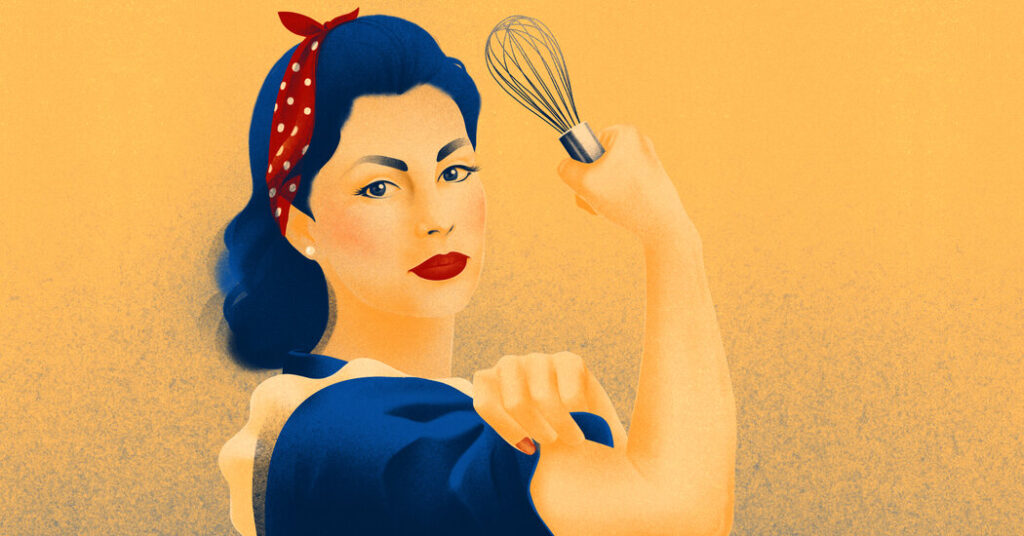
In bars and ballrooms all around the country, young conservative women are gathering. They are toasting to a future that seems gauzy, protein rich and pressure free. Surrounded by disco balls in a D.C. bistro, they sipped drinks called “God and Country.” Under technicolor lights at a Dallas resort, they clipped on pins that read: “My favorite season is the fall of feminism.” In an Orlando Hyatt Regency, some were baptized in the swimming pool. In Austin, they were offered matchmaking sessions with men who identify as pronatalists, meaning in favor of bigger families and more children.
Spending time at these conventions, it is clear there is a new women’s right coalescing. A ballooning group of young conservatives feel that the pressures they’re juggling as 20-something women have been made worse by the liberal feminism that defined their coming-of-age. Their anti-feminist distress is kindling for the continued rise of right-wing leaders urging women to work less and have more babies, even as their frustration about ambition and wellness rhyme with those first fomented on the left.
Members of these circles are animated by a politically potent nostalgia for a way of life few if any women have ever experienced, one that belongs less to history and more to Instagram and fairy tales.
They are uneasy about the collision course of professional ambitions and motherhood. They’ve been taught to be skeptical of experts, convinced that they have been sold lies about birth control and have attached a sacred glow to being a “mama.” White women especially seem concerned with holding onto a sense of social power and status.
They have celebrity spokeswomen, like Erika Kirk, the Turning Point chief executive, and their own growing media ecosystem, an answer to the “manosphere” comprising publications (Evie, The Conservateur) and podcasts (“Culture Apothecary,” “Relatable”) that target women with conservative punditry and lifestyle advice.
Their beliefs echo those of the think tank scholars and social media provocateurs who have shaped institutions on the new right, from the Claremont Institute to Project 2025. These, too, have emphasized a need to reverse the declining birthrate and persuade more women to stay home.
“That’s part of their ambition, to shape these views and turn back the clock or inspire a return to traditional gender roles,” said Laura Field, author of “Furious Minds: The Making of the MAGA New Right,” citing voices like the academic Patrick Deneen, an intellectual influence on Vice President JD Vance.
“When young women are saying that they don’t want to take birth control and that the natural path is to have children and get married young,” she continued, “that is a reflection of these other cultural voices saying the same thing in a more intellectual vein.”
Catalina Busse, a college student in Arkansas who attended a Turning Point summit in June, said she could not imagine aspiring to a career, though she wants to keep busy while she waits to meet a husband. Another young woman at the same convention said she was raised on frozen dinners prepared by a working mother, and today isn’t certain she would call herself a feminist. Kate Salerno, a 28-year-old who also lives in Texas, started listening to wellness podcasts three years ago, threw out the Cheez-its in her home and felt like she walked through a doorway into a new belief system.
In many of their values, these young women are tied to the ones who railed against communism in the 1950s, rallied for Phyllis Schlafly and against the Equal Rights Amendment in the 1970s, or voted for President Trump in 2016.
Today these women are again having startling real-world effects. Influencers who use large platforms to push the “Make America Healthy Again” mandate of Robert F. Kennedy Jr., and everyday moms who helped shape his cause, have spread doubt about vaccines as measles outbreaks proliferate. On TikTok, users are confronted by floods of videos urging them to get off birth control pills, which doctors consider safe and effective for many. (Some women said in interviews that they were taking this advice, with one saying she got pregnant within four months.) In college classrooms, some young women say they aspire to be trad wives, the mythic figures who forgo corporate life in favor of keeping house.
Standing outside the convention hall at the Turning Point summit in Dallas, Ms. Salerno, who gave birth five months ago, said: “I wouldn’t say I’m a feminist.”
Her mother, who was next to her, jumped in to offer: “You’re fighting for femininity.”
‘Let Down’ by Feminism
You could call it a backlash, but that’s not exactly right. Even as today’s young women on the right react against feminism, they were steeped in a culture informed by its ideas.
They were raised in an era of Teen Vogue and “Barbie for President.” Television and movies depicted women enjoying freewheeling sex and chasing high-flying career ambitions, and a sphere of women’s blogs challenged marriage and motherhood as immutable institutions. Feminist vocabulary entered the popular lexicon even among those who didn’t call themselves feminists. Many young right-wing women use it in their feminist critiques, referring to feminist “waves” to explain their ideology, showing they have absorbed the history they’re challenging.
“The first waves of feminism were necessary,” said Ms. Busse, the college student in Arkansas. “The later ones went overboard with man-hating.”
It’s not just in their language and styling. The interest in the “trad wife” lifestyle, for instance, has echoes of the anti-work sentiments that sprouted on the left during the pandemic. Beginning in 2021, there was a rush of think pieces and books — “Work Won’t Love You Back,” “The Myth of Making It” — from progressive thinkers reflecting on the limits of meaning that people can derive from career ambition.
Wisps of that anti-work notion can now be seen in the right’s celebration of stay-at-home mothers. Two days after Roe v. Wade was overturned, Mr. Vance, not yet vice president, wrote on X: “If your worldview tells you that it’s bad for women to become mothers but liberating for them to work 90 hours a week in a cubicle at The New York Times or Goldman Sachs, you’ve been had.”
In Dallas, 27-year-old Callie Shaw said she felt firmly that her role models weren’t women in pantsuits. “I’m the product of the generation that said the future is female,” said Ms. Shaw. “The product of that movement, women like me, realized that climbing the corporate ladder isn’t that fulfilling.”
As women’s rights activists and historians have seen many times before, young women are finding it cathartic to blame feminism for failing to solve the problems it named.
“Mischaracterizing feminist messages as having been false promises of total satisfaction — which I guarantee you is not a feminist promise — is a way of working to behave as though feminists lied to you,” said Rebecca Traister, author of “All the Single Ladies,” about unmarried women as a political force.
On the right, these feelings of disenchantment have fomented renewed energy around motherhood as not only a source of life-giving purpose but an imperative.
In March, some 200 people gathered in Austin for NatalCon, a convention devoted to the topic of getting women to have more babies. At the opening reception, Sabba Manyara stood in the domed entrance of the Bullock Texas State History Museum, sipping a glass of wine and taking stock of the other attendees: A majority seemed to be male think tank scholars and fringe right-wing online personalities. Sprinkled among them were a handful of women; some, like herself, had once called themselves feminists.
When Ms. Manyara, 31, started her career in insurance a decade ago, she remembered scrolling her university’s page dedicated to notable alumni and wondering why there were so few women. She had mentors, though, who nurtured her ambitions. An older female colleague who had married young encouraged Ms. Manyara to focus first on getting promoted: “Don’t make any major decisions before you’re 30,” Ms. Manyara recalled her saying.
She listened, working long hours throughout her 20s, but still felt like she did not have the life she wanted.
“The path to starting a family seemed really difficult,” Ms. Manyara said. “I felt a bit let down by mainstream feminism.”
Craving what she called “non-mainstream” perspectives, Ms. Manyara immersed herself in podcasts and pronatalist shows, like one hosted by Simone and Malcolm Collins, a tech-obsessed couple who say they want to have as many babies as they possibly can. When she heard they were speaking NatalCon this spring, she flew out to Austin.
In the audience at the convention, she listened to charismatic pundits and influencers who offered a seemingly simple answer to the profound dilemma of how to balance work and family — which was not to think about work at all.
The pronatalist movement has brought together a far-reaching coalition that includes conservative Christians like Mr. Vance, who want to put the family back at the center of American life, and technologists like Elon Musk, who worry about how the falling birthrate will affect the work force. NatalCon also featured speeches from far-right provocateurs, like the conspiracy theorist Jack Posobiec, who told the overwhelmingly white crowd that women needed to have more babies to protect “Western civilization,” which he warned was not “replacing” itself.
Jane Junn, a political scientist at the University of Southern California, argued that when white women fixate on the primacy of motherhood, it can often be a way of preserving their sense of power: “White women know they’re second in sex, but they can be first in race,” Ms. Junn said. “What comes from that is their protection of the maternal sphere.”
MAHA Warrior to MAGA It Girl
Corporate malaise and burnout have both formed a gateway toward anti-feminist thinking, strengthening the view that liberal feminism, with its emphasis on career advancement, isn’t serving women. But something else intimate and fundamental is bringing people into the new women’s right tent too, and that’s distrust of the medical establishment.
Many of these women started listening to wellness influencers, like Turning Point podcast host Alex Clark, because they had burning questions about their own bodies: What kitchen ingredients could be causing inflammation? Can taking birth control pills affect fertility? (Doctors say there is no research to suggest this.)
Once they embraced shows like Ms. Clark’s, they were introduced to a wider world of right-wing thinking. “All these doors opened for me when I found out about the food,” Ms. Salerno said. “It only takes one topic to start going down a rabbit hole.”
This constellation of concerns about wellness also neatly overlaps with pronatalism, giving women a source of meaning and purpose far beyond work: protecting their bodies and those of their children. At the women’s Turning Point summit in June, an attendee asked Charlie Kirk, the organization’s founder who was assassinated in September, a thorny question. For women, like her, who didn’t want to have careers, what should they do with all their time before getting married? Explore roles in the “MAHA space,” he suggested.
“Dallas has a huge infrastructure of MAHA small businesses,” Mr. Kirk said.
Outside the convention hall, there was a sea of booths where women following that advice marketed their supplements and MAHA-themed crew necks. College-aged women milled about, surrounded by a new kind of role model with not-your-mother’s advice: Go back to the kitchen, this time seed-oil free.
On Saturday evening, at a homemaker’s social, dozens of young women played MAHA-themed trivia. The women were competing for prizes, like an apron that read, “In my healthy era.” Mostly, they seemed relieved to be in company with others who shared the sense of purpose they found in rooting toxins out of their kitchens and raising children vaccine free.
On the screen at the front of the room were familiar feminist phrases, this time repackaged for a new audience. “What does MAHA say about health freedom?” the trivia screen read, with a cheeky reference to the pharmaceutical industry: “Your body, their choice.”
Emma Goldberg is a Times reporter who writes about political subcultures and the way we live now.
The post Fighting for Femininity, Not Feminism appeared first on New York Times.