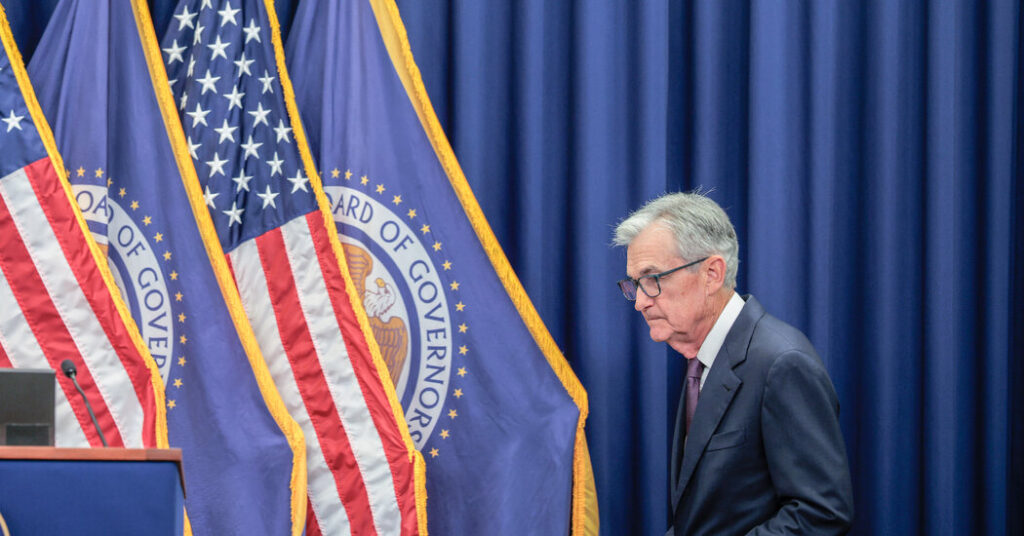
Working at the Federal Reserve is a terrible way to make headlines. The chair — in this case, Jerome Powell, whose term expires in May — is considered newsworthy, but the other 11 members of the voting committee fade into the background. Lately, however, they have been getting restive. When the Fed decided last week to cut rates, the vote came with three dissents, the most since 2019.
In many ways this is a healthy development, but it will entail a rethink of how the Federal Reserve operates and how it influences the economy.
The Federal Reserve has tremendous expertise in performing technical analysis, and it executes its responsibilities with much less politicization than any other institution of economic policymaking in Washington. Unlike, say, Supreme Court justices, Fed officials tend to update their views often, more based on the business cycle than the electoral cycle.
The Fed’s biggest weakness has been that all of that expertise and technical analysis can tend toward groupthink. That’s what led the Fed to miss the severity of the 2008 financial crisis. In the wake of that disaster, the Fed adopted some internal reforms, including introducing devil’s advocate-style boxes on the report, called the Tealbook, that staff members prepare to help inform interest rate decisions. But groupthink persisted in the Federal Open Market Committee, which votes on decisions about the target federal funds rate. In 2021, as inflation soared past 6 percent, there was an enormous public debate about monetary policy, but you would not have known it from the committee’s unanimous votes at eight consecutive meetings that year in favor of keeping rates at zero.
The decision the Fed made last week to cut rates, in order to help support the labor market, was not an easy call. I would not have cut rates because the inflation rate is well above the Federal Reserve’s target and the economy is already getting a lot of support from the strong stock market, loose financial conditions and a rising budget deficit. But I am not sure I am right! And people I respect did support cutting rates. A healthy deliberative process does not paper over these disagreements with forced consensus. It liberates people to express their views, argue them and ultimately take a vote.
That is exactly what happened when three Open Market Committee members dissented from the committee’s decision last week. Over the past six months, there have been an average of two dissenting votes per meeting — quadruple the average rate since 1990. Strikingly, many of the dissents have come from the seven-member board of governors, a group that did not register a single dissenting vote from 2005 to 2024.
Although this type of fractious decision-making has been largely unknown at the Federal Reserve since the early 1980s, it has been the norm for other central banks. The Bank of England routinely has close votes on difficult monetary policy decisions.
Dissents can also help undergird the independence of the Federal Reserve. The 1935 Banking Act set 14-year terms for the governors, and said the terms would be staggered to prevent any one president from having too much influence on the direction of monetary policy. This backstop has not been necessary in recent years, as leaders from Paul Volcker during the 1980s through Mr. Powell today have acted in an apolitical manner. If President Trump picks someone outside that mold, who seeks only to advance the president’s agenda of sharp rate reductions regardless of the nation’s economic circumstances, expect even more dissents.
The Fed acting more like a committee is a healthy way to firmly turn the page on the era when the chair was treated as some sort of maestro, oracle or wizard with an omniscient understanding of the economy and omnipotent powers to steer it. This view reached its zenith when Alan Greenspan, who led the Fed from 1987 to 2006 and who — partly with skill, but also with a large helping of luck — steered the economy to what was then its longest period without a recession. Even after the 2008 financial crisis dented the credibility of the Federal Reserve, its pronouncements continue to be treated with extraordinary reverence. Announcements of future action have instantaneous effects on markets, as though the great and powerful Oz has spoken.
Maybe instead of announcing that rate cuts of 25 basis points will take place at each of the next three meetings, the Fed should just cut the rate by 75 points and be done with it. The effect would be to demystify those all-important pronouncements. And I’m not sure it would change anything for the markets, which already react as though every prediction is a done deal.
The American economy is a sprawling, complicated, dynamic universe of energy and contradictions. There’s rarely going to be just one obvious answer. So although I hope for wise decisions from the Federal Reserve as a whole, I’m cheering most of all for the dissenters helping to get the committee closer to the right answer. And I’m glad I’m not in their shoes.
Jason Furman, a contributing Opinion writer, was the chairman of the White House Council of Economic Advisers from 2013 to 2017.
The Times is committed to publishing a diversity of letters to the editor. We’d like to hear what you think about this or any of our articles. Here are some tips. And here’s our email: [email protected].
Follow the New York Times Opinion section on Facebook, Instagram, TikTok, Bluesky, WhatsApp and Threads.
The post Donald Trump May Be About to Pick the Least Important Fed Chair in Decades appeared first on New York Times.