One of the worst features of the election primary system in our polarized “Red vs. Blue” time is the tendency of primary voters to flock to the candidate they most want to “destroy” the other party, not the candidate best positioned to do so.
Let’s say a zombie is scratching at your door. You’ve got a shotgun, a handgun and your favorite frying pan. The shotgun has the greatest chance of success, the handgun — if one is careful and skilled — has a solid chance of working, and the frying pan? It probably won’t dispatch the threat but, come on, how cool would it be to take out a zombie with a frying pan? So, you go with that.
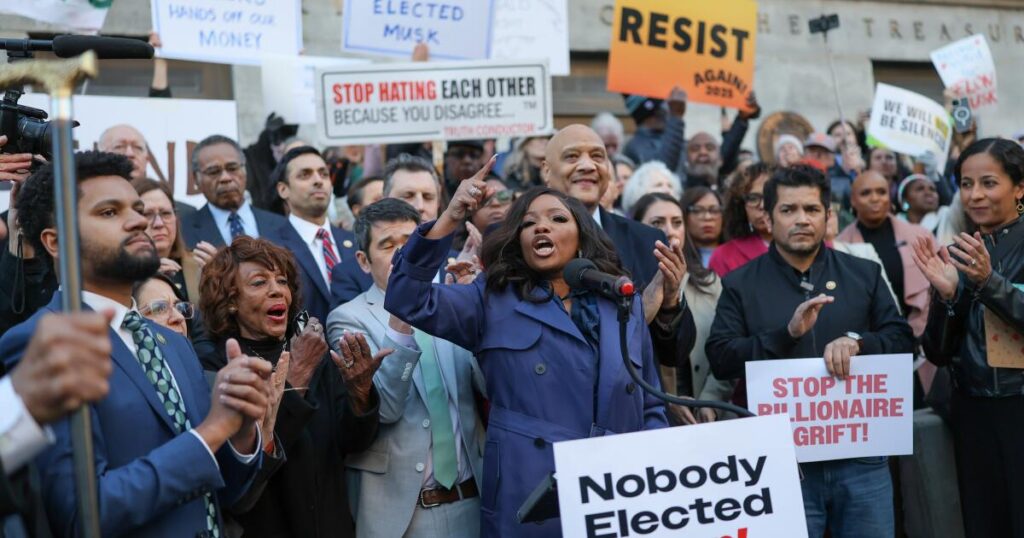
In this extended metaphor, Texas Rep. Jasmine Crockett is the Democrats’ frying pan and Atty. Gen. Ken Paxton is the Republican one.
Given trends in media coverage, you’re probably more familiar with examples of this phenomenon from the GOP. Remember Christine O’Donnell, the sketchy Delaware Senate candidate who had to run an ad in 2010 assuring voters, “I’m not a witch.” Or Todd Akin, the 2012 Missouri senate candidate who got into trouble for insisting that women don’t get pregnant in cases of “legitimate rape.” More recently, there was Mark Robinson, the 2024 North Carolina lieutenant governor who dabbled in Holocaust denial and mocked school-shooting survivors as “spoiled little bastards.” Only after he got the nomination was it revealed that he described himself as a “black NAZI” on a porn site.
Democrats have a similar, if less colorful, problem. In a bunch of races, Democrat primary voters preferred the candidate who was more ideologically pure, more pugnacious, or — in the President Trump era — the most committed to “resistance.” Once nominated, they were ill-suited to appeal to swing voters in a general election.
Just a few examples of Democratic candidates who excited the base but not mainstream voters: Mandela Barnes, the very progressive Wisconsin Senate candidate in 2022; Kara Eastman, the preferred candidate of “Justice Democrats” in Nebraska’s second district House race in 2018; Stacey Abrams, the election-denying two-time candidate for Georgia governor; and Andrew Gillum, the Florida progressive underdog who beat out more centrist candidates to get the Democrats’ nomination for governor, only to lose narrowly to Ron DeSantis in 2018.
Some of these races were indeed close. But the populist left and populist right take the wrong lesson from the narrowness of their defeats. Like the ugly Americans who think foreigners will understand English if they just shout louder, each side convinces themselves that if they only fought harder, wasted a little more money, they could’ve won.
To be fair, sometimes they’re right. But even in those cases, they’re merely making a down payment on bigger losses to come. Because by electing bomb throwers and crackpots they hurt the brand of their party for the next election.
Which brings me back to Texas. The Senate primary is heating up. On the GOP side it’s a three-way race among solid, reliable, moderately boring conservative incumbent Sen. John Cornyn, Republican two-term Congressman Wesley Hunt and the rabble-rousing, wildly corrupt (sorry, “ethically challenged”) populist demagogue and hard-core MAGA loyalist Ken Paxton.
Although nothing is assured given what might be a Democratic wave year, Cornyn would probably beat Crockett, who most analysts and Democrats (when speaking anonymously) think cannot win against anybody except maybe Paxton. But she can soak up an enormous amount of money and attention.
Crockett is very smart, but she is in many ways a Democratic version of Republican bomb throwers and social media phenoms Marjorie Taylor Greene or Lauren Boebert. Indeed, Crockett has already trademarked her insult for Greene (whom she said has a “bleach-blonde bad-built butch body”). Crockett has also said that 80% of the “most violent crimes” are committed by “white supremacists,” Black people can’t be Republicans because Republicans are racist, Latinos have a “slave mentality” and that police shouldn’t prevent crime, they can only solve it, etc.
This stuff may work in a safe congressional district, but it’s not the stuff of a successful statewide race in Texas.
When Crockett announced she was running, Rep. Colin Allred, a more moderate candidate who was positioning himself to be a safe alternative to the Republicans, announced he was no longer pursuing a Senate bid.
And so here we are. Two parties, once again, are poised to nominate candidates so flawed they have a chance of losing to the other.
This is what happens in a polarized age when parties outsource their nominating process to the angriest voters in their coalition. They’d rather take a shot with their favorite frying pan, than shoot that boring shotgun.
The post Does either party actually want to win the Senate race in Texas? appeared first on Los Angeles Times.