A blast of Arctic air has plunged much of the United States into a bitter cold snap. About 202 million people — around 60 percent of the population of the contiguous United States — live in the areas expected to see freezing temperatures over the next week.
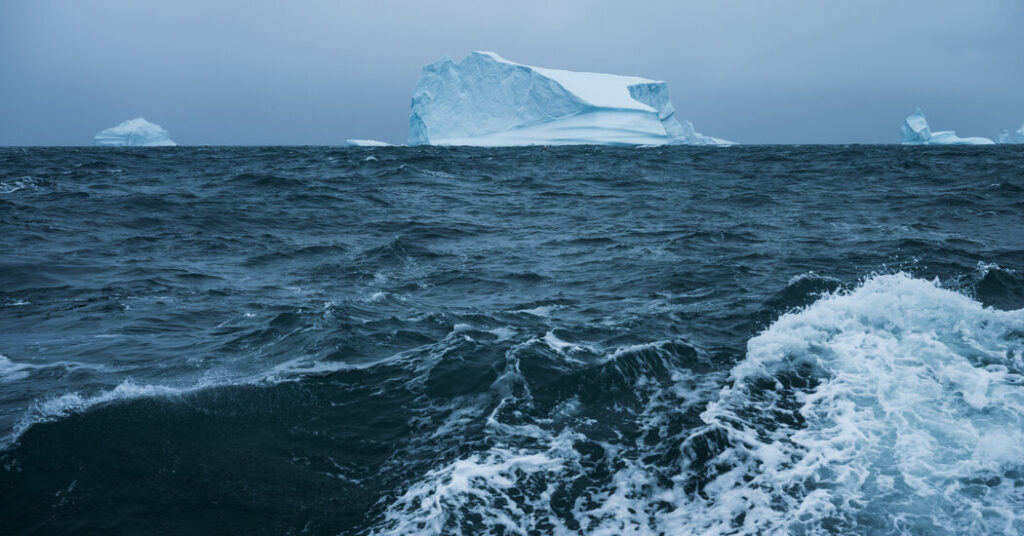
Follow that frigid air north to the Arctic, and you find a region undergoing sweeping changes that could have global consequences. (I also wrote about the worrying state of the Arctic last year.)
Temperatures in the Arctic are warming far faster than the rest of the planet. Sea ice is rapidly declining, opening up new shipping routes. And record temperatures and thawing permafrost are turning Arctic rivers orange with toxic heavy metals, according to a new report from federal scientists.
But this year, there are also near-term policy upheavals that are reshaping the Arctic.
The Trump administration is working to commercialize Alaska, opening up previously protected waters to oil and gas drilling, and allowing preparations for a road that would reach a proposed copper and zinc mine. The White House is also prioritizing national security in the region, expanding military operations and vying for influence in Greenland.
Against this backdrop, Trump has his eyes fixed on the area. In an executive order signed in April, he instructed the government to take steps to “ensure the security and leadership of Arctic waterways.”
The Arctic as a strategic asset
Shortly after retaking office this year, Trump began moving to exert American influence over Greenland, which is a Danish territory that is mostly covered by a vast ice sheet. Since then, the White House has used a mix of flattery and threats to try and make its case. The U.S. is adding new icebreakers to its fleet, and Vice President JD Vance visited Greenland in March.
This has all led to fraying alliances, with Denmark’s military intelligence service recently raising concerns about the United States.
On Monday, the White House appointed Tom Dans to lead the United States Arctic Research Commission. Dans has been a key figure in Trump’s efforts to exert influence in Greenland and is the brother of Paul Dans, an architect of Project 2025, a right-wing blueprint for overhauling the government.
Closer to home, the White House is working to expand commercial operations in Alaska.
Last month the Trump administration “announced a plan to allow new oil and gas drilling across nearly 1.3 billion acres of U.S. coastal waters, including a remote region off Alaska in the northern Arctic where drilling has never before taken place,” Maxine Joselow and Lisa Friedman report.
A month before that, Trump signed an executive order “directing the government to approve a 211-mile industrial road that would cut through pristine Alaskan wilderness to reach a proposed copper and zinc mine,” they wrote.
Yet even as the White House looks for new commercial opportunities in the Arctic, it is facing obstacles.
In January, an auction for the rights to drill in Alaska’s Arctic National Wildlife Refuge did not attract a single bid. Major American banks have said they would not finance drilling in the protected area. The new areas Trump has opened for exploration include the coastal waters of the refuge, but it is not yet clear if any new drilling will occur.
Even if projects begin moving forward, they are likely to be met with lawsuits. This month, environmentalists sued to stop ConocoPhillips from drilling in the National Petroleum Reserve, a vast expanse on Alaska’s North Slope.
Nevertheless, ConocoPhillips is among the companies that are pressing ahead in the region. In 2023, it began construction of the $8 billion Willow project in Alaska.
Explaining the company’s thinking at the time, Connor Dunn, a ConocoPhillips manager, said: “There is going to be a significant need for U.S. domestic oil production for a great many decades to come.”
Dire warnings about the Arctic’s future
As the commercial and geostrategic terrain shifts, so, too, has the Arctic landscape.
As Eric Niiler reports, record-setting temperatures and rainfall in the Arctic over the past year have sped up the thawing of permafrost and washed toxic minerals, including naturally occurring deposits of pyrite, into some Alaskan rivers.
That’s according to a report issued on Tuesday by the National Oceanic and Atmospheric Administration, which documented rapid environmental changes from Norway’s Svalbard Island to the Greenland ice sheet and the tundra of northern Canada and Alaska.
Arctic tundra, which for thousands of years has absorbed carbon dioxide, is now releasing planet-warming gases into the atmosphere.
All that heat, and the arrival of more rain instead of snow, is causing glaciers to melt, both on land and at sea. One result, scientists fear, is that an influx of fresh water into the North Atlantic could disrupt the ocean currents and have ripple effects across the world.
Raymond Zhong recently accompanied a group of researchers on an expedition to the waters off Greenland as they studied this scenario.
Trump Administration: Live Updates
Updated
- Hegseth gives a briefing to lawmakers but declines to show full video of a contentious boat strike.
- The United States threatens to penalize European tech firms.
- The White House shrugs off the rise in the unemployment rate.
But while the Trump administration is fixated on commercial opportunities, it is turning a blind eye to science in the region.
As Sachi Mulkey wrote, in May, a government committee took the unusual step of editing a Biden-era planning document on the Arctic to “align with the current administration’s policies.” The revised version no longer included the words climate change, a main focus of work there for decades.
Clean, limitless energy exists. China is going big in the race to harness it.
Fusion energy, the melding together of atoms to release extraordinary energy, uses fuels that are plentiful, carries no risk of meltdowns and leaves no long-lived radioactive waste.
China and the United States are in a tightening contest to dominate the energy future, and fusion energy could change the calculus for both nations and the globe. Whoever conquers it could build plants around the world and forge new alliances with energy-hungry countries.
But the Americans and the Chinese have very different strategies for getting there.
Over the summer, the Chinese government and private investors poured $2.1 billion into a new state-owned fusion company. That investment alone is two and a half times the U.S. Energy Department’s annual fusion budget. — Raymond Zhong, Chris Buckley, Keith Bradsher and Harry Stevens
And read our Power Movesseries on the battle between the United States and China for the energy future.
MAHA moms are angry at the E.P.A. Lee Zeldin is trying to win them back.
Just last week, several prominent activists from the “Make America Healthy Again” movement circulated a petition urging President Trump to fire Lee Zeldin, the administrator of the Environmental Protection Agency. The activists said that Zeldin was prioritizing the interests of chemical manufacturers over the well-being of American children.
But in recent days, Zeldin, a seasoned politician, has gone on a charm offensive.
On Monday, he made a surprise appearance at a MAHA holiday reception and invited activists to visit him at E.P.A. headquarters the following day. There, he introduced them to senior department heads and promised that the agency would adopt a “MAHA agenda.” — Hiroko Tabuchi
Quote of the day
“I think this makes our company much more China-proof.”
That’s from Jim Farley, the chief executive of Ford, explaining his company’s announcement on Monday that it would significantly scale back plans to produce electric vehicles, taking a $19.5 billion hit to its profit to do so.
Ford’s move comes despite the explosive growth of electric vehicle sales from Chinese automakers, which have rapidly expanded in Asia, Europe and Latin America in recent years.
As Jack Ewing reports, the F-150 Lightning, an electric version of Ford’s popular pickup manufactured in Michigan, will no longer be a pure electric vehicle. An expert who spoke to Ewing was skeptical that Ford’s moves would protect it from Chinese competition.
In an interview with CNBC, Farley said the company would shift toward extended-range hybrid vehicles.
More climate news from around the web:
-
A new data set, which extends back to 1751, suggests the Earth could have warmed faster than previously thought, CNN reports.
-
Reuters reports that insured losses last year from disasters and storms around the world are expected to hit $107 billion in 2025, driven by the Los Angeles wildfires. Some 83 percent of global insured losses happened in the United States.
Read past editions of the newsletter here.
If you’re enjoying what you’re reading, please consider recommending it to others. They can sign up here.
Follow The New York Times on Instagram, Threads, Facebook and TikTok at @nytimes.
Reach us at [email protected]. We read every message, and reply to many!
David Gelles reports on climate change and leads The Times’s Climate Forward newsletter and events series.
The post Commercializing the Arctic appeared first on New York Times.