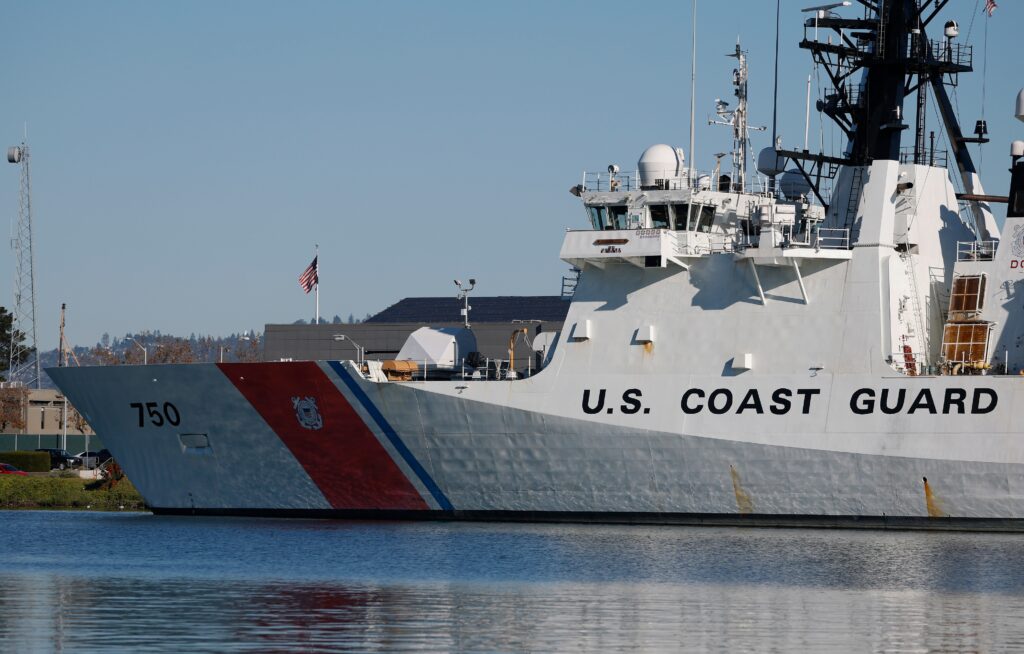
The U.S. Coast Guard has allowed a new workplace harassment policy to take effect that downgrades the definition of swastikas and nooses from overt hate symbols to “potentially divisive” despite an uproar over the new language that forced the service’s top officer to declare that both would remain prohibited.
The new policy went into effect Monday, according to written correspondence that the Coast Guard provided to Congress this week, a copy of which was reviewed by The Washington Post. The manual is posted online and makes clear that its previous version “is cancelled.”
Spokespeople for the Coast Guard and the Department of Homeland Security, which oversees the military service, did not immediately respond to requests for comment. The symbols issue is expected to come up at a House committee hearing Tuesday.
The Post was first to report on the Coast Guard’s plan to revise its workplace harassment policy last month. The Trump administration called the article “false,” but within hours of its publication the service’s acting commandant, Adm. Kevin Lunday, issued a memo forcefully denouncing symbols such as swastikas and nooses, and emphasizing that both remain prohibited.
Lunday said at the time that his Nov. 20 memo would supersede any other language. It was not immediately clear Tuesday why publication of the new harassment policy was not paused so the “potentially divisive” language used to describe swastikas and nooses could be removed to align with Lunday’s directive.
Lunday has been the Coast Guard’s acting commandant for several months. He was elevated to the role after the Trump administration ousted his predecessor, Adm. Linda Fagan, citing among other things her “excessive focus” on “non-mission-critical” diversity and inclusion initiatives. The Senate is expected to hold Lunday’s confirmation vote later this week.
The Coast Guard’s policy softening the definition of swastikas — an emblem of fascism and white supremacy inextricably linked to the Nazis’ extermination of millions of Jews and the deaths of more than 400,000 U.S. troops who died fighting in World War II — comes as antisemitism is on the rise globally. At least 15 people were killed over the weekend at a Hanukkah celebration in Australia.
Deborah Lipstadt, a historian who served as President Joe Biden’s special envoy to monitor and combat antisemitism, said the Coast Guard’s decision to approve the change was “terrifying.”
“What’s really disturbing is, at this moment, when there is a whitewashing of Nazis amongst some on the far right, and Churchill is painted as the devil incarnate when it comes to World War II, to take the swastika and call it ‘potentially divisive’ is hard to fathom,” Lipstadt said. “Most importantly, the swastika was the symbol hundreds of thousands of Americans fought and gave their lives to defeat. It is not ‘potentially divisive,’ it’s a hate symbol.”
Citing court documents, Lipstadt noted that Unite the Right marchers in Charlottesville, while planning a 2017 demonstration that left a woman dead and 19 others injured, had urged one another not to use swastikas “because it will paint us as Nazis.”
“When far-right protesters in Charlottesville were strategic enough to recognize the swastika would do them no good and now we have an arm of the U.S. military saying ‘It’s not so bad,’ that’s frightening,” Lipstadt said.
The post Coast Guard enacts policy calling swastikas, nooses ‘potentially divisive’ appeared first on Washington Post.