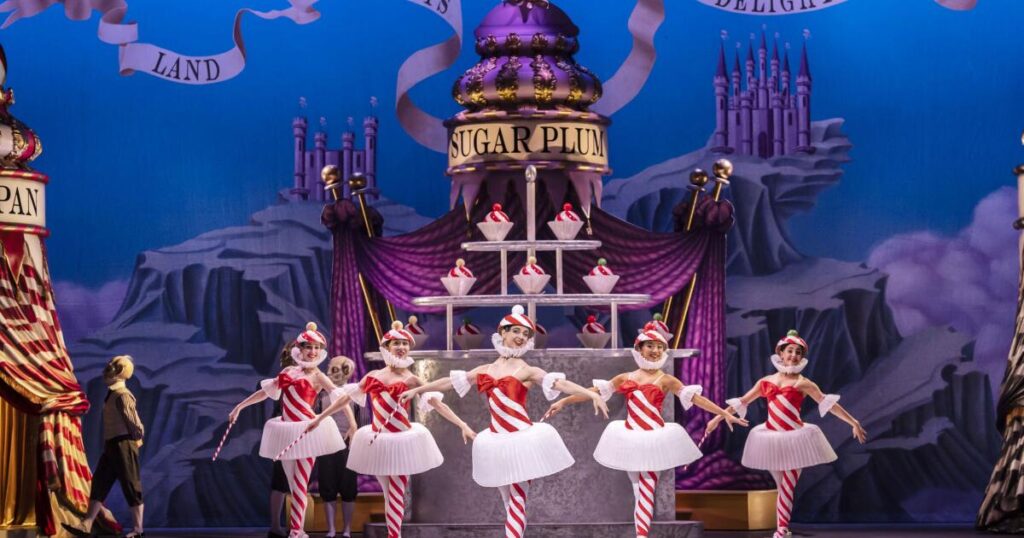
For many children, their first experience with ballet often happens at Christmastime via “The Nutcracker.” Now, PBS has a treat in store for viewers who are looking to share that tradition with their families this holiday season.
If time, location or affordability are keeping you from seeing the ballet this December, the English National Ballet’s lavish and bold new production of “Nutcracker,” airing Tuesday at 8 p.m. Pacific time (and streaming on PBS.org and PBS app) as part of “Great Performances” on PBS, offers a fabulous and alternative way to experience the holiday classic. The production, which debuted at the London Coliseum last year, is a delightfully fascinating blend of the traditional performance many grew up watching and takes a bold new approach to the iconic ballet first performed in Russia in 1892.
“It’s really a visually arresting production,” says “Great Performances” executive producer David Horn. “I think this will give a lot of people their first exposure [to ballet]. I thought it was a terrific show for us to celebrate the holiday season with.”
The gorgeous score by Tchaikovsky is the same. As is the story of a young girl who is gifted a toy nutcracker by her godfather Herr Drosselmeyer, only to have the nutcracker come alive and take her to a magical world with Isolde, the Ice Queen (Anna Nevzorova) and the Sugar Plum Fairy (Emma Hawes). But right as the show begins, viewers will notice this production’s innovative approach to the material. There are subtle nods to the Edwardian era this version is set in. Look for some of the dancers, for instance, to be holding up signs that say “Votes for Women.”
While it has always been Clara’s story, she’s often not the main protagonist but instead more of an observer of all the action. “I tend to get to Act 2 and go, ‘What’s happened? They’re just sitting down and watching. It’s so passive,” says costume and set designer Dick Bird.
That all changes with this production, which brings Clara to the forefront. The biggest change is that two dancers play Clara. When everything from the rats to the Christmas tree get bigger, so does Clara as she goes from a young girl to an adolescent. “This Clara is dealing with the constraints of Edwardian London that doesn’t really allow much space for a young woman,” says choreographer and English National Ballet artistic director Aaron S. Watkin. “But when she dives into her dreams, everything and anything is possible. She’s not an innocent bystander being led by the Nutcracker Prince and saved by him. She’s actually found her own agency. In this world, she can really be what she wants.”
When the Nutcracker Prince (Francesco Gabriele Frola) and Clara get into the seahorse sleigh, it’s Clara who drives it. “She’s not sitting in the back seat,” Watkin says. “I think that just sums it all up. When we first did it, the Nutcracker just naturally went to the front seat.” But that didn’t feel right. “They’re small [changes] but very big messages.”
First soloist Ivana Bueno portrays the older Clara and loved getting to collaborate with Watkin and choreographer Arielle Smith on this new version of Clara. “”She’s not scared to fight. She’s in charge of the battle,” she says. “She knows what she wants. It’s really nice and fun to play a character like that. You just feel empowered.”
This version also spends more time with Drosselmeyer (Junor Souza). The story opens with a young Clara (Delilah Wiggins) and her mother shopping at Drosselmeyer’s Sweets & Delights Emporium for candy. “I thought it was important we understood who Drosselmeyer was,” says Smith.
As a throughline to the production, those sweets come to life in the second act and represent various countries. There’s the Ukrainian poppy seed cake makivnyk, the Middle Eastern hot chocolate sahlep, the Spanish nougat turrón and the Chinese candied fruit tanghulu, among others.
“That allows us, I suppose, [to get away from] these rather cliched expressions of national identity and instead to express them in sweets from those countries,” Bird says. “That becomes so enjoyable for a design because you’re not just thinking of the national dress from the particular country, but you’re thinking about how a sweet moves or how a drink moves and all of those possibilities.”
The costumes worked in concert with the dances and took an incredible amount of precision. The costumes for the red and white marzipan, for example, have only one leg that is striped red and white, and considerable time was spent on how to make sure that one leg of the tight looked in unison with all the dancers. “The amount of R and D it takes to work out solutions is fascinating, “ Bird says.
The makivnyk dancers are in stunning black and white body suits with matching umbrellas. “That’s quite a thing for the eye to look at, and it’s very striking,” says Smith. “It was a real privilege to be able to experiment with that and to create the choreography around the design.”
The Mother Ginger sequence, which usually finds young dancers emerging from the giant skirt of a dancer on stilts, is completely reimagined here. The young dancers are dressed as various types of English licorice and they make their entrance from a giant box of licorice allsorts.
“Licorice is the most consumed sweet in Britain,” says Bird. “They’re such crazy sorts of shapes and colors.” Watching the licorice sequence now reminds Bird of what incredible fun it was to do the show. “It’s your job to just think of absolutely insane ideas and then you have a whole team of people to realize it for you and to take it as seriously as you do.”
The young dancers in the licorice scene come from English National Ballet’s Ballet Futures Programme and Adagio School of Dance in Essex. “I wanted it to be a show that everyone wanted to do,” Smith says. “The crowd just loved those kids as soon as they came out.”
Their dance is also surprisingly complex for their age. “What they’re doing for their age is really hard,” Smith says. “I really like that the kids are part of it and they’re not just sort of standing ornaments at the side. They actually get to dance.”
In each sequence, Clara tries the candy and then participates in the dance. “My favorite part is how curious she is,” Bueno says. “I think that’s also what makes the choreography quite special. She’s very involved in all of the dances. Nothing will stop her. She’s a very strong woman.”
Bueno hopes young viewers watching take away a larger message. “This new generation,” she said, “will grow up knowing that they are enough and they will be very confident in themselves, which is what we all want.”
The post Can’t attend a ‘Nutcracker’ performance this year? PBS has a lavish, no-cost alternative appeared first on Los Angeles Times.