The birthday was like any other, which is to say, fraught. Deep in the pandemic, I was unemployed, depressed and warring with my boyfriend in our cramped Brooklyn apartment. I woke up hungry for a grand gesture — a celebration that would make up for the bleakness of the everyday. Instead he ended up gifting me a sleek suitcase, into which I incorrectly read a subliminal message: Pack your things.
Then there was the issue of the nonexistent birthday cake. Most bakeries were closed, and the only dessert in the house was a half-inch of freezer-burned mint chip. Furious, I marched to the bodega to buy a box of Betty Crocker yellow cake. I mixed the batter and sat huddled in front of the oven window watching it rise. Then we devoured it straight from the pan, with spoons. It wasn’t particularly good, but it had that buttery, implausibly bouncy texture I like. I was relieved. For once, I hadn’t relied on someone else to celebrate me. I could celebrate myself.
Many childhood birthdays have a predictable shape, a cheerful routine of parents urging you to make a wish, teachers doling out cupcakes, classmates warbling the requisite tune. But in adulthood, they can become an exercise in expectation management. It’s the one day a year when you simultaneously believe the world revolves around you, while at the same time being old enough to know that obviously it does not. You wake up hoping that the sun will shine, that your friends will remember, that somehow your existence will be made to feel meaningful. More often you endure a deflatingly average workday and continue into the next year, after experiencing what feels like an annual performance review for being alive.
My own expectations were set early. As a twin, birthdays were never entirely mine. My parents, conscious of this, gave us gifts aimed at our distinct personalities but within the same aesthetic orbit: sweaters with marginally different necklines, iPod Nanos in neon pink and blue. Birthdays were emphasized as markers of our individuality — but while I regularly named preferences that were different from my sister’s, I never considered whether I actually wanted them.
By adulthood, the birthday responsibility had been transferred from my parents, who had raised me, to my friends, who had chosen me. Lacking any real conviction in my own desires, I outsourced the question, hoping others would know how to celebrate. On my first birthday in New York, turning the aplomb-less age of 23, I threw myself a party but spent most of the night spiraling: Who would show up? Were people having a good time? The next year, humiliated by my own anxiety, I vowed to “grow up,” telling friends I was doing nothing, then resenting my own decision. My boyfriend took me to dinner instead. The restaurant forgot the candle.
So, the Betty Crocker cake came as a true epiphany: I could summon my own satisfaction. By my next birthday, I’d started baking regularly at home, and I decided to make a cake from scratch, something ambitious: coconut sponge layered with lime curd, custard and pink peppercorn brittle. I spent the day whisking and weighing, trying to avoid scorching myself with spitting caramel.
Baking, it turns out, is the ideal birthday activity — it supplies a set of instructions and a soothing level of control through gram or cup measurements. There’s also short-term gratification; after a few hours of effort, you’re left with something sweet. Of course, my galley kitchen turned into a hotbed of chaos, with flour in every crevice, and the cake turned out amateurish, the custard oozing between the layers. But it was satisfying to have witnessed a transformation happen, these disparate ingredients now something delicious and crowned with candles — a year briefly made tangible. The day hadn’t been governed by my perception of other people’s effort or neglect. I’d just had a nice time doing something with my hands.
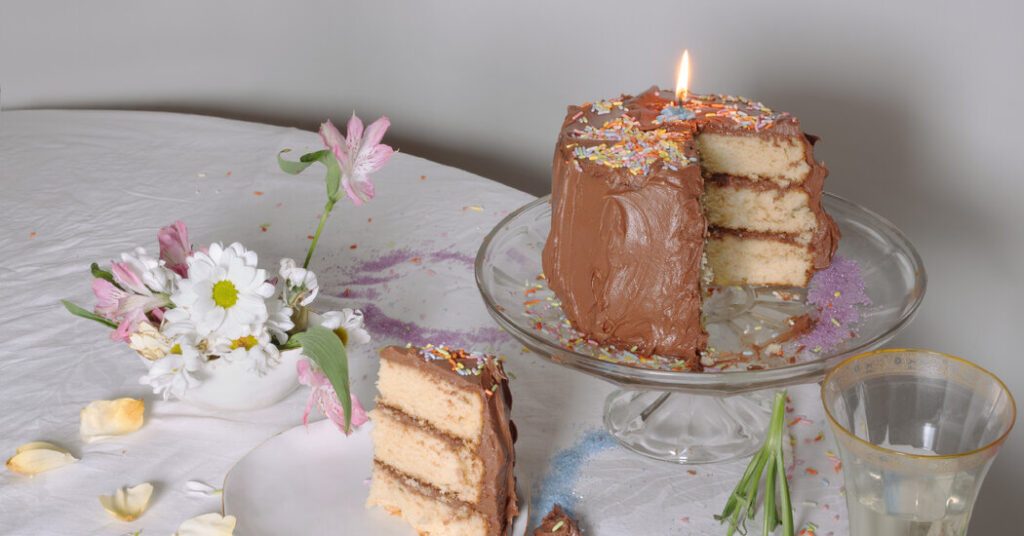
Now, each year, I make my own cake. When eventually I started a job as a pastry cook, I lost the appetite to bake at home, but I still clung fiercely to the ritual. I ferried olive oil sponge scraps from work to use as the base, slathered store-bought raspberry jam between the layers, improvised frosting with whipped cream or any dairy I had on hand. The activity affords me a true moment of contending with myself: What do I actually want? To eat? To make? And what feels realistic, in baking as in life? I ask myself if I am emotionally sturdy enough for a layer cake, or if I should make banana bread with candles and call it a gâteau. The plan itself becomes a kind of self-inventory. Each cake becomes a mirror of the year: sometimes ambitious, sometimes makeshift, sometimes a disaster. It hardly matters which one. Because birthdays are unbidden, perhaps the best way to meet them is by turning them from something that happens to you into something you make happen.
This year, my birthday fell a few weeks after my wedding. (The suitcase was not the feared metaphor after all, and has in fact proven very useful.) Earlier in the week, a friend asked if I had any plans. For a moment I felt that familiar thrumming of anxiety and anticipation. I briefly considered posting up at a bar and inviting folks to come by. But on the day of, I just bought a box of strawberry-flavored cake mix, a collaboration between Dolly Parton and Duncan Hines that yielded a shockingly pink crumb — better than any homemade version I’ve ever tried. I layered it with cream cheese frosting fortified with Nesquik powder, and then my husband and I ate it together at home.
Tanya Bush is a writer and a baker in Brooklyn. Her narrative cookbook “Will This Make You Happy” comes out in March.
The post Birthdays Can Be Disappointing. But Not if You Bake Your Own Cake. appeared first on New York Times.