If you’ve been wondering how James Cameron was going to get five whole movies out of the “Avatar” series, the third one, “Fire and Ash,” has the answer. It’s padding. Lots and lots of padding. And a lot of the padding is repetition. Repetitively repetitive repetition. Disney gave James Cameron carte blanche and a blank check to do whatever he wanted, and he wanted to do “Avatar: The Way of Water” again, except not as good.
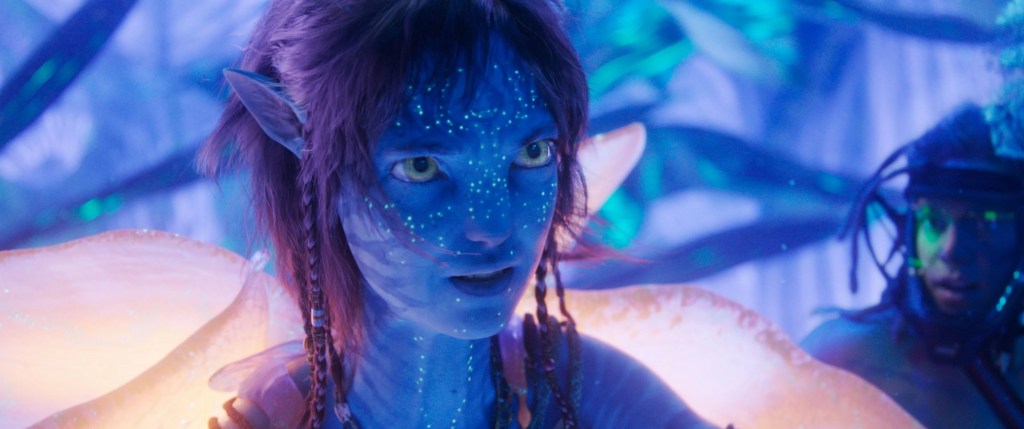
“Avatar: Fire and Ash” begins with a sky-high dragon-flying sequence that’s extremely disorienting. Not because of James Cameron’s swooping, acrophobic 3-D CGI photography, but because we’re following the Sully children, and they still suffer from an extreme lack of personality. It’s hard to remember who is who and how to tell them apart. Except, of course, for Jake and Neytiri’s adopted teenage daughter Kiri, who is voiced by Sigourney Weaver and always sounds like 76-year-old. That’s distracting in general, but when a romance kicks in between her and the human teenager Spider (Jack Champion), it’s creepy.
We play catch-up with the Sully family. Their son Lo’ak (Brittain Dalton) blames himself for the death of his brother. Jake (Sam Worthington) blames him too, although he won’t admit it. Neytiri (Zoe Saldaña) blames the “sky people” — read: humans — and is now a full-blown racist who begrudgingly takes orders from her husband when he tells her to, hey, you know, be less racist. Spider, the son of their arch-enemy Miles Quaritch, has that love story blossoming with Kiri — which, again, ew — but he needs a gas mask to breathe the poisonous air on Pandora, and he’s running out of those, so the Sully family takes him to live somewhere else.
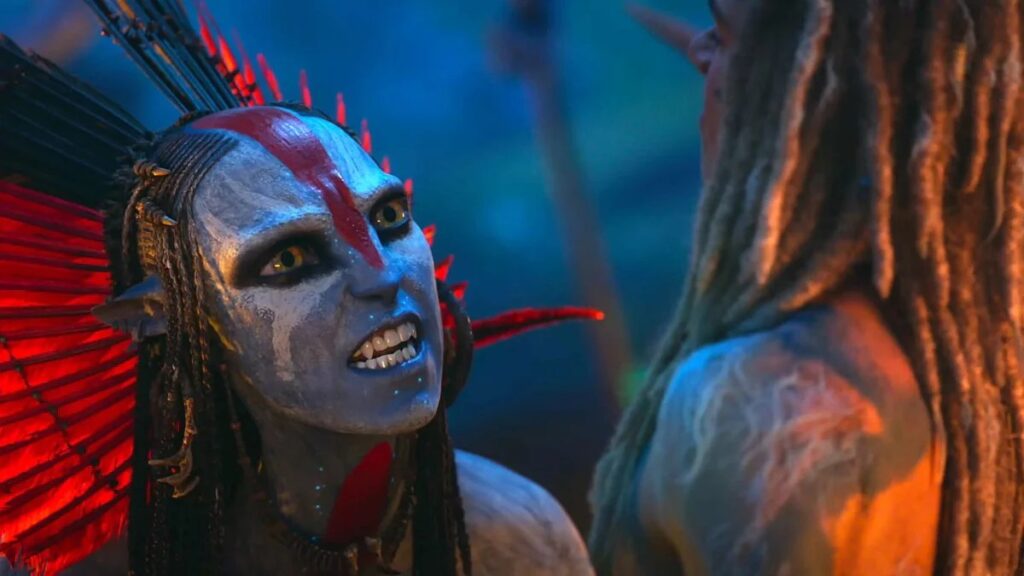
Along the way they’re attacked and separated by the Mangkwan clan, led by Varang (Oona Chaplin), a cartoonishly evil witch who wants the sky people’s guns so she can do more cartoonishly evil things. The Mangkwan clan are James Cameron’s version of the offensive indigenous stereotypes from racist old safari movies like “Trader Horn,” and although they have a superficial, tragic backstory, they undermine almost all of Cameron’s efforts to make “Avatar” a modern refutation of those outdated colonialist tropes. (Then again, the plot of the original “Avatar” already did that.)
So Spider gets captured by the humans and starts building a relationship with his father Quaritch (Stephen Lang), who is now in a Na’Vi avatar body. And yes, that is exactly what happened last time. Except this time nobody keeps an eye on Spider, even though through a series of iffy machinations he’s now the most important person on the planet, and he’s in a tiny cell in the middle of their laboratory, so you’d think there’d at least be a camera in there. But no, because otherwise the plot couldn’t happen.
Meanwhile Lo’ak — just like in the last movie — spends most of his time dealing with the exile of his best friend the space whale, who speaks with subtitles, and somehow that’s always laugh-out-loud funny. Even funnier is the scene where we find out space whales have a pretty complicated judicial system, full of strict bureaucracies and decorum.
Then of course there’s Quaritch, who has been on a very specific character arc in regards to his son and his new Na’Vi body, and who isn’t allowed to move more than one inch forward in that arc no matter how long this movie is. And it’s three-hours-and-seventeen-minutes long. Quaritch falls in with the Mangkwan clan, which could have been a dark and dramatically intriguing mirror of Jake’s storyline in the original “Avatar,” except James Cameron doesn’t want to use his excruciatingly long runtime to get into those weeds. Cameron is too concerned with going over his old notes and getting everyone, mostly, after all of that funky falderal, back to where they were before the end of “The Way of Water.” And also throwing in a few more parts about the awesome power of white colonialists, because apparently that’s an inescapable part of this franchise.
“Avatar: Fire and Ash” is, in fits and starts, exciting. But it’s exciting because characters are running for their lives, and that’s inherently engaging no matter what the context is. When the movie slows down — and boy, does it often slow down — the context gets in the way, because the plot is silly, the characters are on slow-moving journeys, and everything James Cameron is trying to say gets canceled out by the way he’s saying it.
This is yet another “Avatar” movie about why indigenous people are amazing, in which they have to be constantly saved by colonialists, who are more important to the story. This is yet another “Avatar” movie about the evils of militarism in which all the exciting, shut-your-brain-off action sequences are about soldiers looking cool while fighting wars with cool-looking weapons. And this is yet another “Avatar” movie about the evils of capitalism, brought to you by a giant mega-corporation for the sake of turning a profit. The only way “Avatar: Fire and Ash” could be more hypocritical, and taken less seriously, is if the characters also yelled “Hypocrisy sucks!” while sitting on Whoopee cushions.
You’d think, at least, with all this money and creative freedom, James Cameron would able to put something new and nifty in front of our eyeballs. But apart from a few weird images, “Fire and Ash” tries to get away with doing what “The Way of Water” already did. Remember how both “Avatar” and “The Way of Water” ended with a giant battle sequence, a series of cavalry charges, and finally a one-on-one fight between the hero and the villain? Get ready for more of that, except this time there’s a sky beam. And not even a sky beam that has a reason to be there. Everyone’s like, “Time for the final battle! Hey wait, what’s a sky beam doing here? Try to avoid it, I guess.”
What’s particularly frustrating about “Avatar: Fire and Ash” — besides the incredible number of other, more interesting and meaningful films that could have been made with the same time, talent and resources — is that James Cameron repeatedly gets close to doing something different. Several scenes find these characters about to make a choice which could send these movies in a new direction, in both story and tone, but then copping out. The film wants credit for almost being bold without ever actually being bold.
I’m sure it will make at least two billion dollars.
“Avatar: Fire and Ash” opens exclusively in theaters on Dec. 19.
The post ‘Avatar: Fire and Ash’ Review: James Cameron’s Repetitive, Hypocritical Sequel Gives Us the Blues appeared first on TheWrap.