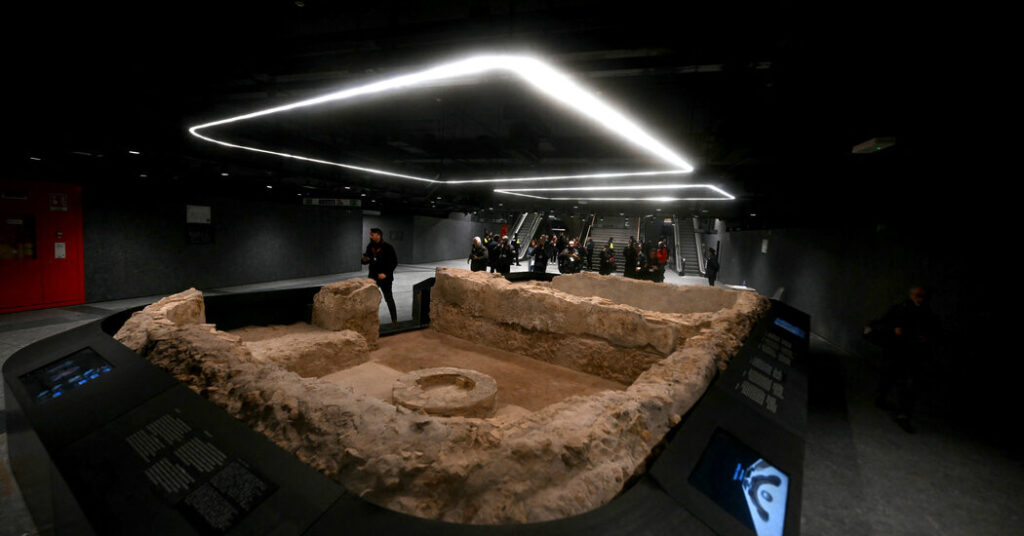
Rushing to catch their after-work trains on Tuesday, commuters at one of Rome’s newest subway stations could peer at the remains of thermal baths damaged by the great fire of 64 A.D., peruse fragments of ancient stone wells and pause before a display of marble decorations erected there by ancient Roman architects.
Welcome to the Colosseum stop on Line C, Rome’s third subway line, which opened to passengers on Tuesday after 11 years of construction. Part station, part museum, it gives passengers the chance to both catch their train — and view artifacts from Rome’s ancient past, nearly all of which had been discovered on or near the site during its excavation.
The station, Mayor Roberto Gualtieri said at its opening ceremony on Tuesday, exemplified how “complex engineering works” could coexist with the “extraordinary historical stratification of our city.”
A second stop, Porta Metronia, also opened nearby on Tuesday. The construction highlighted the challenge and also the opportunity of building subway lines underneath a city built upon layers of priceless archaeological relics. The risk of damaging antiquities makes it hard to dig. Yet the likelihood of finding them has often made the digging worthwhile.
Under the new Colosseum station, archaeologists found 28 ancient wells. Roughly 10 yards beneath Porta Metronia, the excavations yielded a vast military complex that included a barracks and a commander’s villa. The remains were removed, restored and put back in place, where they can be glimpsed by commuters moving through the station. A more formal museum, allowing the public to get closer to the ruins, is scheduled to open next year.
Had the subway never been built, Mr. Gualtieri said, several ancient structures and hundreds of artifacts would “never have been discovered” at all. “Today, we know much more about our past,” he said.
The extended subway is the latest effort to make life more livable and sustainable for the modern day inhabitants of a nearly 2,800-year-old city, connecting its far-flung southern suburbs with the city center, including another archaeologically-rich station at San Giovanni, which opened in 2017.
It has also given archaeologists plenty of fodder for future research topics: the living habits of Rome’s early inhabitants; ancient water management practices; and the vast military complex at the Porta Metronia station.
“Rome’s underbelly had quite a few surprises in store for us,” said Elisa Cella, the archaeologist responsible for overseeing the dig at the new Colosseum station, which stretches from below the amphitheater for which the station is named to the Basilica of Maxentius, part of Rome’s sprawling archaeological center.
To dig in such a sensitive area, the builders sometimes had to set aside traditional excavation methods for more sensitive techniques, including digging by hand. Thousands of sensors were installed to ensure the monuments would not be lastingly affected by vibrations or shifts in the soil or the water table.
“Rome is the most difficult city in the world in which to build a subway,” said Marco Cervone, construction manager at both new stations. “It’s not just what’s underneath that’s important, it’s also what’s on top,” he added.
The new Colosseum station is connected by a passageway to an older station of the same name, which opened in 1955.
At the new station, people won’t have to buy tickets to experience something of the ancient world around it. The station’s atrium contains marble remnants from the amphitheater’s deposits, photographs and a video that reconstructs what ancient Rome would have looked like in that spot.
At least four more stations are set to open over the next dozen years, including one at Piazza Venezia, Rome’s most central point, and another near St. Peter’s Basilica in the Vatican. For many Romans, their completion can’t come soon enough. Construction at Piazza Venezia has exacerbated traffic jams and created a headache for local businesses. “An incredible nuisance,” said Enzo Bellisario, the manager of a bar at Piazza Venezia.
A small price to pay for modernity, city officials say. “Rome embracing itself,” said Eugenio Patanè, a deputy mayor who oversees transport in the city. “Ancient Rome shaking hands with the modern city in a dialogue that moves us all.”
Elisabetta Povoledo is a Times reporter based in Rome, covering Italy, the Vatican and the culture of the region. She has been a journalist for 35 years.
The post At Rome’s New Stations, Peruse Ancient Relics While Catching a Train appeared first on New York Times.