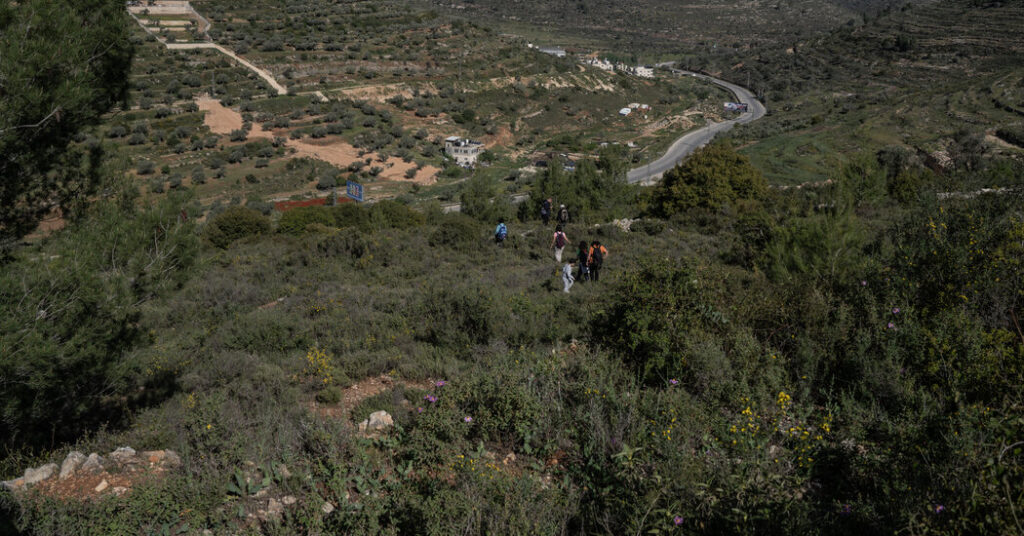
It was just after dawn, and the hills outside Ramallah, a Palestinian city in the Israeli-occupied West Bank, glowed in the soft morning light.
A small group of Palestinian hikers, boots crunching the gravel underfoot and jackets zipped against the chill, prepared to head down a dirt track, toward a spring used for centuries by Palestinian farmers.
Then they spotted the tent in the distance, close to their path. Two Israeli settlers, recognizable by their skullcaps and long sidelocks, emerged from the tent, marching straight for the hikers.
Scared, the hikers changed course and pivoted to the northwest, skirting any confrontation, but shortening the hoped-for walk.
It was a familiar experience: While Palestinian hikers once walked linear routes for miles, they now — fearing attacks by settlers — often use circular routes sticking closer to their villages.
“We used to roam for hours,” said Jamal Aruri, 64, a retired photographer and experienced hiker at the front of the group. “Now, we walk in circles.”
As Israeli settlers build more encampments across the valleys of the West Bank, the hiking trails that Mr. Aruri has walked since childhood are, one by one, being turned into dead ends.
The war in Gaza distracted international attention from Israel’s expanded settlement activity in the West Bank. But the cease-fire has renewed scrutiny of tensions in the West Bank, where unauthorized construction by settlers is visibly transforming the landscape day by day and violent attacks are prompting small Palestinian communities to dwindle in size and even to pull up stakes entirely.
Settler outposts — often small clusters of tents or trailers or simple farmsteads with animal sheds — are increasingly cutting off Palestinians from the land. It’s a process that has been happening since Israel captured the territory from Jordan during the Arab-Israeli war of 1967. But it has accelerated since Prime Minister Benjamin Netanyahu’s government took office in late 2022, with several longtime settler leaders in his coalition.
Since then, settlers have built over 130 outposts — more than in the previous two decades combined — that are technically unauthorized but usually protected and provided with crucial infrastructure by the Israeli government. Because of the risk of confrontation with armed settlers or Israeli soldiers if Palestinians draw near, each outpost effectively renders the surrounding land off-limits to Palestinians in many cases.
As a result, according to the Palestinian Authority, the semiautonomous administration that oversees parts of the West Bank, these new settler projects have since 2023 allowed settlers to exert control over an extra 123,000 acres.
Palestinian herding communities have borne the brunt of this expansion. Intimidated and pressured by the settlers’ encroaching presence, at least 38 herding communities have abandoned their hamlets since 2023, according to records compiled by B’Tselem, an Israeli rights group.
Palestinian hikers have also been badly affected. The West Bank is a land of terraced hills, steep valleys and ancient olive trees, where generations of Palestinians have walked the footpaths between villages. Now, new roads — built by settlers to connect their outposts to Israeli highways — are effectively blocking off well-known trails to Palestinian hikers leery of confrontations with settlers using the roads.
Mr. Aruri’s hikes tell the story of this slow-motion takeover.
After steering clear of the two settlers, Mr. Aruri’s group suddenly encountered another obstacle — a freshly opened dirt road, cut across the hillside.
There were no official signs, no markings, just the quiet assertion of a new reality. This was a settler road, built by Israelis living in outposts considered illegal not only by most of the international community, but also not even authorized by their own government.
The hikers exchanged glances. They knew that proceeding farther risked a violent encounter. Without a word, Mr. Aruri turned in a different direction, cutting about a kilometer from their planned journey.
“This is what hiking has become in the West Bank: a series of advances and retreats, always circling back,” said Shawkat Sarsour, 55, an agricultural expert.
Before heading out, hikers in the West Bank have a checklist similar to those anywhere, making sure they have the right footwear, clothing, snacks and other gear for the day. But hiking here now requires a different kind of preparation, unique to the West Bank: Routes must be scouted in advance for new blockades or military patrols.
And while hikers elsewhere may stay alert for signs of dangerous animals, here, people keep an eye out for drones, buzzing like mechanical wasps, which are often a warning that settlers or soldiers are near, Mr. Aruri explained.
For all the changes in recent years, the most noticeable shift is in the distances hiked. Where the journeys once stretched 20 kilometers — about 12 miles — across open valleys, many now loop back within eight miles.
“It’s not fear,” Mr. Aruri said. “It’s simple math. The land left to us is shrinking.”
For decades, Mr. Aruri’s photography documented wars and uprisings.
Now, he trains his lens on the land itself — wild irises pushing through cracked bedrock or the gnarled trunks of olive trees that have stood for centuries. His photography book, “Secrets of the Caves,” documents the grottoes where Palestinians once hid during wars.
“These caves are our archives,” he said, but many of them are now off-limits.
The hikers who regularly join Mr. Aruri are an unlikely coalition — university students, workers at nonprofits, businesspeople, farmers and their children.
After the coronavirus lockdowns in 2020, the group swelled. “People were desperate for open air,” Mr. Aruri recalled. “And we realized: Walking is a way to maintain physical and mental health.”
But to minimize risk, Mr. Aruri now limits his groups to no more than 12 people.
In the past, his group often changed its routes according to the season: springtime trails through wild anemones, summer routes near grape farms and late autumn walks among carob and fig trees. In December, they venture into warmer parts to the northeast. “We wanted to walk with the land, not just on it,” Mr. Aruri said.
But it is increasingly hard to do that. He avoids trails near recently established outposts, especially in the northern West Bank, where attacks have spiked. Some trails that he used to love — routes passing through lush meadows near the village of Ein al-Beida or near springs in the South Hebron Hills — are now no-go zones.
“Some of the trails have vanished completely,” Mr. Aruri said. “We walk at the edges of cities,” he added, since the more remote areas “are taken over by settlers.”
Still, he’s determined to continue. “If we stop walking, we let go,” he says. “And I’m not ready to let go.”
“Every walk is a way of saying we are here,” he added, “even when we can’t reach every spring or cave we once knew.”
The post As Israeli Settlements Get Bigger, Palestinian Hikes Grow Shorter appeared first on New York Times.