New York is a city of trade-offs. For as long as the rent has been too high, the subways perpetually delayed and the rats abundant, New York’s singular arts scene has brought people to the city and kept them there.
The arts have helped define New York’s image and buoyed its economy, creating jobs in advertising, television, publishing and architecture that helped solidify the middle class.
Until now.
Over the past five years, after decades of growth, New York’s creative sector has shrunk as the cost of living has soared, according to a report to be released Monday by the Center for an Urban Future, a think tank.
Today, there are fewer dancers and fashion designers, video editors and graphic designers than there were in 2019, the report found. New York’s share of people working in creative industries compared with the rest of the United States declined during the same period.
Of course, New York has never exactly been a cheap place to make art, and creative workers have always come and gone. But something different is happening.
The number of artists living in the city grew by about 35 percent between 2004 and 2019, but has declined by over 4 percent since then. Almost 50 arts venues have closed in the past five years, including galleries, theaters and clubs; some large museums have laid off employees.
“These were all fields that were growing spectacularly for most of this century — they were outpacing the rest of the city’s economy,” said Jonathan Bowles, the center’s executive director. “We’re all talking about affordability, but I still don’t think people grasp how important this issue is to the city’s economic competitiveness.”
The problem is more than a pandemic recovery issue, Mr. Bowles argued: While the health crisis drove artists out of the city, the affordability crisis prevented them from returning. And the problem extends far beyond the cliché of the starving artist, though painters and actors are certainly struggling.
Instead, the report warns of a domino effect that could threaten multiple layers of the city’s economy at once.
As artists flee, the broader creative economy, which includes middle-class industries like advertising and design that rely on the arts for inspiration and talent, are at risk of being hollowed out. Along the way, New York could lose an essential part of its identity, and one of its most powerful draws for tourists and locals alike.
Runaway costs have left many artists unable to rent both an apartment and a studio space. Arts venues are struggling to cover surging insurance bills. And the rise of artificial intelligence has made some creative jobs obsolete.
At the same time, a surge of philanthropic support aimed at keeping the city’s arts scene alive during the pandemic has waned.
The combined effect is what Mr. Bowles called a “tipping point” moment for New York’s creative economy, with ramifications for a huge swath of the city’s population, from advertising executives to bartenders.
Andrew J. Robertson, the chairman of the global advertising behemoth BBDO Worldwide, which is based in the city, said that young people in his industry no longer believed they had to be in New York and could instead work from more affordable hubs like Atlanta or Austin, Texas.
“Unless something is done, the incentive for both the people and the companies to disperse to other places across the U.S. is very real,” Mr. Robertson said. “I don’t think New York suddenly becomes a former creative hub, but it’s hard to see how it grows, which is really what you want.”
As New York’s artists face this precarious moment, many are coming up with inventive ways to make it work.
In the East New York neighborhood of Brooklyn, a new organization, the Queer Nightlife Community Center, serves as both a nightclub and a gathering place, allowing people to swap ideas about how to survive in an industry where many need to work four or five gigs at a time to make the rent.
The D.J.s, dancers and sound engineers who are on their feet until 4 a.m. or later help create “the sites where culture is shaped in New York,” said Michael Falco-Felderman, who runs the center.
Last year, James Sundquist, a painter, was so desperate to find an affordable studio that he and some friends signed a sub-sublease on a space. He paid two months in rent upfront and then found out that the arrangement was a scam.
As Mr. Sundquist loaded his paintings from the studio into a U-Haul truck, he said, “I started thinking about the value of a cubic foot in New York.”
It had become too expensive to rent studio space, open a gallery or rent a booth at an art fair. But the U-Haul could be rented by the day, and there was enough room inside to display some of his work.
The U-Haul Gallery was born. Every month or so, Mr. Sundquist and his business partner Jack Chase curate a four-day show in a rented truck with works from local artists, which typically costs between $1,200 and $1,800, a fraction of what it takes to rent space at an art fair.
Earlier this year, the duo got 12 U-Hauls together during the week of the Armory Show, one of the city’s most prestigious art fairs, and parked them outside a row of blue-chip galleries in Chelsea.
Jose Durán, a painter and former fashion designer, takes it as an article of faith that you have to adapt to stay in New York.
“That’s what I love about this city,” he said, “that we always make it work.”
In his case, that means painting in the same $1,600-a-month two-bedroom Bronx apartment where he sleeps, breathing in fumes, despite his chronic asthma, because he cannot afford a separate studio space.
Last year, Mr. Durán said, was particularly bad for business, so he started making smaller, cheaper works on paper rather than 11-foot-wide paintings on linen.
But the way Mr. Durán sees it, his art has to be made in New York because it is all about New York.
Mr. Durán spent his childhood visiting his mother’s friends at their modest apartments, decorated in a sumptuous, baroque style, which he came to see as the ultimate expression of immigrant aspiration.
It was on those visits that he learned an essential truth, he said: “New York is the place that everyone wants to be.”
But the city has not built new housing specifically for artists in decades.
Westbeth Artists Housing had so many people on the wait list for its 384 rent-stabilized and Section 8 units that the building closed the list in 2019. Westbeth is undergoing an $84 million renovation that will open up a few dozen more units.
At the Manhattan Plaza apartment building in Hell’s Kitchen, nicknamed “Broadway’s Bedroom,” some affordable units are reserved for New Yorkers who work in the performing arts. The high-rise’s wait list recently reopened.
The city and affordable housing developers have run into major obstacles trying to build more artist housing in recent years, in part because the city’s human rights law bans housing discrimination on the basis of occupation.
Two Manhattan City Councilmen, Keith Powers and Erik Bottcher, recently introduced a bill that would clarify that constructing new housing for artists does not violate the law.
Still, city government has not exactly watched passively as artists have fled. In fact, the city has significantly increased funding for its Department for Cultural Affairs over the past decade.
City Hall has also created the Office of Nightlife, launched new programs to secure affordable work space for artists and continued to fund Materials for the Arts, a warehouse that processes six million pounds of donated art materials a year.
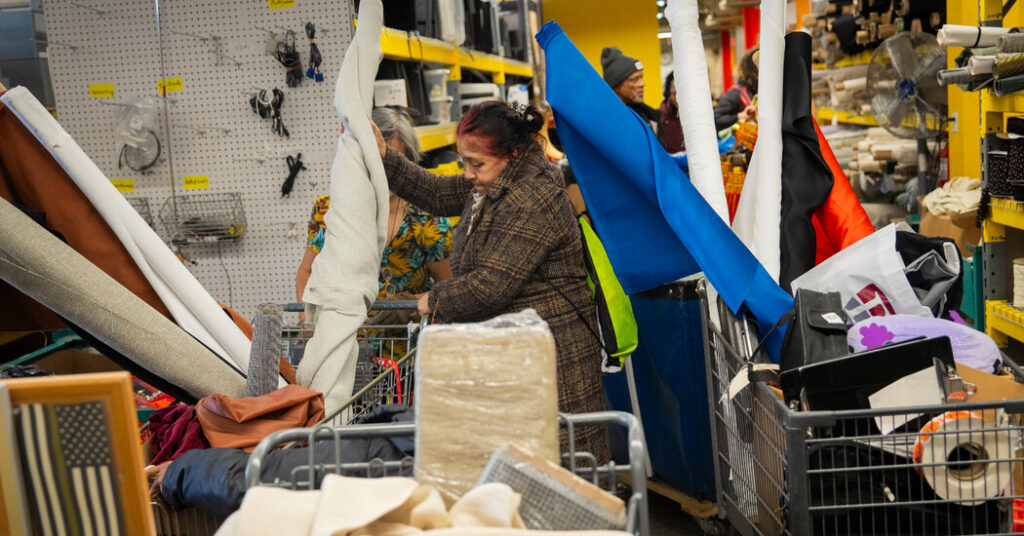
On a recent morning inside the 35,000-square-foot space in Long Island City, public school art teachers and employees from arts nonprofits hoisted naked mannequins and leather from airplane seats into their shopping carts.
The site, which staff members affectionately call Toys “R” Us for artists, is scrambling to keep up with the demand for free materials, despite recently doubling the number of schools and groups it serves.
The crisis for artists in New York underscores the difficulty of tackling the city’s broader affordability problem.
It may be that New York will never again be an incubator for young creative talent the way it was for Mi Jong Lee, who arrived in the city in 1980 with two suitcases and next to no money and spent the next few decades establishing herself as a fashion designer and clothing manufacturer.
Ms. Lee has recently made it her mission to try to revive parts of the garment industry, once an essential part of the city’s economy.
She mortgaged her home to purchase a full-floor factory where she helps nurture small fashion brands and oversees the production of 48,000 T-shirts a month, which she hopes will prevent at least some jobs from being exported overseas.
But Ms. Lee said she knew “that the old ways are not coming back.”
“I’m looking at young creatives, and it’s heartbreaking,” she said. “I really do believe that the arts are the last bastion of truth. When they fold, when we fold, it’s really at that point you lose hope.”
Eliza Shapiro reports on New York City for The Times.
The post With Prices Soaring, Can New York Survive as a Mecca for the Arts? appeared first on New York Times.