The lowest rung on D.C.’s political ladder is a job requiring elected officials to sit through endless hours of public meetings, study the intricacies of zoning regulations and liquor license applications, and listen to residents complain about traffic, parking, noise and garbage — all for no pay.
Not one cent.
So it was something of a wonder when a bar owner named Branden Givand recently claimed — falsely — that he had assumed the duties of the job, otherwise known by the less-than-riveting title, advisory neighborhood commissioner.
Givand’s declaration surprised those Washingtonians who pay attention to such granular matters, but none more so than the seat’s duly elected occupant. His name is Anthony Thomas-Davis, now in his second term representing a slice of Columbia Heights.
“I had someone who asked if I had resigned and asked what’s happening — it generated confusion,” Thomas-Davis said in an interview. “I was not confused.”
As the nation’s capital, Washington is rife with gilded job titles — president of this, undersecretary of that — the flaunting of which typically follows the question, “What do you do?”
The title of advisory neighborhood commissioner does not exactly roll off the tongue and can induce myriad queries, not the least of which include, “A what?”
The commissioners, who are elected to their seats, typically ruminate about the effects on their neighborhoods of proposed development projects and budgets, among other things. The ANCs, as the commissions are called by people in the know, then relay their nonbinding decisions up the ladder to leaders with actual power — the mayor, for example, or the D.C. Council.
A total of 345 commissioners, making up 46 ANCs, slog through meetings that can make two hours of CSPAN feel like a high-speed thriller. Their decisions rarely, if ever, generate widespread chatter. Same with the election of a new commissioner.
A citizen impersonating an ANC commissioner? That’s a different story.
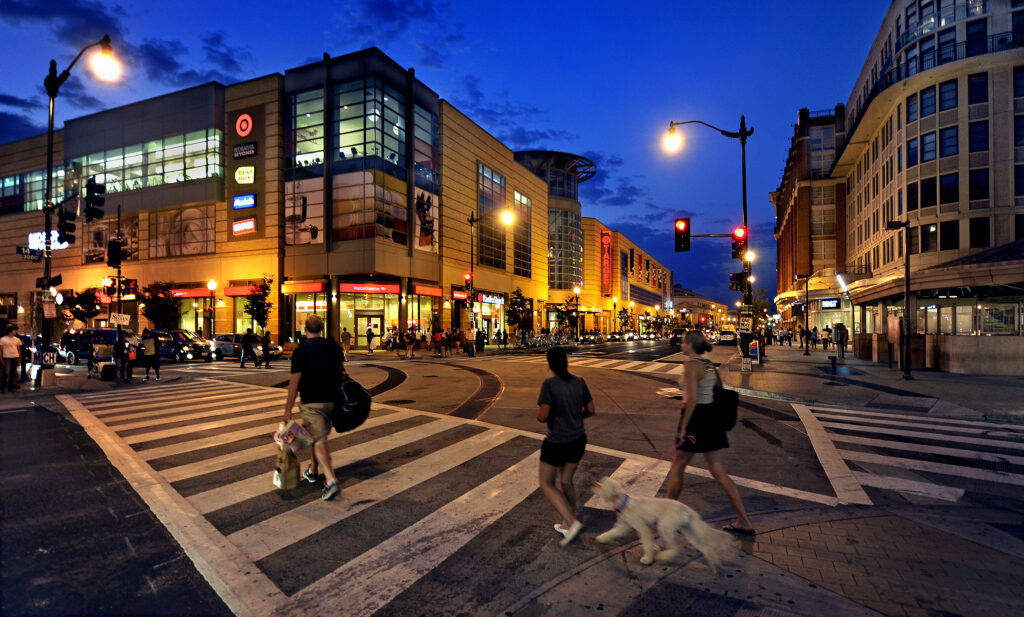
The reason for Givand’s claim to the job is rooted in his feud with Thomas-Davis, whose district includes the 11th Street NW block where Givand owns a bar, Johnny’s All-American.
Their dispute peaked last month when Thomas-Davis, at a meeting of ANC 1A, introduced a resolution protesting Givand’s renewal of Johnny’s liquor license with the Alcoholic Beverage and Cannabis Administration (ABCA).
Givand, in a “Neighbors and Business Owners” post on his website a few days later, declared that he had replaced Thomas-Davis on the ANC. “I AM your new Commissioner,” Givand asserted. “He is out. I am in.”
“Now THIS is the kind of ANC drama that’s been missing around here the past few years,” a reader wrote into PoPville, the purveyor of hyperlocal dish that has been dutifully covering the contretemps (one headline: “Meanwhile Some, Uh, Drama Continues at Johnny’s in Columbia Heights — Yikes”).
ANC 1A’s commissioners were not amused by Givand’s antics. A week after the bar owner’s posting, they sent Givand a cease-and-desist letter warning that “knowingly and falsely assuming or pretending to be a public officer” is illegal.
“You are required to remove all such false representation within 24 hours of receipt of this letter,” the commission wrote Dec. 1. The panel promised to refer the matter to the D.C. Office of the Attorney General unless Givand deleted his claim to the seat.
More than a week later, the claim remained. The bar owner, in an interview, said that he had not received the ANC’s letter and that he had no intention of withdrawing his assertion that he was the new commissioner.
“I’m the captain now,” Givand, 39, said. “I’m not going to let some guy tell me I can’t represent my small slice of community.”
Givand’s antipathy toward Thomas-Davis led him to hang on the outside of his bar two posters announcing a campaign to recall the commissioner. Beneath an unflattering caricature of Thomas-Davis, the posters include the slogan, “Terrible for our amazing community. Terrible for our amazing businesses.”
Sarah Graham, a D.C. Board of Elections spokesperson, said her agency has received no paperwork required to initiate the recall process.
Thomas-Davis, 38, a policy adviser for council member Charles Allen (D-Ward 6), expressed no worries. “I will continue to remain in my seat,” he said. “The job is rewarding even if it does have its challenges.”
Established in the 1970s, ANCs are nonpartisan bodies intended to give Washingtonians the chance to speak up about issues affecting their communities. Although ANC votes are advisory, city agencies such as the Zoning Commission and ABCA are required to give “great weight” to their decisions.
The ANCs can also be a platform for neophyte politicians. An ANC commissioner named Muriel E. Bowser was elected to a two-year term in 2004 in Ward 4 before ascending to a seat on the council and her current job (mayor).
Over the years, ANCs have on occasion drawn attention because of a commissioner’s conduct or when a disgruntled citizen launches a recall campaign.
“I’m frequently reminded of that Henry Kissinger saying about academia — the politics are so bitter because the stakes are so low,” said Gottlieb Simon, who for two decades served as executive director of the D.C. agency that oversees the ANCs. “Somehow, that seems to apply.”
Simon waved off the idea that ANCs occupy the lowest rung of the city’s political hierarchy. “It’s a pejorative,” he said. “I’d say ANCs are the level closest to the people. The mayor is the furthest from the people.”
Thomas-Davis said he views his main obligation as knowing his constituents, including restaurant and bar owners. He said he has tried to get to know Givand, only to be rebuffed.
The commissioner’s effort took on added urgency in recent months as Givand’s liquor license came up for renewal, a process that required Johnny’s to post a notice informing the public that they have 45 days to protest the application. ANCs typically use this period to finalize what are known as settlement agreements with establishments, negotiating sensitive concerns such as operating hours and acceptable noise levels.
Thomas-Davis said Givand has ignored several invitations to discuss what the commissioner described as his and residents’ concerns about late-night noise and the bar’s exterior appearance.
“He has been kind of belligerent,” Thomas-Davis said. “When one commissioner is not respected, when one person says, ‘I will not engage with the commission,’ it gives the impression that other businesses can eschew a process.”
Givand said he has refused to meet with Thomas-Davis because he sees no need to enter into an agreement with the ANC. The only person to complain about his bar, he said, is the commissioner (an ABCA spokesperson said one anonymous complaint has been filed with the agency since Johnny’s opened three years ago).
Their dispute reached ANC 1A last month when Thomas-Davis, in a Zoom meeting, proposed that the commission pass a resolution protesting Givand’s liquor-license renewal. He cited “escalating concerns” that include “persistent outdoor noise.”
“Everything he’s saying is defamous, slanderous,” Givand responded.
“I have done my job as a duly sworn commissioner,” Thomas-Davis said.
The heated back-and-forth prompted one commissioner to urge the two to “tone it down a little.” Another urged them to keep their debate “as sterile as possible.”
After more than an hour of discussion, the commission voted to reject Thomas-Davis’s resolution, though the matter is not dead.
The ANC is scheduled to reconsider his protest resolution later this month, though commissioners expressed hope that the two sides could come to an agreement before then.
“I don’t want to give this more air,” Jeremy Sherman, the ANC’s chair, said in a subsequent interview, his tone suggesting he’s eager for the commission to return to parking and noise and other far more familiar headaches.
The post Who needs an election? A bar owner falsely claims a seat already filled. appeared first on Washington Post.