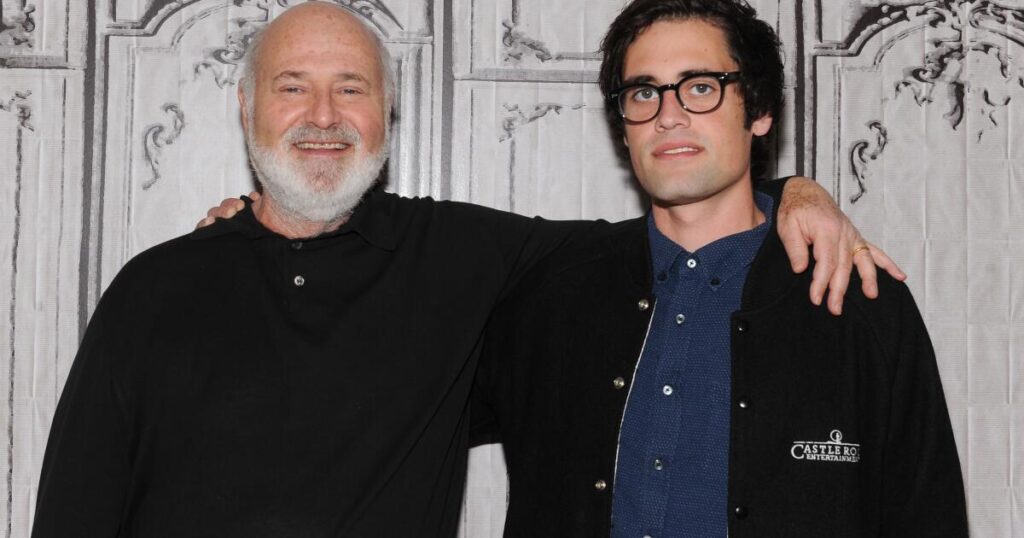
Nick Reiner spent year struggling with addiction and with help from his father, Hollywood legend Rob Reiner, told his story to the world.
On Monday, Nick was booked into the L.A. County jail on suspicion of murder, hours after Reiner and his wife were found dead inside their Brentwood home.
Nick cycled in and out of rehab centers and experienced bouts of homelessness as a teenager.
He had gotten clean by 2015, when he worked with his father on “Hey Charlie,” a semi-autobiographical film about addiction and recovery. Rob Reiner directed and Nick co-wrote the film about a successful actor with political ambitions and a son addicted to drugs.
Many aspects of the movie were inspired by Nick’s relationship with his father — including a line where the father character tells his son, “I’d rather you hate me and you be alive.” Nick said in a 2016 interview with AOL that he “didn’t bond a lot” with his father while he was growing up.
Nick gave an interview about “Hey Charlie” alongside his family at the Toronto Film Festival in 2015, saying that his decision to quit heroin was driven by a practical realization.
“I got sick of doing that,” he told The Times. “I come from a nice family. I’m not supposed to be out there on the streets and in homeless shelters doing all these … things.”
During the interview, Rob said he regretted valuing the advice of counselors over the voice of his son.
“When Nick would tell us that it wasn’t working for him, we wouldn’t listen,” he said. “We were desperate, and because the people had diplomas on their wall, we listened to them when we should have been listening to our son.”
Michele added: “We were so influenced by these people. They would tell us he’s a liar, that he was trying to manipulate us. And we believed them.”
Nick talked about the many different rehab centers and programs he tried without success. In 2016, he told People magazine that he lived on the streets because he refused to go to the rehab facilities his parents recommended.
“If I wanted to do it my way and not go to the programs they were suggesting, then I had to be homeless,” he said.
He told the magazine that he could have died on the streets.
“It’s all luck,” he said. “You roll the dice and you hope you make it.”
At the time of the premiere, The Times reported that Rob Reiner and his wife at their worst moments “wondered if there was an end in sight, and whether it would be the tragic one that a voice in the back of their heads kept telling them was coming.”
Rob Reiner said the filming brought up tough memories.
“It was very, very hard going through it the first time, with these painful and difficult highs and lows,” he said. “And then making the movie dredged it all up again.”
But he said the process of making the movie was therapeutic, allowing them to work through a lot of past trauma and develop a closer relationship.
Police have released few details about the killing.
The couple was found at the home in the 200 block of Chadbourne Avenue on Sunday afternoon.
Early in his career, Rob Reiner played Michael “Meathead” Stivic on the iconic sitcom “All in the Family” from 1971 to 1979, alongside Carroll O’Connor as Archie Bunker.
As a director, Reiner helmed a string of hits including “When Harry Met Sally,” “The Princess Bride” and “This Is Spinal Tap.” His work took a dramatic turn when he directed the 1986 adaptation of Stephen King’s novella “Stand by Me.”
In interviews, Nick praised his parents for helping him find sobriety but also said he was trying to forge his own life.
NPR asked them whether they’d want to work together again after “About Charlie.”
“I think for now, it’s best for me at least to be sort of independent. But that’s not to say I didn’t have an amazing experience,” Nick said. (Based on IMBD, he did not have any other movie roles.)
Rob added: “He was the heart and soul of the film and any time I would get an opportunity to work with him I would do it, but I do understand him wanting to forge his own way. I do know what that’s about, I went through it, and he’s brilliant and talented and he’s going to figure out his path.”
The post What we know about Nick Reiner, who struggled with addiction and shared his recovery with the world appeared first on Los Angeles Times.