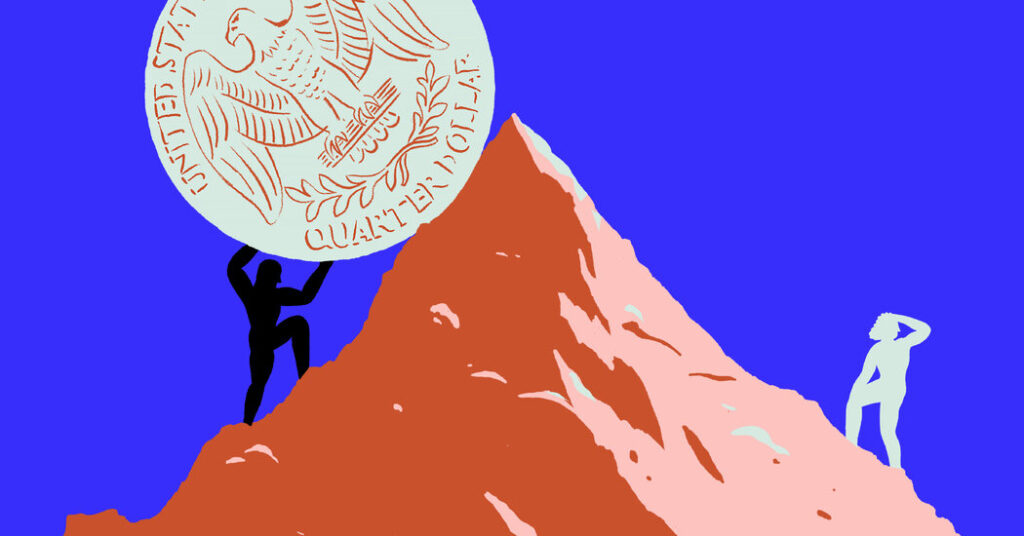
Within 50 years of independence, America built two competing heavens: the rapture and the American dream. One was driven by the end-of-days fervor of the Second Great Awakening; the other was drawn from the unruly optimism of founders like Thomas Jefferson. One promised the righteous would rise; the other swore everyone could.
But today the architecture of ascent feels irrelevant. Everything costs more — child care, rent, mortgages, health insurance, utilities, groceries, restaurants, household goods, streaming services, tickets of all kinds (concert, plane, parking), not to mention holiday gifts. Salaries are stuck, worker power has calcified and the struggle against inflation grinds into its fifth year.
How and when did moving up start to seem so out of reach? These books tackle the question head on. Some of these authors dig into how the cracks in the road to a better life formed; others clock where the pressure lands now. Together, they show that Americans have struggled to fix their economy since the founding of the Republic — and that one generation’s efforts often bear fruit only in the next.
The Price of Democracy
by Vanessa S. Williamson
From the levies of the Boston Tea Party to the tariffs of the Gilded Age, few things define American history like taxes. In this incisive chronicle of U.S. taxation, Williamson, a fellow at the Brookings Institution, argues that tax policy is about more than funding the government — it’s a mechanism for distributing and maintaining power.
Taxes have often buoyed the country’s wealthy at the expense of everyone else. After the Revolution, Williamson writes, Abigail Adams was among the elites who bought up devalued government war bonds for cents on the dollar — then watched their value soar as Massachusetts raised taxes to repay them, largely on the backs of yeoman farmers.
Despite such inequities, Williamson’s surprising thesis is that taxes, when done right, are good for democracy. The creation of the income tax in the 1860s buttressed the Union war effort, ensuring that it wasn’t just the poor who foot the bill. After the war, the Reconstruction government in South Carolina imposed taxes on land that more than quadrupled the number of children who could get public education, even in the face of rampant tax evasion.
Opposition to taxation has long masqueraded as appeals to fairness, Williamson argues, but the real danger comes when no one feels invested. Ultimately, she writes, when people help fund a working government, they’re more likely to claim a say in what it does — and expect it to answer back.
One Man’s Freedom
by Nicholas Buccola
Between the Montgomery bus boycott of the 1950s and the 1964 election, the civil rights leader Martin Luther King Jr. and the Republican presidential nominee Barry Goldwater put forth powerful ideas about what “freedom” meant in America. In this illuminating double portrait, Buccola reconstructs the way their movements collided. Each man’s notion of liberty promoted a different understanding of the ideal economic order: King’s freedom required equal access to public goods and services; Goldwater’s rested on personal property rights.
Buccola, a professor of political philosophy at Claremont McKenna, tracks how their competing visions — articulated in speeches, sermons and Senate debates — became the twin moral logics of modern America: one sanctifying the market, the other demanding its reform. Goldwater warned that “Big Government” (with its taxes and safety nets) and “Big Labor” (with its upward pressure on wages) threatened “the American economic way of life.” King replied that political rights without economic opportunities were hollow. Buccola argues that King’s civil rights coalition helped defeat Goldwater’s campaign, but Goldwater’s ideas coursed down both aisles of American politics, shaping the Reagan Revolution and the free-market globalism of the Clinton White House.
Lords of Finance
by Liaquat Ahamed
In his Pulitzer Prize-winning history from 2009, Ahamed follows the four men who controlled the world’s major central banks in the years before the Great Depression — Montagu Norman (Bank of England), Benjamin Strong (Federal Reserve Bank of New York), Émile Moreau (Banque de France) and Hjalmar Schacht (Reichsbank).
This book has a global lens, but it belongs among the annals of American history because the effects of the U.S. economy have always sprawled back and forth across national borders. As European economies staggered after World War I under reparations and debt, Strong used American credit lines to help revive European banks. That infusion helped push the continent back onto the gold standard and tethered global currencies to an Anglo‑American financial center.
When Strong died in 1928 and the American stock market plummeted, the fragile balance began to falter. The Europeans clung to their Victorian faith in balanced budgets and let intuition and national prejudice guide them as they drained liquidity from a world already in collapse. Ahamed, a former World Bank financier, wrote this history against the backdrop of the 2008 global economic crisis, and the circumstances that led to it were no doubt on his mind when he observed that the bankers in his book were “standard-bearers of an orthodoxy that seemed to imprison them.”
The Radical Fund
by John Fabian Witt
Americans haven’t always counted on government to improve the common lot. The 1920s were an era of booming markets and deepening inequality. Private capital was often the only lifeline for those battling poverty, entrenched segregation and the wide-scale assault on civil liberties.
In 1922, Charles Garland, a 23-year-old Wall Street banking heir from Massachusetts, refused to profit from a system he saw as unjust and gave away the entirety of his million-dollar inheritance to found the American Fund for Public Service. As Witt shows in his engrossing history of the Fund, that act of renunciation became a financial engine that sustained the people and institutions that would shape the New Deal and, later, the civil rights movement.
Under Roger Baldwin of the A.C.L.U., the Fund advanced the projects of the Black sociologist W.E.B. Du Bois, the Socialist Party standard-bearer Norman Thomas and the N.A.A.C.P. co-founder Mary White Ovington. Their fights set in motion big-tent labor alliances like the Congress of Industrial Organizations and the legal campaigns that would culminate in Brown v. Board of Education.
Babbitt
by Sinclair Lewis
“Honest, do you think people would think I was too liberal if I just said the strikers were decent?” asks George F. Babbitt, the gadget-loving, Buick-driving, country-club-belonging real estate man at the center of Lewis’s 1922 satire of middle-class complacency. Set amid a protest of switchboard operators in the fictional Midwestern city of Zenith, Babbitt follows a prosperous American’s brief rebellion against his own comfort.
“Don’t worry, dear,” his wife replies. “I know you don’t mean a word of it.” And yet helping the strikers is the first thing his college self — who dreamed of defending the poor — would do. “I’ve never done a single thing I wanted to in my whole life!” he confesses to his son. A short-lived midlife crisis ensues. He dabbles in bohemian circles, has an affair with a widow and causes a stir at his athletic club. But when dissent earns him the cold shoulder from his community and his wife falls ill, Babbitt folds.
The novel was a best seller, and its title entered the lexicon: A “Babbitt” became shorthand for the conformist trapped in a small-minded world. Lewis, the first American to win the Nobel Prize in Literature, saw what economists often miss: The dream he skewered isn’t aspirational — it’s compulsory. Opting out means exile, so most people stay in — smiling through the void.
The post What Happened to the American Dream? Will It Ever Come Back? appeared first on New York Times.