The new spymaster of Britain’s Secret Intelligence Service warned on Monday that Russia posed an “acute threat” to the West, plotting arson and sabotage operations, assassinations, and cyber and drone attacks across Europe.
“The new frontline is everywhere,” said the chief, Blaise Metreweli, who in October became the first woman to lead the agency, known as MI6, after a career as an intelligence agent. “The export of chaos is a feature, not a bug, in the Russian approach to international engagement,” she said.
In her inaugural speech at the MI6 headquarters, Ms. Metreweli struck an unapologetically dark tone, describing a “new age of uncertainty” in which Russia and other hostile powers use a battery of weapons, from cyber technology to disinformation, to sow discord and disrupt Western democratic societies.
In such a world, Ms. Metreweli said, intelligence agencies need to harness A.I. and other technologies to fight back, by striking alliances in the “wider tech ecosystem” and changing the mentality of intelligence agents.
“Mastery of technology must infuse everything we do, not just in our labs but in the field, in our tradecraft, and even more importantly, in the mind-set of every officer,” she said. “We must be as comfortable with lines of code as we are with human sources, as fluent in Python as we are in multiple languages.”
For Ms. Metreweli, the reference to computer programming was hardly surprising. A graduate of Cambridge University, she most recently served as MI6’s director general of technology and innovation, a post commonly referred to as Q — the developer of the gadgets immortalized in the James Bond film series.
As the agency’s chief, Ms. Metreweli, 48, is now known by the letter C, a designation that dates to the first chief of the Secret Intelligence Service, Mansfield Cumming, who signed his directives with C in the early 1900s. By tradition, the only publicly identified official in MI6 is the chief.
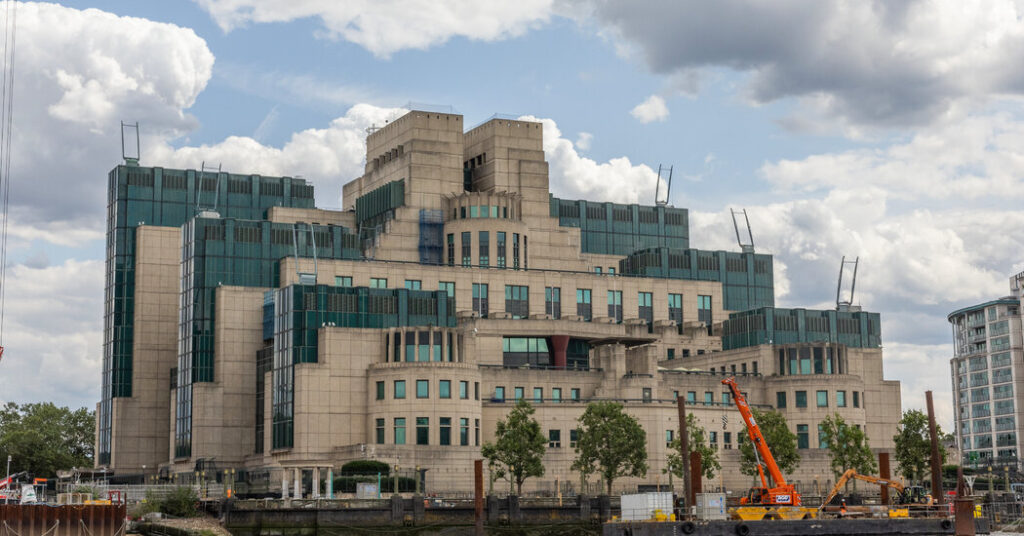
Ms. Metreweli had no public profile when she was named to run MI6, and nothing in her demeanor on Monday suggested that she planned to pivot to a more public role as the director. Speaking crisply from a lectern in her private dining room atop the agency’s brooding building on the Thames, she stuck to the script of her speech and took no questions from an audience of about 20 journalists.
Still, Ms. Metreweli did offer a glimpse into her personal life, noting that she came “from a family shaped by devastating conflict,” which left her with a “deep sense of gratitude for the U.K.’s precious freedom and democracy.”
This appeared to be a reference to an article in The Daily Mail last June, which reported, citing documents found in German archives, that one of Ms. Metreweli’s grandfathers, Constantine Dobrowolski, was a Ukrainian who defected from the Soviet Red Army and collaborated with the Nazis during World War II.
Asked for a comment on Monday, MI6 referred The Times to a statement that a spokesman for the Foreign Office gave to The Mail at the time: “Blaise Metreweli neither knew nor met her paternal grandfather. Blaise’s ancestry is characterized by conflict and division and, as is the case for many with eastern European heritage, only partially understood.”
“It is precisely this complex heritage which has contributed to her commitment to prevent conflict and protect the British public from modern threats from today’s hostile states,,” the spokesman told the paper.
Ms. Metreveli described a childhood spent overseas and her budding interest in psychology, anthropology and A.I. Though she offered only the most spare details about her career, which included a stint in Britain’s domestic security agency, MI5, she suggested she had her share of derring-do.
“Over the years, I’ve listened to terrorists who have told us how to defuse the bomb because they know that more violence won’t help,” Ms. Metreweli said. “To proliferators and smugglers, who’ve told us where to find the dangerous material, motivated to protect their children’s future.”
Unlike past MI6 chiefs, who often used speeches to offer a tour of the world’s hot spots, Ms. Metreweli kept her remarks focused on Russia. She referred to China, which Britain has characterized as a national security threat, in a single phrase as a “central part of the global transformation taking place this century.”
She also said nothing about the United States, despite a long intelligence-sharing relationship between MI6 and the C.I.A., an arrangement that has come under question with the return of President Trump. Ms Metreweli did refer to the Five Eyes, a group of allies — Australia, Britain, Canada, New Zealand and the United States — whose agencies share intelligence.
If anything, Ms. Metreveli suggested that Britain needed to rely more on itself, with the pillars of post-World War II security under pressure, and, as she put it, “new blocs and identities forming and alliances reshaping.”
“Our world is more dangerous and contested now than for decades,” Ms. Metreweli said, describing an “interlocking web of security challenges — military, technological, social, ethical even — each shaping the other in complex ways.”
“We are living in a space between peace and war,” she said.
Mark Landler is the London bureau chief of The Times, covering the United Kingdom, as well as American foreign policy in Europe, Asia and the Middle East. He has been a journalist for more than three decades.
The post U.K. Spy Chief Warns of Acute Russia Threat: The ‘Frontline is Everywhere’ appeared first on New York Times.