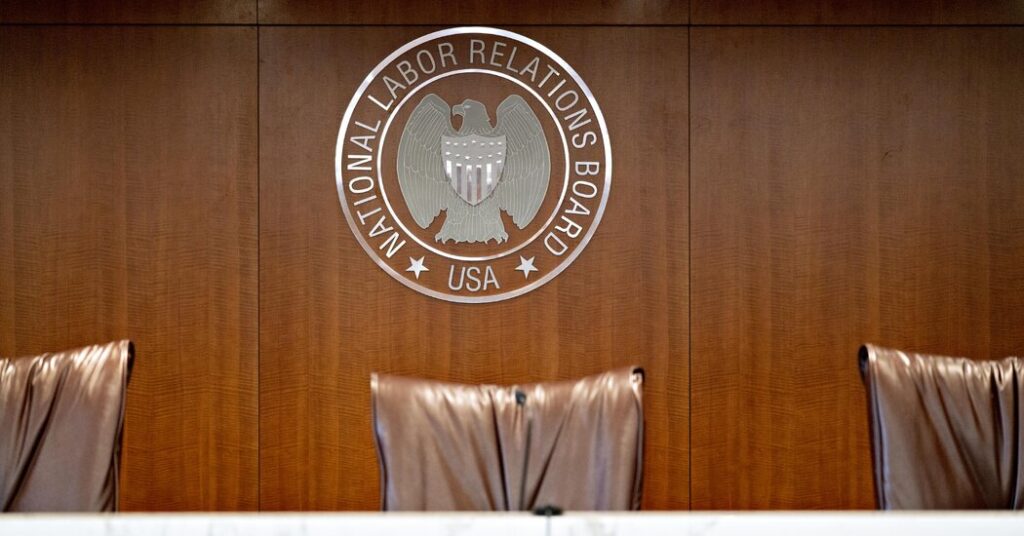
The agency charged with overseeing U.S. labor relations has been largely sidelined for the past year, mired in a legal limbo that has delayed the handling of major cases and fueled deep uncertainty about the future of federal labor law.
The agency, the National Labor Relations Board, has for months had merely a single member on its five-seat board, two short of the required number to hear cases. Even if the vacancies are filled — the Senate could vote to confirm two nominees from President Trump as soon as this week — the board could fundamentally change if the Supreme Court rules in coming months that the president has wide powers to fire appointed officials at federal agencies.
“The inability of the board to function for the last year has highlighted, for people who care about labor relations in this country, how broken the system is,” said Lauren McFerran, a Democrat and former chairwoman of the N.L.R.B. “Anyone could have seen this coming, but a year of nonfunctional labor law is a crisis point.”
In one case, which grew out of unfair labor practice claims against SpaceX and two other companies, the U.S. Court of Appeals for the Fifth Circuit ruled in August that the N.L.R.B.’s structure was unconstitutional, and granted the companies an immediate hold on the cases against them. This means that labor law is effectively unenforceable in Texas, Louisiana and Mississippi, which make up the circuit.
With the N.L.R.B.’s future uncertain, New York and California have moved to strengthen their own labor oversight agencies, prompting legal challenges by the N.L.R.B. and Amazon, moves supported by trade groups.
“There is no room for parallel or complementary state legislation,” said William B. Cowen, the labor board’s acting general counsel.
Mr. Cowen said the agency remained effective despite the lack of a sitting board, because the vast majority of cases are resolved in earlier stages. In the 2024 fiscal year, according to the board’s data, regional offices settled 96 percent of cases that advanced past filing.
“I’m not saying that what the board does is unimportant. It’s very important. They decide the most important, the most contentious issues,” Mr. Cowen said. “It is a very small percentage.”
But for many labor leaders and workers’ advocates, it isn’t just the board’s stalemate that is upsetting — it is the potential loss of political independence. A likely outcome of the legal wrangling, some fear, is a federal labor agency that is ineffective and beholden to the president, but also has pre-emptive authority over any state body.
“Unions will turn to other tools of self help,” Ms. McFerran said. “All the state activity is a response to a larger problem: It is an effort to address this growing tidal wave of a crisis.”
For decades, the N.L.R.B. has been hampered by underfunding and, some labor leaders argue, a lack of meaningful enforcement authority. Partisan appointments regularly changed the board’s composition and priorities, but the board had remained independent.
Then, in January, Mr. Trump fired Gwynne A. Wilcox, a Democrat, the first time in the board’s 90-year history that a member was removed. Earlier this year, the Supreme Court held that her firing was lawful; its impending decision in a case related to a removal at another agency could establish that executive authority as law.
As Ms. Wilcox’s case wound through the courts, and with the N.L.R.B. inactive, Gov. Kathy Hochul of New York signed a law in September that significantly expanded the powers of the state’s labor relations agency.
“While the Trump administration has failed to prioritize a strong National Labor Relations Board and is dismantling unions left and right,” Ms. Hochul, a Democrat, said at the time, “here in New York we are taking strong action to protect worker rights and sending a clear message that we will always have the backs of New York’s workers.”
Soon after, the N.L.R.B. sued New York in federal court in Albany.
The board has also sued California, which in September passed a law expanding the authority of its own labor board. The statute, which is set to take effect in January, allows the state agency to conduct union elections and take action in unfair labor cases if the N.L.R.B. doesn’t act.
“We need to step in if the federal government is not doing its job, because the consequences are real for the State of California,” said Felix De La Torre, the state public employment board’s general counsel.
Mr. Cowen, the acting general counsel of the N.L.R.B., said the states are acting in part because “they don’t like the decisions the board has been making.”
In a brief filed in the California lawsuit, a coalition of business groups argued that allowing a state agency to have jurisdiction over labor matters previously reserved for the N.L.R.B. “threatens to dismantle this coherent national framework Congress established to regulate private-sector labor relations.” Not only, they said, would this undermine the federal board but it would create a “patchwork of conflicting state regimes, destabilizing labor markets across the country.”
The states’ interventions also provided new forums for a simmering labor dispute between Amazon and the Teamsters union, which has sought to organize the company’s warehouse workers. The Teamsters have intervened in the cases on the side of the state labor boards, arguing that the N.L.R.B. was weak and ineffectual.
Amazon sued New York after the Teamsters sought remedy from the newly empowered state board in a dispute stemming from an organizing campaign in Staten Island. Last month, a federal judge in Brooklyn ruled in Amazon’s favor, preventing the New York board from enforcing the law.
Although Amazon’s lawsuit in New York argued for the legal supremacy of the N.L.R.B. over the state, in other lawsuits, Amazon and other companies have questioned the authority of the N.L.R.B. itself. They have argued that the board has overstepped its authority and said that the N.L.R.B.’s structure is unconstitutional.
“All we’re asking is for both the N.L.R.B. and the states to follow the law,” an Amazon spokeswoman, Eileen Hards, said. “In the case with the N.L.R.B., they were acting as both the prosecutor and the judge — which makes little sense and is unconstitutional on its face. And in New York, the state tried to overreach and get involved in a federal law issue — which states aren’t allowed to do.”
This year, the N.L.R.B. dropped its legal objections to arguments that its board members and judges were protected by tenure, a significant move in light of the Fifth Circuit ruling. Mr. Cowen said that if the Supreme Court rules to take away removal protections, the agency is prepared to “move ahead as usual.”
After several months, both of Mr. Trump’s two nominees for N.L.R.B. membership were voted through a Senate subcommittee, setting up a full vote as soon as this week that would re-establish a quorum on the panel.
“There’s a lot of drama about this, but this issue is not going to persist forever,” Mr. Cowen said. “It’s going to the Supreme Court, and the Supreme Court is going to decide.”
Rebecca Davis O’Brien covers labor and the work force for The Times.
The post Trump’s Cuts to U.S. Labor Board Leave Festering Disputes and a Power Struggle appeared first on New York Times.