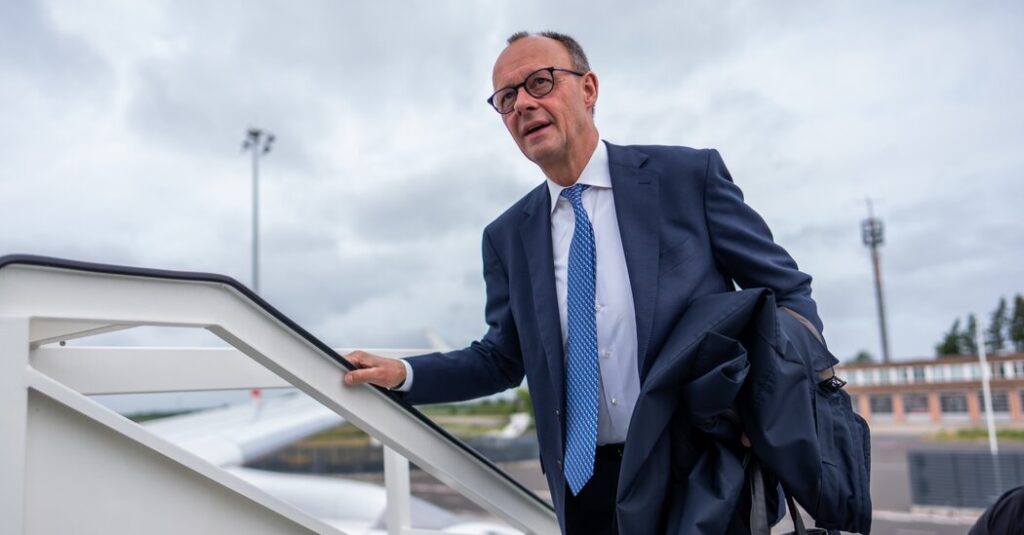
The plane ferrying Friedrich Merz to Berlin looked as if someone had spruced up Air Force One and then shrunk it in the wash.
It was painted white, with the gold, red and black of the German flag blazed across the side like a racing stripe. The cabin was paneled in dark, laminated wood and fitted with wide leather seats. Mr. Merz, the German chancellor, nestled into one, newspapers stacked on his lap.
As is customary with new chancellors, Mr. Merz had to give up driving when he took office in May. But he is a licensed pilot, and midflight he told me that he was, somehow, still allowed to take a plane up some days. This plane? No, he said. It was larger than the ones he was licensed to fly.
For some Europeans, that might seem like a metaphor. In seven months in office, Mr. Merz has emerged as the closest thing Europe has to a political pilot in an extraordinary time of upheaval, including a reversal in relations with the United States.
But the continent, and his country, need him to fly even higher.
Europe is caught between a militarily aggressive Russia and a rhetorically hostile American administration that no longer wants to guarantee European security. The German economy, Europe’s largest, is wobbling. Its politics, once a model of stability and consensus, have fractured. Mr. Merz’s political center is threatened by an ascending far-right party, which now leads some national polls and which appears to be the preferred partner for many in the Trump administration.
Mr. Merz’s leading role in confronting those challenges will be on display this week. On Sunday and Monday he hosted negotiations between Volodymyr Zelensky, the president of Ukraine, and two envoys from President Trump, Jared Kushner and Steve Witkoff, in hopes of reaching a peace agreement that Europe and Ukraine can accept. On Monday evening, a large group of European leaders will join the negotiators in Berlin for a dinner.
Later in the week, critical debates loom in Brussels over funding for Ukraine’s army and a trade agreement that could boost German growth.
Mr. Merz remains confident he can navigate it all.
The chancellor, 70, is a conservative Christian Democrat, a combative old-school politician and a former corporate lawyer. He is betting on a throwback form of leadership and, in some ways, a throwback vision of consensus-driven democracy in Germany, Europe and even the United States.
More than anything, he is betting he, personally, can broker the agreements needed to build a safer, more prosperous Europe, most important with Mr. Trump.
Mr. Merz’s approach is being severely tested. He has lost support at home since taking office in May. His courtship of Mr. Trump has mostly minimized damage to Europe on issues like trade and the war in Ukraine thus far.
But Mr. Merz remains the strongest leader standing among Europe’s major powers, especially now that President Emmanuel Macron of France and Prime Minister Keir Starmer of Britain are faltering domestically. He is emerging as Europe’s indispensable leader — or at least, acting like it.
When Mr. Trump’s negotiators stunned Europe by reaching a Moscow-friendly agreement with Russia to end the war in Ukraine, Mr. Merz was the first continental leader to get Mr. Trump on the phone and push back.
Mr. Merz still believes he can coax Mr. Trump to break decisively from Vladimir V. Putin, the Russian president.
“I remain hopeful that we will permanently convince the United States and win them over to end this war together with us in Ukraine,” he told me. “That means we must support Ukraine until Russia can no longer continue this war economically. That is the only option we have.”
A Deal Maker
Since becoming chancellor in May, Mr. Merz has helped lead a flattery-forward European approach to dealing with Mr. Trump.
Visiting the White House in June, Mr. Merz brought Mr. Trump a framed copy of the birth certificate of the president’s German grandfather. The chancellor bragged that his personal BMW — the one he is currently not allowed to drive — was built in South Carolina.
Those who know Mr. Merz say the bonhomie reflects not only a familiar formula for dealing with Mr. Trump but also Mr. Merz’s genuine affection for the United States. It is an affinity that has shaped his worldview.
Since the early 1980s, Mr. Merz has maintained an annual ritual of visiting America, something that endured until the Covid-19 pandemic. For a decade, he served as chairman of the Atlantik-Brücke, the premier nonprofit association fostering ties between America and Germany.
Through those years, Mr. Merz made regular visits to the White House under multiple presidents, and also met with governors and local lawmakers in states like North Carolina and Oklahoma.
“This friendship is really deep” between Mr. Merz and America, said David Deissner, who worked alongside Mr. Merz at the Atlantik-Brücke. “He really feels it.”
Mr. Merz has also been shaped, and made wealthy, by his years in corporate law, dealing in mergers and acquisitions. Friends say Mr. Merz approaches the chancellorship as a businessman, sizing up negotiating partners and seeking to cut deals.
Mr. Merz made the comparison himself in our conversation on the chancellor’s plane as he returned this fall from Europe’s largest auto show, in Munich.
Like Mr. Trump, he told me, “I am building much more on personal relationships than on relationships with a country.”
His chancellorship has been shaped heavily by his investment in a relationship with Mr. Trump. The men regularly text and call each other, officials on both sides of the Atlantic said.
Mr. Trump has reciprocated, at least superficially, even as he calls European leaders in general “weak” and his administration pines for far-right partners in Europe. The White House press secretary, Karoline Leavitt, said in an email, “President Trump has great respect for Chancellor Merz and appreciates his friendship very much.”
Still, time and again, Mr. Merz has watched Mr. Trump swerve back toward versions of a peace plan that would heavily favor Russia — and has then tried to talk the president out of them.
Most recently, he has urged Mr. Trump to approach Russia and Ukraine not as an opportunity for profit but as a long-running war that must end in a lasting peace.
During his election campaign, Mr. Merz publicly questioned the future of American democracy under Mr. Trump’s leadership. Yet throughout our conversation, Mr. Merz expressed hope that America would return to its postwar tradition of supporting Europe and democracy.
Pragmatic and Patient
Mr. Merz is the product of a bucolic corner of western Germany called the Sauerland and of the party system, once safe and stable, that long dominated German politics. But his rise to become leader of one of Europe’s most important nations was long and halting.
By his own account, he had a rebellious youth, smoking and drinking with friends from age 14 and forced to transfer high schools after a string of disciplinary violations. He calmed in the early 1980s, after starting a family. He and his wife, Charlotte, have three children.
Today, Mr. Merz bears the scars of the repeated political failures he suffered before finally winning the chancellorship.
In 1989, he was elected to the European Parliament in Brussels. He began quickly climbing the ranks of the center-right Christian Democrats. But his expanding ambitions were blocked by Angela Merkel, who defeated him for the party’s chancellor nomination in the early 2000s. She went on to hold the job for 16 years.
Trained as a lawyer at the University of Bonn and at Philipps University of Marburg, Mr. Merz immersed himself in the world of business as a partner at the multinational law firm Mayer Brown. He held board seats for financial giants like HSBC and BlackRock.
He re-entered politics when Ms. Merkel prepared to leave the stage in 2018. He twice campaigned to replace her as party leader, promising a lurch to the right on immigration and other issues.
Both times, he lost.
Mr. Merz tried a third time, in 2022, after his party had lost the chancellorship in an upset. He softened his tone, courted support further along the party’s ideological spectrum and won.
The experience seems to have taught Mr. Merz pragmatism and patience. He has governed as a deal-maker, sometime to his own supporters’ chagrin.
Optimistic Under Pressure
Mr. Merz led his party to victory in February’s elections by promising to curb migration, to revitalize the economy and to reinvigorate the military. He has since been a disrupter of German taboos — about government spending and about a strong German military in Europe.
The chief complaint about him is that he has been slow to deliver results, despite those efforts.
Mr. Merz got an earful in September when he addressed a meeting of the VDMA, a trade group representing German machine manufacturers, over the pace of his economic plans.
“The direction which the government walks is OK,” Bertram Kawlath, the group president, said in an interview. “But the speed is not OK.”
Many business leaders and economists complain Mr. Merz has watered down plans to appease his governing partners, the center-left Social Democrats. He has struggled to hold his narrow majority together on difficult votes over judicial nominations and changes to public pensions.
Mr. Trump has proved even more difficult to persuade. Mr. Merz has been reluctant to pressure the president on his trade policies, which hurt Germany’s export-driven economy. He fears retaliation, and his advisers say he harbors no illusions that he can change Mr. Trump’s mind.
Mr. Merz knows time is running out to recharge economic growth. The far-right, populist party Alternative for Germany, or AfD, has gained some ground with appeals to economically distressed voters.
Still, the chancellor remains optimistic.
During the half-day when I followed him through the auto show, Mr. Merz bounded through exhibits like an exuberant salesman, beaming over the latest advancements in electric vehicles and self-driving cars.
Business leaders said in a private meeting, he was energized and upbeat about German industry, despite its prolonged slump.
On the flight back to Berlin, Mr. Merz elaborated on his plans to revive the economy, his love of America and his connection with Mr. Trump. He never wavered in his conviction that all would work out: the economy, German politics, the war.
Perhaps that is what you expect from a man who spent his life grinding toward a goal and then finally reached it.
As we prepared to land, the chancellor told me about how he still flew his private plane. I asked how long that might last.
“In Germany,” he said, “they say, ‘Fly until the doctor comes.’”
Jim Tankersley is the Berlin bureau chief for The Times, leading coverage of Germany, Austria and Switzerland.
The post The Turbulent Times of Friedrich Merz appeared first on New York Times.