It was the kind of Sunday evening cherished by the Sydneysiders who call Bondi Beach home: groups of friends lolling in the sand, surfers in dripping wet suits trudging back aground, gleeful children tittering to the backdrop of soft crashing waves.
On a grassy park with a playground on one end of the beach, a well-worn tradition was underway — an annual beachside Hanukkah celebration, where hundreds of people, from toddlers to grandparents, enjoyed the first night of the festival of lights with music, face painting, a giant menorah and barbecue.
Around 6:30 p.m., a grayish hatchback pulled up nearby. Two figures dressed in dark shirts emerged. They were toting long-barrel guns and took position on an elevated footbridge overlooking the party. A series of rapid-fire pops rang out that a few recognized as gunshots. But many others thought they must be firecrackers — this being Bondi Beach and Australia, the alternative was unthinkable.
Within seconds, as the realization spread that bullets were raining on them, panic took hold. A young mother grabbed her 17-month-old baby and dove under a metal barbecue grill. Another woman shoved aside plastic chairs and pushed her 26-year-old daughter and octogenarian mother to the ground.
“It just didn’t stop,” said another woman who was at the event, who only gave her name as Pearl. “We were so targeted in that little space. We were like sitting ducks.”
Across the street, Kaitlin Davidson, a 28-year-old nurse, saw the two gunmen on the bridge directly out the window of her ground-floor apartment.
“They just kept reloading,” she said. “They had a ridiculous amount of ammunition and multiple guns.”
On Monday, the authorities said that the two gunmen had been a father-son pair, 50 and 24 years old. The police raided two homes connected to the men, but much remained unclear about how and why they carried out the worst mass shooting in Australia in nearly three decades. What was evident was that they had targeted Jews, a community already on edge because of an alarming rise in antisemitic episodes in Australia.
The younger man had been on the authorities’ radar since 2019, but there was “no indication of any ongoing threat or threat of him engaging in violence,” Prime Minister Anthony Albanese said on Monday.
By the time it was over, 14 were dead at the scene, including the older gunman. Two other victims, including a 10-year-old girl, who had been taken to hospitals died there, the police said on Monday.
The 10 or so minutes of dozens of rounds of gunfire turned the half-mile span of Bondi Beach into a scene out of a disaster movie, as droves of beachgoers, tourists and passers-by scattered and sprinted in every direction, jumping over cars and scaling concrete walls, leaving behind sandals, phones, bags and many, many colorful beach towels.
A few officers who arrived within minutes began firing at the gunmen, but their handguns seemed outmatched by the firearms carried by the shooters, a witness said.
Benjamin Holzman, 42, who was at the event with his wife and 5-year-old daughter, said the shots fired by police sounded like small pops, compared to the blast of the attackers’ guns, which he said “almost sounded like a missile.” Police did not specify what weapons were used in Sunday’s shooting but said the older suspect was a licensed gun owner, who had six legally registered firearms.
Mr. Holtzman said his family hid behind a pole about a foot wide. Nearby, he said, another parent tried to console their toddler by quietly telling the child a story.
At some point, one of the shooters walked off the bridge and moved even closer to the gathering. He was near a row parked cars when a bystander, identified later as Ahmed el Ahmed, tackled him, knocking him down and disarming him. The gunman retreated back to the pedestrian bridge.
There both shooters eventually appeared to fall to the ground. When the gunfire stopped, Ms. Davidson ran across the street to help, identifying herself as a nurse. On one side of the bridge, she saw a policewoman who had been shot on her bulletproof vest. Ms. Davidson pulled it off the officer and found she wasn’t seriously hurt. Then, someone led her to the other side, where she saw what the gunmen had been firing at.
“It was a war zone,” Ms. Davidson said.
People had been shot in the legs, buttocks and shoulders. There were people who had been shot in the back, seemingly while running away, she recounted.
Across a narrow walkway from the playground, dozens of lifeguards who had gathered for their surf lifesaving club’s annual Christmas party were watching the situation.
“It sounded like it was all around us. There was a massive amount of fear,” recalled Ben Ferguson, a volunteer lifeguard. Someone in the club yelled out, “Oh, my god, he’s reloading,” he said.
Almost as soon as the gunfire stopped, before anyone knew about the gunmen’s whereabouts, a lifeguard with a military background ran out to usher children to safety in the clubhouse, Mr. Ferguson said.
Glancing out the window and seeing the exposed people still on the grass, Mr. Ferguson said he was overwhelmed with “a massive amount of guilt,” and he and others ran out to help. They used rescue boards as stretchers and brought over as many towels as they could from the clubhouse to serve as tourniquets.
“The first 15 minutes were delirium,” Mr. Ferguson said. He said the surf lifesaving community draws people who are naturally empathetic, and everyone felt compelled to help.
David Smith, 25, a volunteer with Community Health Support, a Jewish organization that responds to those in medical need, was dispatched by the group to the scene of the shooting.
He went from patient to patient, assessing their injuries and tagging them based on the priority of their medical need — red for the most urgent, which included more than 20 victims. People were screaming, and children were looking for their parents, he recalled, as some of the injured cried out, exclaiming that they had done nothing to deserve this.
Because of how tight-knit Bondi’s Jewish community is, Mr. Smith knew three of the dead and three of the injured who were still in the hospital, he said. The tragedy was all the more surreal because the scenic beach has been the backdrop to his everyday routines, he said.
“This is my morning run, this is my afternoon swim,” he said.
For hours, the makeshift crew of paramedics, police, lifeguards and scores of others who rushed toward the scene instead of away from it worked to stabilize victims and put them into ambulances. A cluster of bloodied rescue boards sat overnight in the center of the park, now a cordoned-off crime scene.
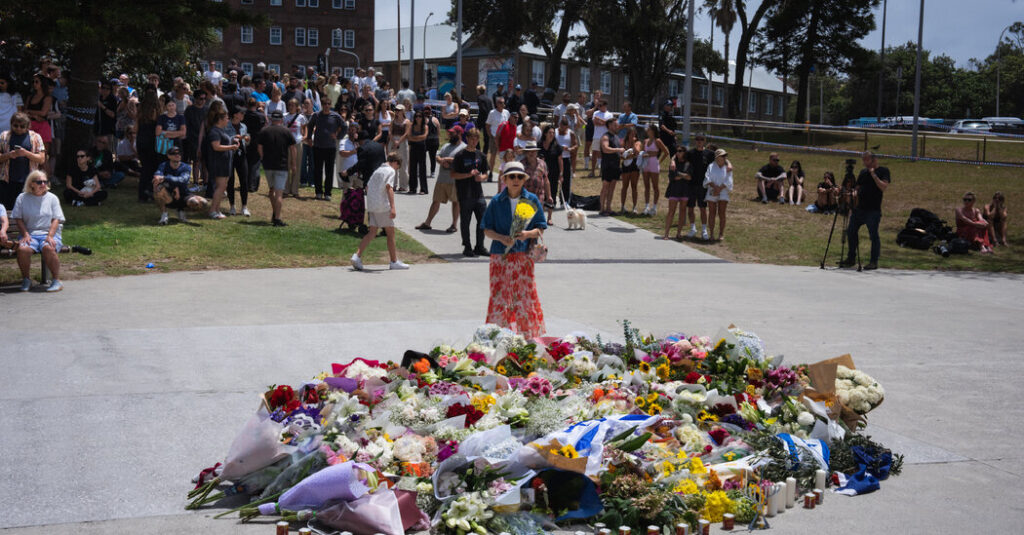
On Monday morning, groups of locals walked down to the beach still trying to make sense of the senseless.
Yvonne Haber, an architect who has lived in Bondi for three decades, said the attack was all the more painful because the beach had been at the core of Sydney’s Jewish community ever since the first refugees fleeing the Holocaust settled there after World War II.
“Bondi has often been a place where Jews come to be a community together,” said Ms. Haber, 62. “This is our worst nightmare.”
Victoria Kim is the Australia correspondent for The New York Times, based in Sydney, covering Australia, New Zealand and the broader Pacific region.
The post The Panicked Moments When a Beach Celebration Became a ‘War Zone’ appeared first on New York Times.