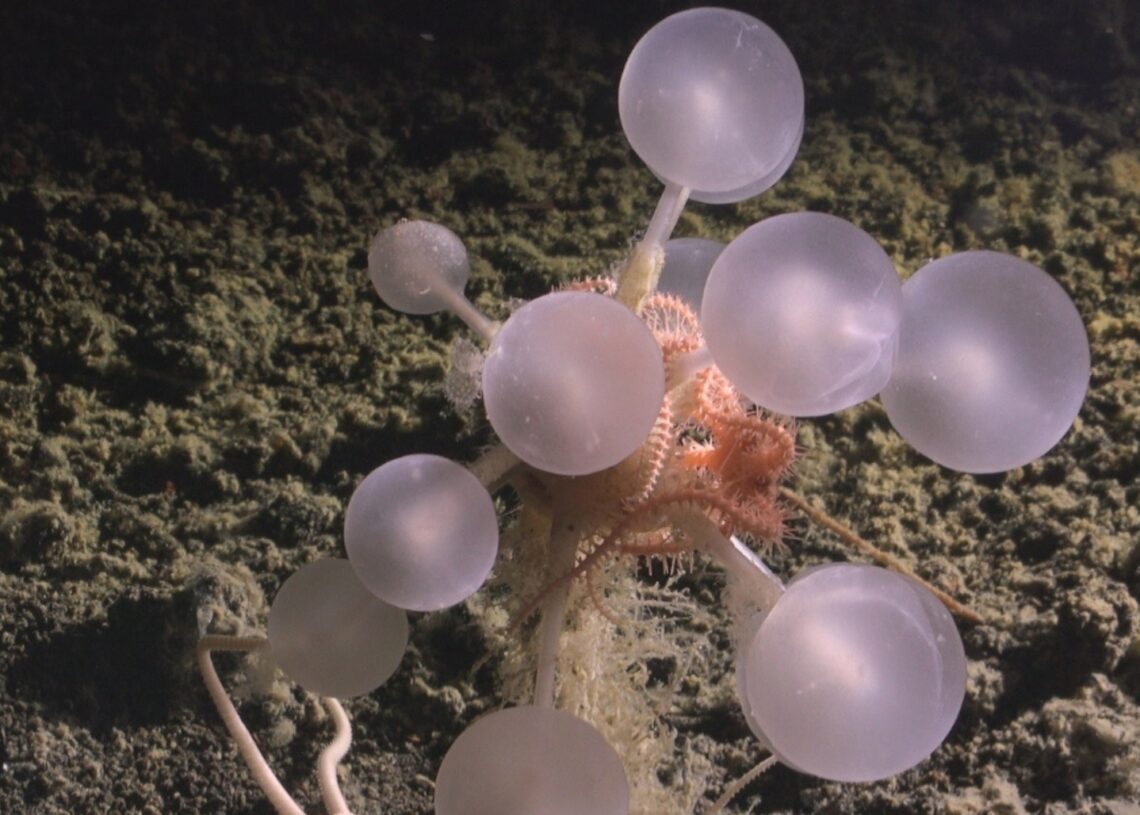
Sponges aren’t supposed to be scary. They don’t hunt, chase, or bite. We think of them as puffy shower accessories or how we clean our dishes. Instead, scientists in the Southern Ocean found one that eats meat.
Among 30 newly identified species announced by the Nippon Foundation–Nekton Ocean Census is a carnivorous sponge researchers have nicknamed the “death-ball.” It resembles a cluster of fleshy bubbles attached to thin stalks, an appearance that feels sorta cute and playful until you learn how it feeds.
The sponge is part of the genus Chondrocladia, a type of sponge that has left behind the typical filter-feeding way of life. These sponges do not just filter particles from the water like most others. They trap prey instead. Their surfaces are covered in tiny hooks that grab passing creatures in the deep ocean. Once the prey is caught, the sponge slowly breaks it down and absorbs it. No chasing, no biting, just patience.
Meet the Meat-Eating ‘Death Ball’ Sponge, the Deep Sea’s Newest Nightmare
The death-ball sponge was spotted earlier this year by the remotely operated vehicle SuBastian at a depth of roughly 3,600 meters, nearly 12,000 feet below the surface. The location was a trench east of Montagu Island in the Southern Ocean, one of the least explored regions on Earth. That remoteness is part of the appeal. Places like this still produce creatures that feel genuinely unfamiliar.
The expedition delivered more than one unsettling find. Scientists also documented new species of scale worms coated in iridescent armor, along with unfamiliar crustaceans and sea stars. The team captured the first recorded footage of a juvenile colossal squid and explored a newly exposed ecosystem that had been sealed beneath a massive Antarctic iceberg before it broke free.
The discoveries barely scratch the surface of what was collected. According to the Ocean Census team, fewer than 30 percent of the samples gathered during the expedition have been fully analyzed.
“The Southern Ocean remains profoundly under-sampled,” said Michelle Taylor, Head of Science at the Ocean Census, in a statement. “Confirming 30 new species at this stage shows how much biodiversity is still undocumented.”
That point lands harder each time scientists send cameras into the deep. The ocean floor keeps producing organisms that challenge assumptions about what life looks like and how it survives. Even animals long dismissed as simple or harmless turn out to have a darker edge.
All confirmed species from the mission will be added to an open-access database, joining a growing catalog of life forms most humans will never encounter firsthand. The death-ball sponge exists outside the rules we tend to project onto nature.
The post The Meat-Eating ‘Death-Ball’ Sponge Is the Deep-Sea’s Creepiest New Creature appeared first on VICE.