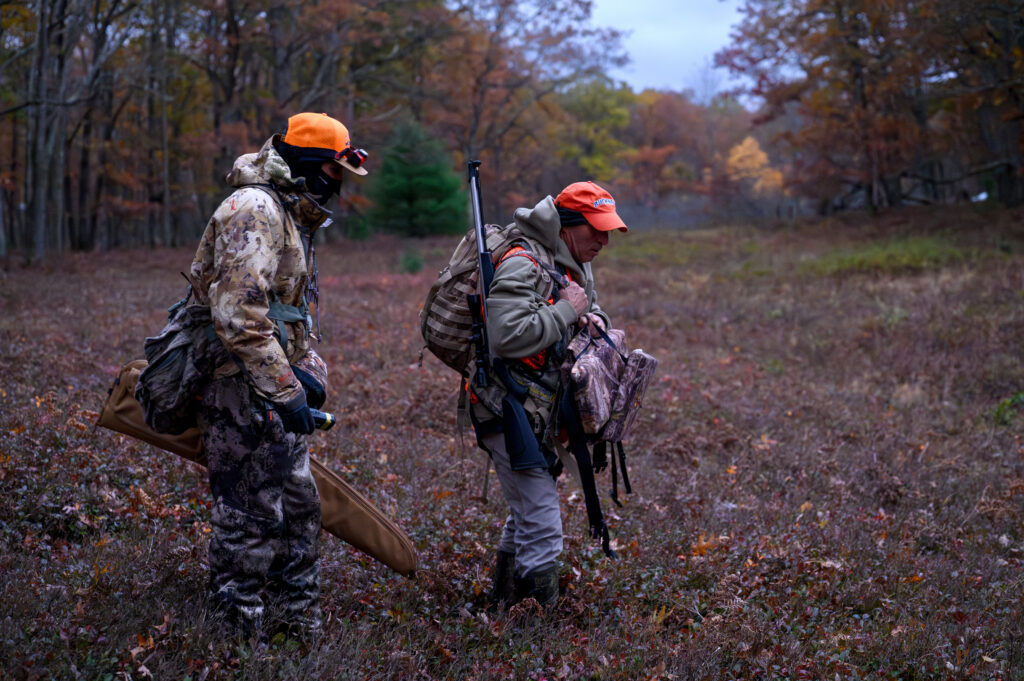
POTTER COUNTY, Pa. — Signs reading “Welcome to God’s Country” greet anyone who enters this Pennsylvania Wilds county. The signs are as much a declaration as a slogan, reminding locals and visitors: You have entered a place that reveres the circle of life, a breathtaking terrain filled with wildlife and a scattering of small towns situated in forested mountains and farm fields atop the central Appalachian plateau.
Jim Kjelgaard, author of “Big Red,” the iconic 1945 book about a young boy and his dog in the wilderness, grew up here. Outdoor enthusiasts journey to the area for many reasons: amateur astronomers to some of the darkest skies on the East Coast; hikers to the 83-mile Susquehannock Trail System; anglers to endless pristine trout streams. In 2024, visitors spent more than $2 billion in the 13-county Wilds region of north-central Pennsylvania.
One of the most cherished reasons to visit “God’s Country” is to hunt. People venture here from across the state and country to be part of something few truly understand: bear camp.
Bear camp is about much more than hunting, and for anyone trying to understand Pennsylvania politics, it’s essential. It sits at the crossroads of rural and urban, illuminating Pennsylvanians’ sense of place and their traditions that transcend profession and party.
With the most electoral college votes of any of the nation’s swing states, Pennsylvania’s lack of affiliation to political parties and stubborn refusal to fit nicely into pigeonholes promise to confound pundits.
Voters here turned out robustly for Barack Obama in the 2008 presidential election, less so in 2012, flipped to Donald Trump in 2016, voted for Joe Biden in 2020 and again backed Trump in 2024.
In between those whipsaws, voters enthusiastically elected governor Josh Shapiro, a Democrat from Montgomery County who earned a respectable number of Trump voters. In July, Shapiro signed a bipartisan bill repealing the state’s long-standing ban on Sunday hunting, providing more flexibility for hunters and boosting the rural economy.
Pennsylvania’s U.S. senators, Republican David McCormick and Democrat John Fetterman, own guns and have hunted deer.
Consistency at the ballot box isn’t nearly as meaningful to many voters here as it might be to politicos who scrutinize election patterns. That’s why it’s important to learn about bear camp. It is emblematic of what makes voters in this state tick — because the core principles animating bear camp are not political and because it exemplifies the blurring of traditional demographic categories.
Bear camp is not made up of people who “cling to their guns,” a comment made by Obama in 2008 about Pennsylvania’s small-town voters. He later acknowledged it was poorly phrased, saying he meant to convey that many of the state’s voters expressed their anxiety over job losses by focusing on cultural issues such as gun laws and immigration. Obama nevertheless won the state, though his walk-back still misread why people hunt and own guns.
Despite a range of differences, the residents here come together to be part of something dangerous and meaningful. Democrats, Republicans and independents can all gather at one camp — and not only get along but also work toward a common goal. People like them will influence the composition of the next Congress and ultimately decide the next presidential election.
David Cunningham arrived here weeks before bear muzzleloader season began in late October to track bear movements, clear the cabin and stock firewood. The retired Pittsburgh firefighter said Potter County is the last place he expected to find himself visiting while growing up in Pittsburgh’s Glen Hazel projects in the 1970s.
The self-admitted “wild street kid” lived in the shadow of Pittsburgh’s last steel mill then. He’s 67 now, a father of four with the energy of a man half his age.
How did he get here?
“I don’t want to sound corny, but it was something that was calling me,” he explained. “It was something that I just felt a huge interest in, but no one in my family hunted, not my dad, none of my relatives.”
When he hit his 20s, Cunningham buddied up with a couple of guys who hunted, borrowed a gun, went to Butler County and got his first deer. “I was hooked,” he said. “It fed my family, and I felt connected to the land.”
Some of the people who come to bear camp are related by blood, some are longtime friends, some are first-timers. When they arrive, they bond as a community to hunt the American black bear.
Two dozen men were part of Cunningham’s bear camp this year. Some are in their early 20s; Cunningham is now the elder of the group. It is run with military precision; everyone has a specific role. That includes meals, with each contributing culinary skills to make feasts that feed 24 men who often have walked 10 miles per day as part of the hunt.
Cunningham and his former boss, Mike Huss, who was the fire chief in Pittsburgh, brought the skill of feeding many and feeding them well.
“I was accustomed to that at the fire department,” Cunningham said. “We ate together, we fought fires together, and I said, ‘Well, this is a missing component of this bear camp.’ We’re together as a team, we’re a unit, but the meals — which are very important — were kind of dysfunctional.”
They raised some money, built a new kitchen at the camp and started planning meals.
Keeping the camp thriving and attracting younger hunters is a testament to their unwillingness to let this tradition slide like so many others have in the digital age. For 40 years, this camp has not only survived, it has grown and prospered.
So has bear hunting in Pennsylvania.
2024 marked the sixth straight year that bear license sales topped 200,000, according to the Pennsylvania Game Commission. Hunters in 2024 harvested 2,642 bears in 56 of the state’s 67 counties. On Nov. 22, a bear was bagged in Butler County weighing over 700 pounds, so far the largest of the 2025 season.
“None of this would have happened had it not been for Dr. Gary Alt, who introduced the most sweeping changes to bear management policies in the history of Pennsylvania,” Cunningham said. Among his accomplishments, the former PGC bear biologist established bear hunting licenses, regulated seasons and placed management units and check stations for data collection.
Alt, who retired from PGC two decades ago, is beloved among bear hunters for his work from 1977 through the early 2000s in bringing back a thriving population of black bears to the state. Much of the state’s forests had been cleared in the late 1800s, and around 1900, Pennsylvania began converting the land to farm use.
“The bears had nowhere to go. They need the woods, the forestland,” said Alt, who grew up in Lackawanna County and netted his first bear at age 14 in swampland on his family’s farm.
The black bear recovery effort grew the animal’s population in Pennsylvania from around 4,000 in the 1970s to 18,000 now, and the bear range expanded from around 12 counties to more than 50 in the same time frame — with Potter County being the gem of them all.
Clay Newcomb, a seventh-generation bear hunter from Arkansas and host of the popular “Bear Grease” podcast, said the bear camp tradition, which dates to Daniel Boone and long before that with Native American tribes, is one of purpose.
Those who believe hunting is a bunch of yahoos shooting guns for a trophy don’t comprehend the science, conservation ethic and basic component of stocking the pantry.
“We use more of a black bear than we use of any other game animal in North America,” Newcomb said. “We use black bear hides or tans. We use the meat, and we render the fat into grease.”
For centuries, bear grease was a valuable commodity on the American frontier, Newcomb said. “Some of the first Europeans that came to America, they were trying to figure out what products that they could send back to Europe from this new place, and a lot of American black bear oil was shipped over to Europe for hundreds of years,” he said.
Today it is used much in the same way as beef tallow in cooking. Most hunters at a bear camp let nothing waste; the harvested bear is processed nose to tail.
Cunningham said this method of wildlife management keeps habitats stabilized. It also preserves a vital attribute of Pennsylvania culture.
“Oftentimes people believe politics define us,” Cunningham said, adding, “well they don’t.” He said the bear camp includes union guys, executives and firefighters like him, with each holding varying political views.
Cunningham, who spent 30 years as a Democrat, switched to the Republican Party when Trump ran for president in 2016. He’s voted for Trump three times but stresses that isn’t his identity.
“For many people in Pennsylvania — whether it is hunting or farming or whatever your pastime is — traditions are often more defining as to who you are than whatever is happening in American politics,” he said. “And a lot of times, we don’t realize that our traditions, like the bonds that are formed here, shape us more than what is consuming the rest of the world in politics. I think that’s why a lot of people don’t understand Pennsylvanians.”
Potter County is a land of headwaters. There is a special hilltop not far from camp, a farmer’s hayfield, where rainfall runs off into three watersheds: Some of it goes into the Susquehanna River and flows south into the Chesapeake Bay. Some runs north into the Genesee River, which begins here, and flows through New York to Lake Ontario, the Gulf of St. Lawrence and the Atlantic Ocean. And some runs west into the Allegheny River, which also begins here, and down to Pittsburgh, to the Ohio, Mississippi and the Gulf of Mexico.
Potter County sends its water to the whole eastern half of the country, to tiny towns and big cities that have all kinds of differences — historical, cultural, political. But when you stand at the source, up on that field, and you get back to bear camp, the differences aren’t important.
That, said Cunningham, is the elusive thing that people miss about Pennsylvanians and the traditions that bind them.
“The political differences don’t matter, and they sure don’t define our day-to-day life,” he said. “We find purpose in so many other things, and bear camp is one of them. Honestly, it is a lot of what my identity is, and if you are trying to figure out who people are, you have to ask a lot of questions and be very curious to get to what happens at bear camp.”
The post The hunting tradition that explains Pennsylvania’s wild politics appeared first on Washington Post.