The Trump administration strategy of blowing up suspected drug-smuggling boats, already criticized by many legal experts as illegal, became even more controversial after The Post reported that, during the first such strike, U.S. forces had killed survivors clinging to their boat’s wreckage. Congress is now demanding the release of unedited Pentagon footage of the attack — a request that the Trump administration is stonewalling.
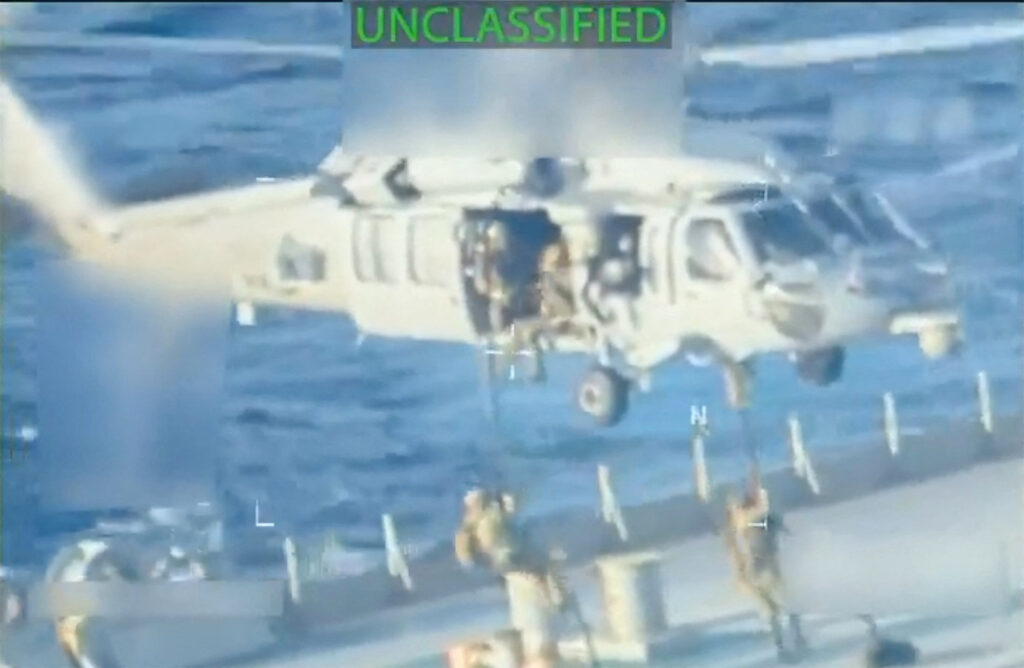
Perhaps it’s just a coincidence that the rate of U.S. boat strikes seems to have slowed down: There have been only two such attacks since mid-November. But now the Trump administration has opened another front in its war against the Nicolás Maduro regime: U.S. forces last week seized a large oil tanker off the coast of Venezuela, and the administration has vowed to commandeer more tankers.
Legal experts I’ve spoken to suggest that the oil tanker seizure, while controversial, has a stronger legal justification than the boat strikes. The tanker confiscated last week was flying a Guyana flag, but Guyana said there was no record of the ship’s registration, which makes it a stateless vessel. The tanker has also been implicated in violating sanctions on both Venezuela and Iran. That could give the U.S. government the right to seize it under American law.
Capturing oil tankers is likely to do far more damage to the Maduro regime than blowing up drug boats. Maduro and his henchmen may profit from the drug trade, but the revenue being reaped by drug cartels, and hence by corrupt Venezuelan officials, is not going to be dramatically affected by the loss of a few speedboats. The seizure of oil tankers is different because Venezuela relies so heavily on oil exports.
According to the Wall Street Journal, the tanker seized last week carried roughly $80 million of oil, or about 5 percent of what Venezuela spends monthly on imported goods. The prospect of more such seizures could lead shipping companies to cut off Venezuela, thereby plunging that country into a fresh economic crisis. Francisco Rodriguez, a Venezuelan economist at the University of Denver, told The Post that the result could be a “a very deep recession.”
The Trump administration seems to imagine that such a crisis could force Maduro from power. But plenty of other despots, such as Fidel Castro, Kim Jong Un and Ayatollah Ali Khamenei, have survived the impoverishment of their people. Maduro has done it himself. The Venezuelan economy has been in free fall for more than a decade, a trend exacerbated by U.S. sanctions; gross domestic product has declined by roughly two-thirds since 2012. (By comparison, U.S. GDP during the Great Depression fell by less than a third.) Yet Maduro appears more firmly entrenched in power than ever, with some describing him as “coup-proof” because of his purges of the military and the viciousness of his security forces.
What makes Trump & Co. think that more economic pressure will topple Maduro? The more likely outcome is to exacerbate the very crises that Trump has cited as the reasons for his actions. With typical hyperbole, Trump claimed that Venezuela has “emptied their prisons into the United States of America” and that “we have a lot of drugs coming in from Venezuela.” There is a germ of truth here: Venezuela is implicated in smuggling drugs (although not fentanyl, which is causing most of the U.S. overdose deaths). It’s also true that almost 8 million refugees have fled Venezuela since 2014, with nearly 800,000 of them coming to the U.S.
But inducing another economic crisis in Venezuela is only going to make both problems — migrants and drugs — worse. After all, one of the central reasons some Venezuelans have taken to drug smuggling, and many others have fled the country, is because of the lack of jobs and economic opportunity. Those concerns would only be exacerbated by a U.S. economic blockade, or by more direct U.S. military action. The Niskanen Center, a centrist Washington think tank, estimates that if U.S. military strikes trigger an internal conflict (think of what happened in Libya after Moammar Gaddafi’s overthrow), it could lead to 1.7 million to 3.1 million more refugees fleeing the country.
If Trump’s priority were actually to reduce the flow of drugs and refugees, the most logical policy would be to lift U.S. sanctions, thereby allowing the economy to revive. But that’s not what Trump is doing, and it’s not clear what motivates him. Normally when presidents embark on a regime-change strategy, they give a major policy address and seek support from both Congress and international institutions such as the United Nations. Trump hasn’t done any of that — he’s simply entangling the U.S. with Venezuela for reasons that he won’t fully explain.
It’s hard to believe Trump is motivated by a desire to promote democracy, given how much he is doing to undermine democracy at home, or by a desire to fight the war on drugs, given that he just pardoned the former president of Honduras, who had been imprisoned on drug-dealing charges very similar to those leveled at Maduro. I get why Secretary of State Marco Rubio wants to topple Maduro (an ally of the Cuban regime), but what’s in it for Trump?
The president owes the American people an explanation of what his objectives are (e.g., does he care whether Maduro is replaced by another dictator?) and what his strategy is to achieve them. Because the current trajectory Trump is embarked on is likely to backfire big time.
The post Seizing Venezuelan oil tankers could backfire on Trump appeared first on Washington Post.