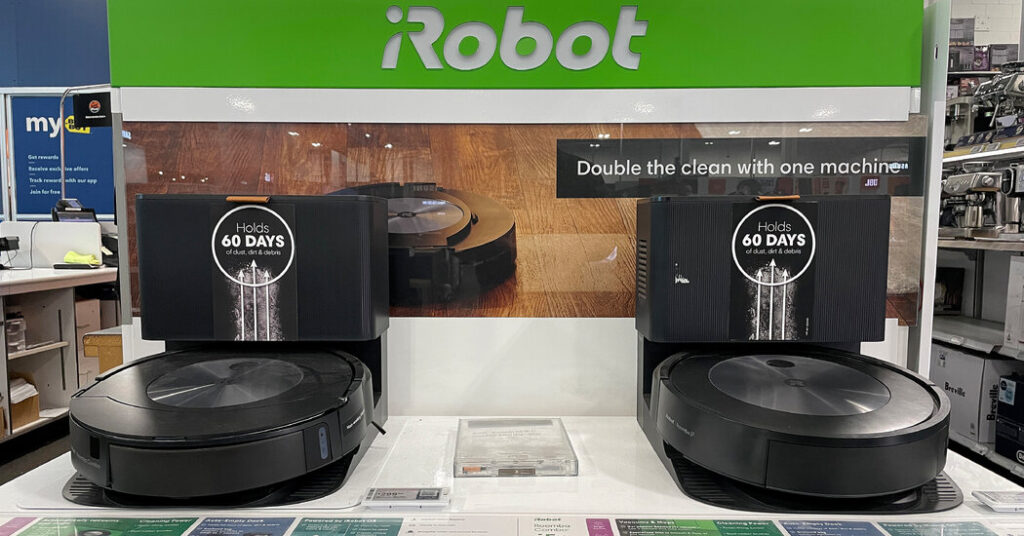
iRobot, the pioneering American maker of the Roomba, once the leader in robot vacuums, said that it had filed for bankruptcy and that control of the company will be taken over by its Chinese supplier.
Founded in 1990 by three researchers at the Massachusetts Institute of Technology, iRobot’s early products signaled an ambitious vision for how robots would help humans. Its robots deployed with U.S. ground troops, searched the World Trade Center after the Sept. 11 attacks in 2001 and monitored an oil spill in the Gulf of Mexico.
But iRobot’s breakthrough success came with robots that did ordinary tasks: cleaning homes, pools and gutters.
When iRobot introduced the Roomba in 2002, it promised to usher in an era where robots were a useful part of every day life. Decades later, the company’s challenges have become representative of how far away that future remains.
The company’s revenue declined in the face of scrutiny from regulators, data privacy issues and competition from rivals including Shenzhen Picea Robotics, iRobot’s new owner.
Picea makes household appliances and parts for companies like Xiaomi, Haier and Electrolux and also sells its own room-cleaning robot under the brand 3i. The company was founded in 2016 by a group of engineers in a program for fledgling start-ups funded by the Shenzhen government.
Chinese companies have been racing to dominate the robotics industry. Public and private investors have poured money into humanoid robotics start-ups, spending about $5 billion this year, as much as the last five years combined. There were more than two million robots working in Chinese factories last year, far more than anywhere else.
In 2022, Amazon said it would acquire iRobot and all of its debt for about $1.7 billion. But the deal fell apart under scrutiny from regulators in the United States and Europe who said it could undercut competition.
In January 2024, iRobot said Amazon would pay it $94 million as the deal collapsed. The same day, iRobot said that it would lay off 350 people, about a third of its work force. Since then, the company’s stock price plummeted as iRobot repeatedly warned investors about “substantial doubt” over its future.
On Sunday, iRobot filed a bankruptcy petition in Delaware. It said in a statement that it expected to complete the process by February. The company’s common stock will be wiped out and the new private entity will be controlled by Picea.
iRobot said it expected to continue operating, meet its commitments to employees and make payments to vendors and other creditors during the bankruptcy process.
“Today’s announcement marks a pivotal milestone in securing iRobot’s long-term future,” said Gary Cohen, chief executive of iRobot. The acquisition by Picea will “strengthen our financial position and will help deliver continuity for our consumers, customers, and partners,” he added.
According to documents filed in bankruptcy court, iRobot owes almost $100 million to Picea, $2.7 million to the Chinese electric vehicle giant BYD and $3.4 million to U.S. Customs and Border Protection in unpaid tariffs.
One of its creditors is Zheng Yu Industrial, a Hong Kong company that makes brushes, mops and dust bags for iRobot at factories in the southern Chinese city of Huizhou. Zhengzhong Hu, a spokesman for Zheng Yu Industrial, said on Monday that no one from iRobot or Picea had contacted the company about repayment of the debt, which iRobot listed as $1 million.
Picea did not respond to a request for comment.
Meaghan Tobin covers business and tech stories in Asia with a focus on China and is based in Taipei.
The post Roomba Maker iRobot Files for Bankruptcy, With Chinese Supplier Taking Control appeared first on New York Times.