BEIRUT — Thirteen months after a ceasefire was supposed to end hostilities between Israel and Hezbollah, Lebanon is bracing for another Israeli military escalation that could imperil its fragile recovery and fling the country back into war.
Lebanese officials in recent days said messages from intermediaries, including the United States, have warned of a potential large-scale Israeli military operation in the country, though the timing is unclear. The threat has highlighted the failings of the truce agreement, brokered by the U.S. and France, that was touted as a breakthrough that would restore calm.
Given the warnings, Lebanon is “intensifying its diplomatic contacts” to safeguard the state and its institutions in the event of an escalation, Foreign Minister Youssef Raggi wrote Friday in a post on X.
Since the truce was signed in November 2024, Israel has carried out near-daily airstrikes in Lebanon, demolished homes and other infrastructure during frequent raids, and continued to occupy five strategic areas in the south of the country — actions that Lebanese and U.N. officials have said represent repeated violations of the ceasefire.
Israel says its strikes are hitting Hezbollah infrastructure and weapons depots and are aimed at preventing the militant group, which has been battered in its conflict with Israel, from recovering or rebuilding its strength. At the same time, Israel has criticized the Lebanese government and its poorly equipped armed forces for not disarming Hezbollah — a task that Lebanese officials say is underway but because of its sensitive nature will unfold in stages.
The impasse has left Lebanon unsettled ahead of an end-of-year deadline that was set back in August, when the Lebanese government told the army to develop a plan to bring weapons under the exclusive control of the state.
With less than three weeks to go, the army said in a statement provided to The Washington Post that Phase 1 of the plan, focused on “weapons control” south of the Litani River — an area just north of the Israeli border that features prominently in the truce agreement — is nearly complete.
Israel “has not provided any tangible evidence proving the reactivation of military activity south of the Litani River, nor any systematic reconstruction of combat capabilities,” the statement said, referring to Hezbollah.
After months of growing anxiety — fueled by increasing Israeli attacks in the south, rumors of worse to come and the approaching deadline — a development last week seemed to ease tensions slightly. Lebanon and Israel agreed to appoint nonmilitary representatives to a ceasefire monitoring body, in a rare instance of direct civilian negotiations between the two countries, which remain officially at war. But Lebanon’s decision to send a civilian representative — Simon Karam, a former ambassador to Washington — did not stop the airstrikes.
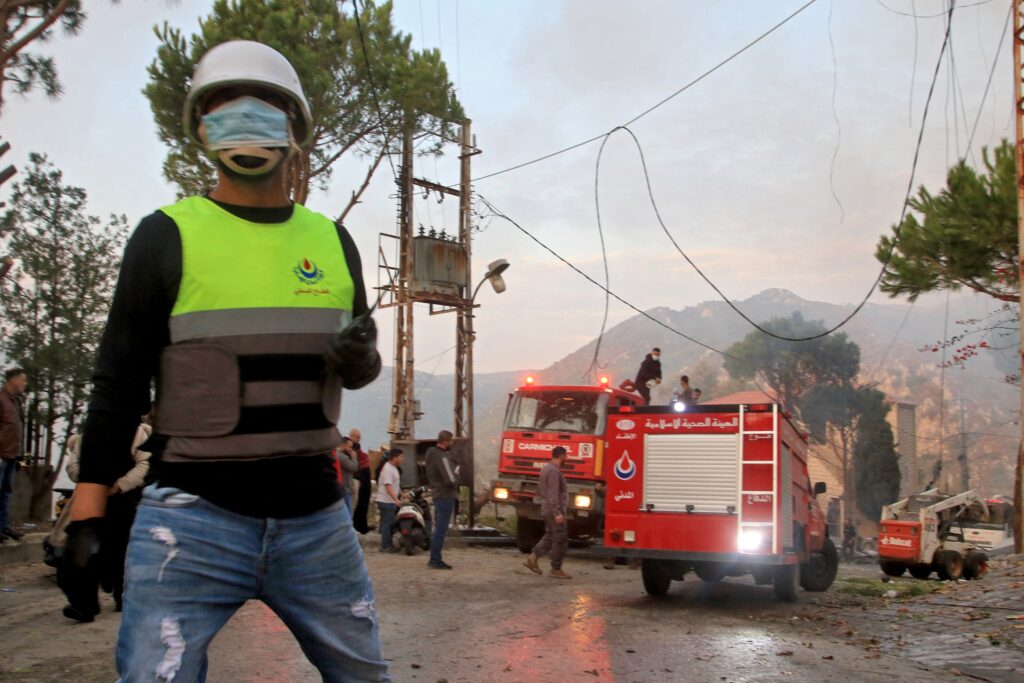
On Friday, Israel again carried out strikes in parts of southern and eastern Lebanon, the country’s state-run news agency reported. No casualties were reported. At least 335 people in Lebanon have been killed by Israeli strikes since the beginning of the truce, according to the Lebanese Health Ministry. Almost half of them were civilians, the United Nations said.
The Israel Defense Forces said in a statement that one of the targets was a Hezbollah “training and qualification” compound and that the strikes targeted other “military infrastructure.”
The statement did not say whether the training center or the other infrastructure was still in use. “The existence of military training and the establishment of terrorist infrastructure intended for attacks against the State of Israel constitute a violation of the understandings between Israel and Lebanon,” it said.
In another tense incident Saturday, the Lebanese army searched a house for weapons in the southern village of Yanouh and said it found none. Israel then threatened to bomb the area, prompting the soldiers to search the house again. Israel eventually suspended the strike after the soldiers refused to withdraw from the village “to prevent it from being targeted,” the army said.
The drumbeat of airstrikes and the specter of escalation have left Lebanon’s government unsure “on any particular day what the IDF or what Prime Minister [Benjamin] Netanyahu will decide,” said Paul Salem, a Beirut-based senior fellow with the Middle East Institute in Washington. “That enormous unpredictability,” he added, “hangs over everything.”
Ali Hamdan, an adviser to Lebanese parliament speaker and Hezbollah ally Nabih Berri, said in an interview that while the Lebanese army had made clear that it was pursuing a phased approach to disarmament, “Israel wants it to happen in 24 hours.”
Hezbollah, which suffered withering losses during the conflict with Israel that began in 2023 — including the killing of its longtime chief Hasan Nasrallah and several other senior leaders — has agreed to disarm in southern Lebanon and cede control to the Lebanese army there.
But the group has rebuffed calls to more broadly surrender its weapons, saying that the country is still at war and that Israel must first comply with the terms of the ceasefire agreement. Lebanese officials have also condemned the truce violations, warning they are hampering the government’s ability to assert control.
“These actions perpetuate instability, fuel renewed conflict and undermine the government’s efforts to restore the state’s authority,” Prime Minister Nawaf Salam wrote in the Financial Times on Wednesday. “The international community must press Israel to cease hostilities and completely withdraw from Lebanon, as well as strengthen support for the Lebanese Armed Forces, the institution best placed to secure lasting stability,” he added.
The government has pursued a gradual approach that it says is consistent with its ceasefire obligations and that avoids a major confrontation with Hezbollah, which could spark civil unrest. The militant group, despite its recent losses, remains both a formidable military force that receives financial backing from Iran and a powerful political party whose base of support include Shiite Muslims, who make up more than a third of Lebanon’s population.
Lebanon’s leaders could face a more difficult test next year, when Phase 2 of the disarmament plan focuses on areas north of the Litani River. For now, the army is focused on the south, where it has deployed nearly 10,000 troops across 2,200 positions, it says, giving it “operational control” of the region, Salem said.
Other key steps — including the military’s assumption of control over key Lebanese ports, the international airport in Beirut and large swaths of the border with Syria, across which illicit weapons were long smuggled — are also evidence that the government is making progress, he added.
A return to all-out war would be catastrophic for Lebanon, which has yet to rebuild from fighting between Israel and Hezbollah that began after Oct. 7, 2023. The prospect of escalation is ramping up pressure on a government already struggling to deliver Lebanon from a series of crises — war, financial ruin and political deadlock — that have dragged on for years.
With tens of thousands of people from the south still displaced from villages decimated during the conflict, the government has been unable to attract the kind of investment or aid that would allow it to rebuild. Nor did it have the opportunity to do so, as Israel’s attacks on the region continued.
“Anything that moves is being hit,” said Tarek Mazraani, a displaced resident of the southern town of Houla. “The situation is terrible. There is no compensation. There is no help.”
Israeli officials and analysts said that while Netanyahu’s government is looking to the end of the year as a possible moment for military action, the deadline could be extended. The White House has expressed unease about another major Middle East conflagration on the watch of President Donald Trump, who has cast himself as a peace broker, said current and former Israeli officials.
U.S. officials have been urging greater restraint in the past two weeks, said a former senior Israeli military official who has been briefed on discussions, speaking on the condition of anonymity to discuss sensitive diplomatic talks. “Trump already told everybody that he achieved peace in the Middle East,” the Israeli official said, adding that an Israeli escalation “would go against this argument.”
“The U.S. won’t like this part of the world blowing up,” a second Israeli official added, also speaking on the condition of anonymity to discuss Israel’s internal calculations.
If the Lebanese army can convince Western governments that its disarmament plan is on track, it could stave off further fighting, Salem said. But if the army’s efforts are dismissed by Washington, then Trump might say, “Well, I tried,” and acquiesce to further Israeli military action, he said.
The White House might not object even though Hezbollah has been “paralyzed, decimated” and has not attacked Israel in a year, Salem said. “From a security standpoint there is no need for an escalation, and they know it,” he said.
Shih reported from Jerusalem. Abbie Cheeseman in Beirut contributed to this report.
The post Rising tensions with Israel have Lebanon fearing return to all-out war appeared first on Washington Post.