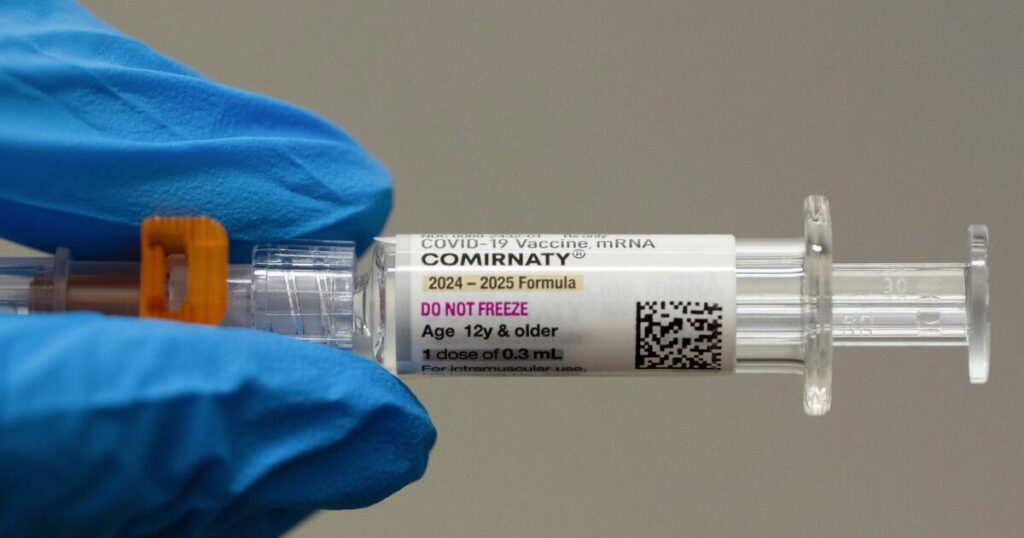
A rapid, two-step immune reaction may underlie rare cases of heart inflammation seen after Covid mRNA vaccination, Stanford University researchers found, shedding light on a mechanism that’s fueled scientific debate and political controversy since the pandemic.
The condition, myocarditis, appears most often in adolescent males and young men. It typically begins one to three days after a second vaccine dose, bringing on chest pain, shortness of breath or palpitations. Symptoms usually resolve quickly with supportive care — monitoring, rest and basic treatment to ease inflammation while the heart recovers on its own.
The new research, published in Science Translational Medicine, traces the reaction to a sequential surge of inflammatory signals. It begins with the immune system’s earliest sentinels — cells that act as first responders against infection. The scientists found that these cells, known as macrophages, release a wave of a signaling protein after an mRNA shot made by Pfizer Inc. and its partner BioNTech SE or by Moderna Inc.
The burst prompts T cells, another branch of the immune system, to produce the protein interferon-gamma. Together, the two molecules amplify inflammation and draw additional immune cells into heart tissue, where they can temporarily irritate or injure heart muscle in a small subset of people. The research was conducted using patient blood samples and on mouse and human tissue models.
The response reflects how the body defends itself against foreign genetic material, said Joseph Wu, director of the Stanford Cardiovascular Institute and senior author of the study.
“Your body needs these cytokines to ward off viruses,” Wu said in a statement. “It’s essential to immune response but can become toxic in large amounts.”
Although the absolute risk is extremely low — roughly a few thousand myocarditis cases per billion mRNA doses, concentrated in young men — the sheer speed and scale of global vaccination meant many cases were detected within a short window. That clustering made the complication appear more common than it was in statistical terms.
Polarized Responses
The surge fed public skepticism, culture-war battles over mandates, and polarized messaging around mRNA technology, despite evidence that the vaccines prevented far more hospitalizations and deaths than they caused.
U.S. Health Secretary Robert F. Kennedy Jr. in August canceled 22 federal grants worth almost $500 million for mRNA vaccine projects, saying “the data show these vaccines fail to protect effectively against upper respiratory infections like Covid and flu,” a move researchers warned would hobble progress in the field. The US Food and Drug Administration is also investigating whether Covid vaccines caused deaths in adults.
Operation Warp Speed poured more than $10 billion into accelerating development, manufacturing and distribution, enabling the shots to receive emergency authorization in just 11 months — the fastest vaccine roll-out in history.
By late 2022, around 92% of fully vaccinated Americans had received an mRNA shot, cementing the platform as a cornerstone of modern vaccinology and helping earn its pioneers the Nobel Prize.
Virus Shield
In their first year alone, Covid vaccines are estimated to have prevented almost 20 million deaths worldwide — including more than a million in the US — and averted millions of hospitalizations, infections and long-term complications such as cardiovascular and neurological problems.
“The mRNA vaccines have done a tremendous job mitigating the Covid pandemic,” Wu said, stressing the contrast with the virus itself. A large UK study in 2021 found Moderna’s second dose was linked to about 10 extra cases of myocarditis per million doses, compared with about 40 per million after a bout of Covid.
The condition’s skew toward young men has long suggested a hormonal influence, since estrogen can temper inflammatory signaling.
To probe that theory, Wu’s team tested genistein — a soy-derived compound with mild estrogen-like effects. In mice and human cardiac tissue models, pretreatment with genistein blunted a sharp surge in interferon-gamma and CXCL10, the inflammatory protein linked to myocarditis, and preserved heart function.
Tofu Defense?
Although the work didn’t test dietary intake, the findings raise the question of whether naturally occurring soy compounds like tofu could, in theory, soften the inflammatory response seen in the model systems.
“Nobody ever overdosed on tofu,” Wu said, noting that his team previously identified genistein as having anti-inflammatory activity, including the ability to counter marijuana-induced damage to blood vessels and heart tissue.
Wu said that the point of the study was explanation, not alarm. “This study is only looking at the mechanism — why a very, very small subset of patients develop myocarditis,” he said. “The vaccine is very, very safe.”
Gale writes for Bloomberg.
The post Researchers identify immune trigger behind myocarditis after Covid vaccination appeared first on Los Angeles Times.