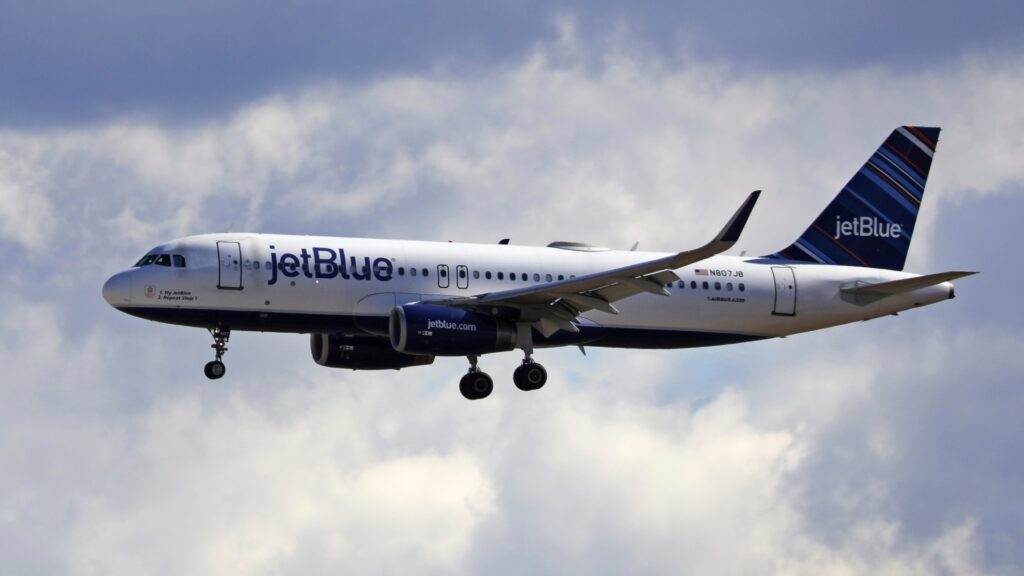
A JetBlue pilot changed elevation to avoid colliding with a U.S. Air Force plane in the southern Caribbean on Friday, he told air traffic controllers.
The New York-bound flight was leaving the island of Curaçao, just north of the Venezuelan coast, when the military aircraft “passed directly in our flight path,” the JetBlue pilot told an air traffic controller in Curaçao, according to audio captured by several sites including You can see ATC.
In audio reviewed by The Washington Post, the airline pilot described the other plane as an air-to-air refueler that was between two and five miles ahead before it traveled toward Venezuelan airspace.
“We almost had a midair collision up here,” the JetBlue pilot said.
U.S. military forces have increased their presence off the Venezuelan coast in recent weeks.
According to the JetBlue pilot, the refueler was not using a GPS transponder that would have identified its presence.
“We had to stop our climb,” the pilot said. “They don’t have their transponder turned on; it’s outrageous.”
The air traffic controller in Curaçao told JetBlue’s pilot that he also did not have the military plane on his “scope.”
“We’ll do a report on our end, too, but they did not have their transponder turned on so there’s no way for you to have seen them,” the pilot said.
“Yes please, make your report so at least in that case you can get your authorities to be investigating that,” the controller told him
According to a JetBlue statement, the airline has reported the situation to federal authorities and would participate in any investigation that follows.
“Our crewmembers are trained on proper procedures for various flight situations, and we appreciate our crew for promptly reporting this situation to our leadership team,” the statement said.
Southern Command, which oversees military operations in Latin America and the Caribbean, is aware of reports regarding U.S. military aircraft in the region and will review the matter, spokesman Col. Emanuel L. Ortiz said in a statement.
Ortiz did not address questions about whether U.S. aircrews have been given special instructions to avoid civilian flight paths or if they are expected to be especially mindful of commercial aircraft while they are flying with location equipment turned off.
“Military aircrews are highly trained professionals who operate in accordance with established procedures and applicable airspace requirements,” Ortiz said. “Safety remains a top priority, and we are working through the appropriate channels to assess the facts surrounding the situation.”
Military aircrews commonly turn off their transponders and other tracking equipment for sensitive missions, such as the ongoing counter-narcotic mission in the Caribbean and eastern Pacific. The Pentagon has deployed a fleet of warships and numerous aircraft, including fighter jets, bombers and helicopters.
Tankers, like the aircraft the JetBlue pilot described, have been heavily used in the Caribbean since September to keep aircraft flying continuously by refueling mid-flight.
It is generally the shared responsibility of all pilots and air traffic control to guard against collisions by maintaining awareness and communicating clearly with each other. But the operations in the Caribbean, where U.S. military aircraft are essentially untraceable on radar when they turn off their tracking equipment, is a unique environment where it is more incumbent on the military to account for commercial aircraft that regularly fly in the region.
The JetBlue flight wasn’t the only reported close call in the region last weekend.
At roughly 4:38 p.m. local time Saturday, an air traffic controller in Curaçao signaled to a passing private jet to change its course because “unidentified traffic,” or an aircraft not sharing its location, was about 10 miles away at an unknown altitude.
Seconds later, according to audio captured by LiveATC.net, one of the private jet pilots told the controller they had just seen the unidentified aircraft and did not receive the usual “resolution advisory” that pilots get to warn when another aircraft is too close.
“We just got that traffic. I don’t know how we didn’t get an RA for that, but they were really close,” the pilot said. “And you turned us into them.”
The controller responded, “They keep on turning irregular.”
Jeff Guzzetti, a former investigator for the National Transportation Safety Board, reviewed audio from both flights.
“It’s disturbing,” he said. “Something like this just shouldn’t happen. If you’ve got military aircraft mixing it up with commercial aircraft, they need to be able to identify each other.”
When an aircraft’s transponder is turned off, Guzzetti explained, air traffic control can only see it on a secondary radar system that does not include altitude.
The private plane pilot said they were headed directly toward the unidentified plane around 26,000 feet, according to the audio. He added it was a “maybe like a 777, 76 something like that” and “it was a wide body.”
Guzzetti said “76” refers to the 767, which the military uses as a refueler and is considered a wide-bodied plane
The post ‘Outrageous’: JetBlue pilot describes near-collision with Air Force plane off Venezuela appeared first on Washington Post.