The lobby of the state-owned theater beside the Neris River in Vilnius, Lithuania, drips with yellow glass — its 72 chandeliers were shipped from the former East Germany 50 years ago. Jurgita Dronina, the new artistic director of the Lithuanian National Opera and Ballet Theater’s ballet company, sipped Champagne beneath this matrix of light on a December evening. The curtain had just fallen on the world premiere of a new “Coppélia,” celebrating the company’s 100th birthday, and Dronina, surrounded by her dancers, was overcome with emotion.
“I don’t think we realize how big this night is,” she said, shaking her head incredulously. “People will be talking about this moment in another hundred years.”
The centenary’s significance feels bigger than the sum of its years. Lithuanian ballet has managed to persist, and often thrive, over a brutal century that has seen several occupations, war and economic uncertainty. Now with confidence in its survival skills, the ballet company is eager to raise its profile from a company of regional importance to one that can rank among Europe’s best.
That eagerness is all over the company’s ambitious anniversary plans, which began with the contemporary reworking of “Coppélia” and continued with a showcase by ballet students from the state-funded M.K. Ciurlionis School of Art in Vilnius, the company’s official feeder program. The festivities will culminate in an international gala on Dec. 20 and 21, featuring famous dancers from the Vienna State Ballet, Paris Opera Ballet, Royal Ballet, La Scala Theater and more.
Dronina, a former principal dancer with the National Ballet of Canada, became the Lithuanian ballet’s artistic director in January at a complicated moment for the country. Since Russia’s invasion of Ukraine in 2022, Lithuania’s major performing arts institutions have stopped performing Russian content, instituting what the ministry of culture has called a “mental quarantine.”
But Lithuanian ballet is indebted to Russian influence. More than at the symphony or opera, the ban affects the repertoire: No Tchaikovsky hits (“Swan Lake,” “Sleeping Beauty”) or ballets with scores by Prokofiev (“Romeo and Juliet”) or Stravinsky (“The Rite of Spring”). When Kristina Gudziunaite, a principal dancer, learned that “Romeo and Juliet” had been pulled from the season in 2022, she was crushed. “My heart was bleeding,” she said. “I love the classics and I had been waiting and waiting for that ballet.”
Politics haven’t stopped Dronina from generating change — more than the ballet company has seen in 50 years. “I want to do what Tamara Rojo did at the English National Ballet,” she said of her mentor and former boss, whom she still calls at all hours for advice. “Tamara took a touring company and made it absolutely world class.”
Dronina was born in Saratov in Soviet-era Russia in 1986 and raised in Vilnius by her Lithuanian mother. She was a principal at the Royal Swedish Ballet and the Dutch National Ballet before joining the National Ballet of Canada in 2016, where she was an international star among largely homegrown talent. The next year, she was hired as a lead principal at the English National Ballet and spent three seasons performing with both companies.
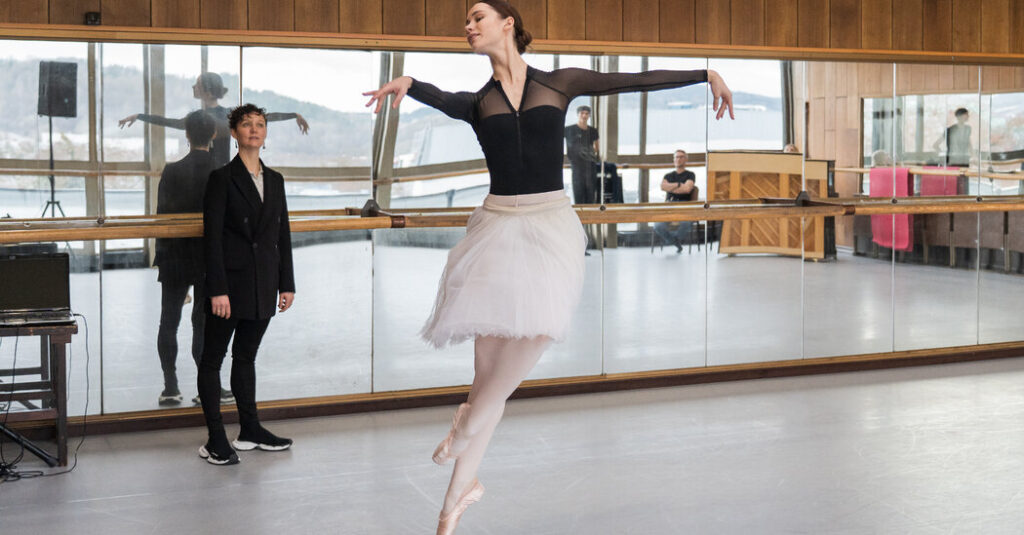
A luminous dancer, noted for her refined grace and emotional sensitivity, Dronina is determined to elevate the Lithuanian company’s artistry and technique. She has lengthened the duration of company class, insisted the women take class on pointe, and introduced a separate pointe class that she teaches herself. She has changed the daily schedule from an Eastern European model of late-evening rehearsals offset by long midday breaks to a 10 a.m. to 5 p.m. work day, giving the dancers a better work-life balance and the opportunity to go to the symphony or theater on nights they don’t perform.
Many of these changes are informed by Dronina’s work ethic as a dancer. She was famous for her epic energy, sometimes performing lead roles in different ballets in Canada and Europe the same week. She also benefited from having work created on her, something she feels is essential for her dancers and the company. This spring, the French choreographer Manuel Legris will create a new “Paquita,” and there’s a co-production with the Estonian National Ballet in the works.
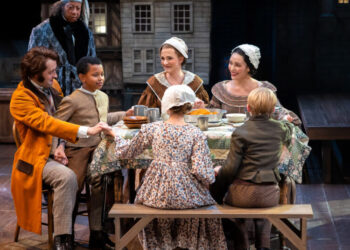
As artistic director Dronina succeeds the choreographer Martynas Remeikis, whose ballets have become an important part of the company’s identity. His “Coppélia” is a sinister, stylized work performed largely off pointe to a dramatically revised score by the Lithuanian composer Jievaras Jasinkis.
The staging turns away from the ballet’s usual humor to get closer to Léo Delibes’s original source material: E.T.A. Hoffmann’s nightmarish short story “The Sandman” (1816), about trauma and obsession. With choreography that continuously bends and folds inward, and a set that features a giant bald head and eerie, childlike creatures, the effect is decidedly bleak.
“Coppélia” wasn’t an arbitrary choice for the company’s centenary. It was the work that introduced Lithuania to ballet in 1925, when the Russian choreographer Pavel Petrov produced a version of the classic at the State Theater in Kaunas (Vilnius was then occupied by Poland). Still recovering from more than a century of imperial Russian rule, Lithuanian theatergoers could have balked at this Russian-identified art form presented by a Russian dance master. Instead, ballet was embraced as a symbol of the country’s emerging cultural affluence, a sign the newly independent state was developing its own professional arts scene.
That pride and self-determination have characterized Lithuania’s attitude toward ballet over the last 100 years. Even when the country was part of the Soviet Union and was watched carefully by the Kremlin, the ballet company still invested in local composers and choreographers, developing several distinctly national works that drew on Lithuanian folklore and heritage.
With the threat of Russian expansion looming once again, signs of solidarity with Ukraine are ubiquitous across Vilnius: Flags drape from windows and city buses flash “Vilnius loves Ukraina” between destination updates.
Today, the Lithuanian ballet company is fiercely proud of its accomplishments. Average seat occupancy is 97 percent, among the highest in Europe, and a recent Opera Europa study showed it had the highest attendance of people under 35 of ballet companies across the continent. Artists once fled Lithuania in droves, but now many are returning. Today more than 80 percent of the company’s 74 dancers are Lithuanian, several of whom left the country only to come back.
Edvinas Jakonis, a principal soloist, spent two years at the English National Ballet before returning to Vilnius, where he grew up watching Rimeikis’s choreography. “I always dreamed of dancing something by Martynas,” he said between “Coppélia” rehearsals. “Every character has a wound in their heart that they carry throughout the story. It’s very personal.”
Dronina has made a concerted effort to bring Lithuanian talent back from abroad. Many of these dancers grew up together, training in the ballet department of the M.K. Ciurlionis School of Art, where they boarded and studied in their adolescence. Dronina, a graduate of this program, remains closely connected to the school. Her mother works as a “night mom” at the school’s residence when she isn’t babysitting her grandchildren, Dronina’s daughter, age 2, and sons, 4 and 13.
Being a mother and ballerina obliged Dronina to make choices that she doesn’t want to force on her dancers. In 2023, she felt she needed to return to the stage three and a half weeks after giving birth. “No dancer should have to make such drastic decisions,” she said. “I will always make sure to guide and support ballerinas who want to combine motherhood with their careers.”
This is part of Dronina’s plan to invest in dancer wellness. She organized the company’s first ballet symposium earlier this fall, hosting lectures on mental health and dance psychology. She is committed to nurturing each dancer, pushing them beyond their comfort zone and refusing to pigeonhole anyone as “classical” or “contemporary,” a tacit practice in some companies.
Conventional rules about hierarchy and promotion don’t interest her either. Last spring, she pulled an 18-year-old student out of the ballet school to dance the Queen of the Dryads, a lead role, in “Don Quixote,” despite colleagues telling her it was a reckless idea. That student, Ieva Repsyte, is now a company soloist who is dancing the lead in the second cast of the new “Coppélia.”
Some of her initiatives have prompted pushback. One of the most contentious changes has been normalizing performing one work in the evening while rehearsing or creating another during the day. This was ordinary for Dronina in her career, but has been met with resistance by dancers who want to “save themselves” for their big night onstage.
“I lead by example,” Dronina said. “I hope that my career has proved that hard work, discipline and unwavering love for this art form bring results.”
The morning after the “Coppélia” premiere, the dancers gathered for company class in a windowless studio with dated wood paneling on the theater’s second floor. Dronina entered, looking energized and pleased. She offered brief congratulations on a job well done and, without delay, found a place at the barre and started to teach.
The post Out From Russia’s Shadow: Lithuania’s National Ballet at 100 appeared first on New York Times.