
I distinctly remember being on the family Mac in Brasília at 13 years old, grooving to a CD I’d just burned and thinking: If only my future friends at my new school could hear this. We were getting ready to move to Miami, where I’d live all four years of high school. The playlist was likely a mix of J-Lo, Brazilian funk, 50 Cent and Eminem — I’m not proud of all my selections.
I wished the future friends could hear the songs because, as a kid who moved around, I felt like music was the quickest sketch of who I really was. Instead of waiting for the months, or even years, to reveal the layers of my personality, I could simply burn a CD. And over the years, I made possibly hundreds of them — for friends new and old, accompanied always with the set list written in pink, purple, blue and green and adorned with plenty of hearts and stars. After the death of CDs, I persisted making playlists on flash drives, and in college and grad school, I did radio — unthinkably to my now sleep-obsessed self — from 11 p.m. to 1 a.m. on Wednesday nights. In an alternate life, I wanted to be a music supervisor (and honestly, I would still do it, especially for restaurants, which all seem to play the same damn “Discover Weekly” playlist on Spotify). Music is still the art form that lets me tap in and just be.
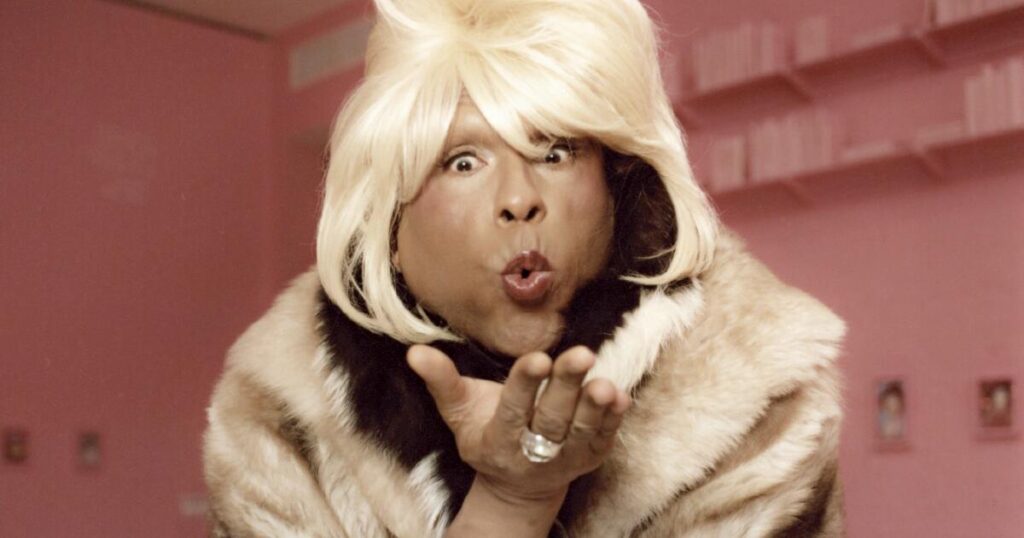
Working on our December stories made me think of what music does so well: It gives its listeners a sense of permission to be unapologetically themselves. It creates a space free of shame, a space of pure belonging. It’s what Selena has carved for her Latino fans especially, what banda music has offered generations of Angeleno families, and what the Egyptian Lover has given “the freaks.” In the mid-2000s, the energy of the L.A. jerkin’ community was so freeing that everybody wanted to be a part of it. And since she got her start in the L.A. punk scene of the ’80s, Vaginal Davis has moved her audience to feel things — even when they’ve initially been too shy to. Her performances are a space to have delirious fun, to paraphrase writer Kate Wolf.
It’s not surprising that our Revelry issue turned into a high-key music issue. What better way to celebrate each other and ourselves?
A re-creation of my past mixes — the good and kind of bad
For the record: A photograph of Earth, Wind & Fire accompanying a story on Bill Whitten in the last edition of Image misidentified the photographer. The photo was taken by Bruce Talamon.
The post In praise of the mixtape and what music does so well — letting us be ourselves appeared first on Los Angeles Times.