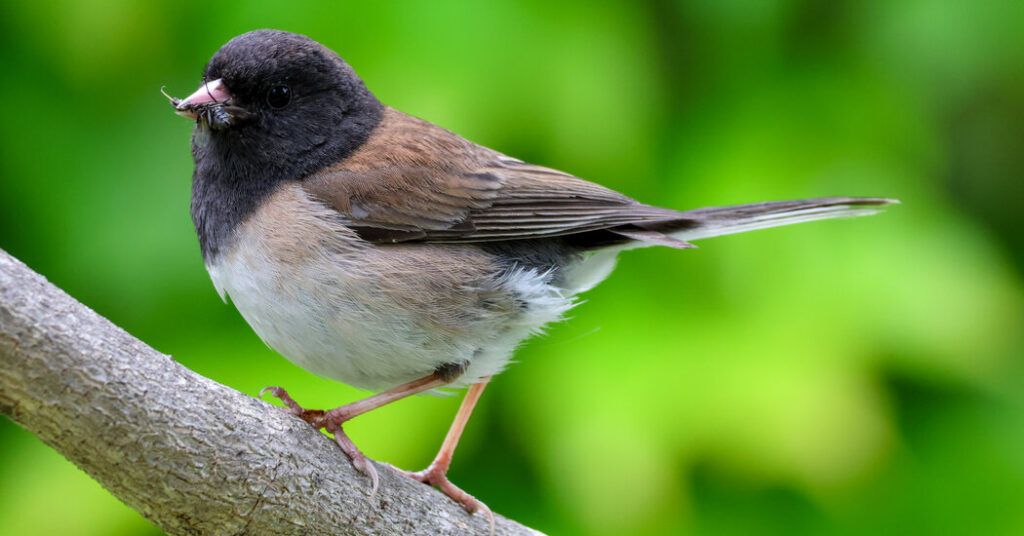
About two decades ago, the dark-eyed junco, a forest-dwelling sparrow, began to colonize urban Los Angeles. The birds proved to be remarkably successful in the city, making themselves at home on the bustling campus of the University of California, Los Angeles.
They also rapidly diverged from their wildland counterparts, adopting different breeding behaviors and displaying different physical traits, including shorter wings. The urban juncos also developed shorter, stubbier beaks, a shift that may have been driven by a change in diet.
But when U.C.L.A.’s campus shut down during the pandemic, something remarkable happened: The beaks of juncos born on campus reverted to their wildland shape. Several years later, after the pandemic-related restrictions had been lifted, the distinctive urban beak shape returned, researchers reported in a new study on Monday.
For ecologists, the Covid-19 pandemic represented a remarkable natural experiment, an opportunity to study what wild animals did when humans stayed home, en masse. During what has become known as the “anthropause,” mountain lions crept closer to cities and sea turtles ventured closer to shore, while birds lowered the volume of their songs, scientists have found.
But the new study, which was published by the Proceedings of the National Academy of Sciences, is the first to document a change in the physical form of a wild animal population.
“We were really shocked,” said Pamela Yeh, who is an evolutionary biologist at U.C.L.A. and an author of the study.
The findings, she added, highlight how “deeply embedded” humans are in natural ecosystems and how rapidly our actions can reshape other species. “I think it’s just important for us to know what our effects are, and know how dramatic our effects can be.”
In their natural forest habitats, dark-eyed juncos survive primarily on seeds and insects. But the birds that live on U.C.L.A.’s campus have diets closer to those of the average college student. “Things like cookies, bread,” said Ellie Diamant, who is an ecologist and evolutionary biologist at Bard College and the other author of the study. “U.C.L.A. students seem to like pizza.” (Dr. Diamant, who began studying the birds as a student in Dr. Yeh’s lab, said that she once had a young junco chick regurgitate a piece of bread into her hand.)
But Covid-19 restrictions sharply limited human activity on campus for most of 2020 and 2021. Classes moved online. Dining halls and restaurants closed.
And then bird beaks began to change. There was a time lag to the phenomenon, the researchers found. The juncos born in the spring of 2020, shortly after the restrictions first went into effect, had the standard urban-style beaks. But those born in 2021 and 2022 had the longer, slimmer beaks more typical of the wildland juncos. The urban beak shape returned in junco chicks born in 2023 and 2024.
The researchers can’t say for certain what drove the quick shift in beak shape, but they suspect that it was a case of rapid, adaptive evolution. When human food became scarce on campus, birds with traditional wildland-shaped beaks might have been better positioned to survive on natural food sources like seeds, and more likely to reproduce the following year.
“It seems to really reflect the previous year leading up to that nesting event,” Dr. Diamant said. “Who is successful and who is not and which traits they’re passing on.”
An alternate possibility is that the dip in human activity might have made the typically skittish wildland juncos more comfortable with venturing into the city, leading to more interbreeding between birds with different beak types. But the scientists said that they did not see much evidence to support this particular theory, which they consider to be a less probable explanation.
Scientists still don’t know precisely what dietary differences might have driven the emergence of a new, urban beak shape, and city-dwelling juncos may be dining on different seeds and insects than their wildland counterparts. But the new study suggests that the easy availability of human food may be an important factor in an evolutionary story that is still unfolding.
“And we don’t have to go far away,” Dr. Yeh said. “You don’t have to go to Antarctica or to the mountains in Nepal or to the plains of Africa. You can go right out to your backyard or to your front yard or to your school campus, and see something pretty amazing happening.”
Emily Anthes is a science reporter, writing primarily about animal health and science. She also covered the coronavirus pandemic.
The post How the Pandemic Lockdowns Changed a Songbird’s Beak appeared first on New York Times.