Catherine Rolfes was between jobs and starting to think about how to make some extra cash to put toward her bills when her sibling suggested they visit a plasma donation center.
At that point, “I’ve never donated plasma,” recalls the 27-year-old, who lives near Columbus, Ohio. “I donated blood back in high school twice, and both times I had a bad reaction. So I was like, I don’t know. But then the bills started getting a little expensive. It’s $125 [to donate]—that’ll come in handy. So I’m like, we’ll go.”
[time-brightcove not-tgx=”true”]
The U.S. is among only a handful of countries that allow donors to receive financial compensation for giving their plasma, the liquid part of blood. Donors here can receive anywhere from $30 to upwards of $100 per visit, and are permitted to donate plasma as frequently as twice a week, another rarity around the world. Regular donors can make hundreds of dollars a month.
Experts credit the compensation for making the U.S. one of the few countries that are self-sufficient in supplying plasma for their own patients—and the single biggest contributor to the global plasma supply. Plasma from U.S. donors is used in life-saving treatments and therapies for people all over the world.
But the practice of paying donors has raised ethical questions for some: Critics say that it can be exploitative of people in need of money.
“It’s a really complex issue,” says Emily Gallagher, an associate professor of finance at the University of Colorado Boulder who has studied compensation for plasma donation. “Generally speaking, the developed countries that allow [paid donation] are the only ones that are able to meet their own domestic plasma needs in terms of the medications that come out of this.”
“And the medication is life-saving—there are many, many people around the world who would not survive without it,” she continues. “At the same time, there are real reasons to be concerned about allowing for these compensated markets.”
‘You’ve given us our life’
For years, Kelli Fairfax didn’t know what was wrong. She was always sick, and it wasn’t until she reached her 30s that she learned why: In 2001, she was diagnosed with Common Variable Immune Deficiency (CVID), an immune system disorder that causes low levels of antibodies in the blood, which can make people with the condition more susceptible to infection.
“When I got diagnosed, it really changed my life,” says Fairfax, a 55-year-old who lives in San Antonio, Texas.
There’s no cure for CVID, but there is a treatment. Replacement immunoglobulin therapy provides a patient with antibodies when their body can’t make them on its own, enabling them to better fight off infection. People with CVID need to receive the treatment for the rest of their lives; Fairfax receives hers every week.
That therapy relies on an essential component: donated human plasma.
“I’m just so thankful,” Fairfax says of plasma donors. “I go to donor stations and I go and I thank them. You know, we call it liquid gold.”
“These people don’t have to do this,” she continues. “We’re thankful because you’ve given us our life.”
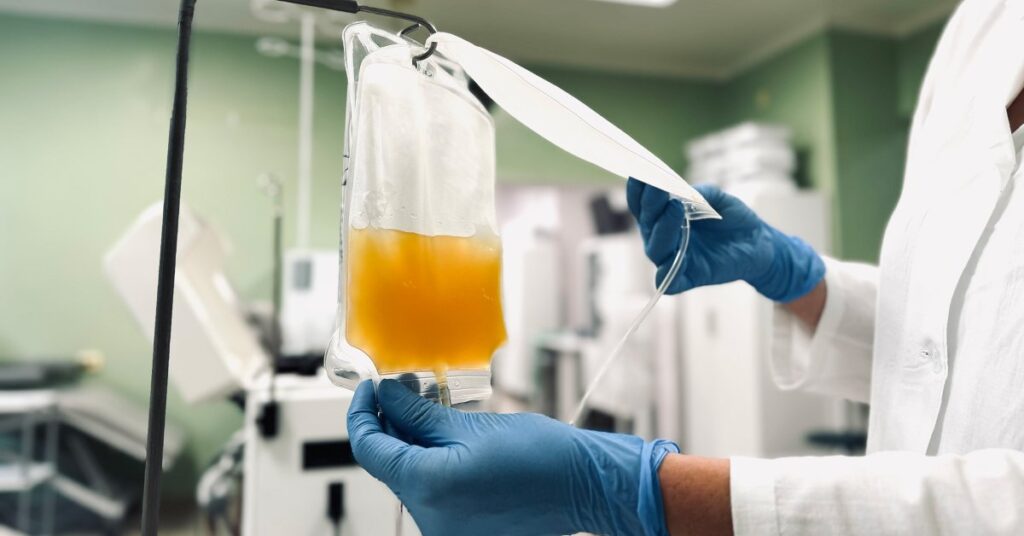
Plasma mainly consists of water, but it also contains important proteins such as gamma globulin—which helps fight off infections—and anti-hemophilic factor—which helps the blood clot properly. Donated human plasma is used to create life-saving treatments for a variety of health conditions. Those include primary immunodeficiencies, such as CVID, that impair the body’s ability to fight off infections, as well as bleeding disorders like hemophilia and some types of cancer. Plasma is also used for more everyday medicine, including for critical care patients who have experienced trauma or burns.
While such patients may only need that treatment for a certain period of time, others—like Fairfax—will need plasma-derived therapies for the rest of their lives. And the number of plasma donations needed to sustain a patient’s treatment varies depending on their condition. Treating one person with hemophilia for a year, for instance, requires roughly 1,200 plasma donations, according to estimates by the Plasma Protein Therapeutics Association (PPTA), a trade association representing more than 1,000 donation centers in North America and Europe, and manufacturers of plasma protein therapies. For patients with Alpha-1, a genetic condition that can damage the lungs and liver, a year of treatment requires about 900 donations.
“There is such a need for donated plasma because for many of these patients, this is the therapy they rely on, but it is not a cure; it is something that they need for their lifetime to lead a healthy, productive life,” says Anita Brikman, the president and CEO of the PPTA.
In 2022, 1.26 million people in the U.S. received a plasma-derived therapy at some point over the course of the year; around the world, the total was around 16.5 million, according to the Marketing Research Bureau, which provides market data about the plasma industry.
“You look across the world, when we think about these patient populations—you can see why the need is so significant,” Brikman says.
Donating to help people—and pay the bills
Bethany Beinlich donated plasma for the first time over the summer. The 22-year-old, who lives in Austin, Texas, heard about donating from her brother-in-law, who did it in college. When she first decided to donate, she was waiting to start her new job, and she wanted some extra “fun money.” And she wanted to help people.
“As a radiation therapist, I am working with cancer patients and I understand how there are different treatments for cancer that are being discovered right now that are using plasma,” she says. So as well as helping her earn some cash, donating is also rewarding for her, knowing that patients could be helped by it.
At first, Beinlich went twice a week. She doesn’t go as frequently now, but she visits a center when she can.
Estimates for the number of plasma donations in the U.S. each year vary, but Brikman says the PPTA pegs it at roughly 45 million. Plasma donation involves blood being drawn from a donor, the plasma being separated out, and other components of the blood—such as red blood cells and platelets—being cycled back into the donor. The process is widely considered to be safe, and, for many donors, it’s smooth and simple. Some people may experience mild reactions, such as lightheadedness, but health experts say that can often be avoided by drinking water and eating a healthy meal.
Overall, Beinlich’s experience has been positive; she’s never had a bad reaction. If anything, she wishes she had done it in college to help pay some of her bills.
For Rolfes, it wasn’t the most pleasant experience at first. She visited a plasma donation center for the first time in mid-October. But after she was hooked up to the machine and the donation process began, she started feeling ill.
“I felt like I was sweating profusely,” she says. “I was hot and then I was cold, and I was literally physically shaking and I was seconds away from passing out.”
“I was very scared,” she says. “It was like this impending doom.”
She told a staff member that she wasn’t feeling well, and they gave her an ice pack and gatorade and stopped the donation process. The issue, a staff member told her afterward, was that she didn’t eat or drink enough before donating, so her blood pressure dropped. After Rolfes rested for a while, staffers asked her if she wanted to continue, and she said yes. For the rest of the donation, she felt fine. And she left with $125 on a debit card, which she used to pay her gas bill and buy some food.
That experience didn’t deter Rolfes from returning later that month to donate again. This time, she drank a lot of water and ate a good, full meal beforehand, and the process went much more smoothly. She left the appointment with another $125, which she used to pay her electric bill and buy groceries.
Rolfes posted a couple TikToks about her first time donating, and received responses from people who said they relied on plasma-derived therapies and thanked her for donating. That was eye-opening, she says. She plans to continue donating, maybe once or twice a month.
“It’s a good little extra money, and for a good cause too,” she says.
The compensation debate
There are only five countries that collect enough plasma donations domestically to meet the needs of their own patients: the U.S., Germany, Austria, Hungary, and the Czech Republic, according to Peter Jaworski, a professor of strategy, ethics, economics, and public policy at Georgetown University’s McDonough School of Business who has studied the ethics and economics of plasma donation. All of those countries allow plasma donation centers to compensate donors.
The U.S., though, is by far the biggest contributor to the world’s plasma supply—plasma collected in the U.S. accounts for nearly 70% of all the plasma collected globally for the manufacturing of plasma-derived therapies, Jaworski says. Many countries that can’t collect enough plasma domestically have to import medicine made from plasma donated in the U.S.
“Not compensating donors would very likely result in a shortage,” says Mario Macis, a professor at Johns Hopkins Carey Business School who has studied compensation for blood and plasma donations. “Most other countries around the world are not self-sufficient when it comes to plasma donation. So compensating donors is very important to ensure an adequate supply—to make sure that patients who need plasma-derived therapies get it.”
But some critics have objected to paying plasma donors, raising an ethical concern: What if the money places undue pressure on vulnerable people to donate? Does the promise of compensation exploit people who are struggling financially?
According to surveys that Gallagher—the University of Colorado Boulder professor—helped conduct, plasma donors are more likely to be under the age of 35, Black, and male, compared to non-donors. Researchers also found that donors are less likely to be fully employed, are more likely to have incomes of less than $20,000, and are more likely to have poor credit scores.
About 64% of the people surveyed said they donated plasma to pay for essential goods and emergencies, such as making their rent payments on time. Only 19% of the people surveyed said they did it to make some extra cash.
In a study, which was published last year, Gallagher and her colleague found that the probability of young people taking out a payday loan decreases by about 18% within three years of a plasma donation center opening near them. These loans, Gallagher says, are “very expensive.” “They often don’t get repaid; they get rolled over again and again, and so they cause debt traps,” she says. Reducing the need to take out these types of loans, then, has a substantial impact on a community.
Still, Gallagher says, “Societies have, for a very long time, debated the ethics of commercializing parts of the human body.”
She notes that many people from low-income households struggle to avoid eviction, afford health costs that aren’t covered by insurance, and afford childcare, among other basic needs.
“All of this creates moments of financial desperation, and a plasma center donation is a very quick way of accessing cash,” she says. “It often takes less than two hours, and you can walk away with a prepaid card with $50 on it. If you were to try and get a job at Starbucks, it could be easily two weeks before you would get paid. It’s really well designed for the needs of financially desperate people.”
Brikman of the PPTA says that “there is no group targeted for plasma donation,” and that donation centers are spread out in various communities across the U.S. And industry experts also point out that donating plasma takes up a considerable amount of time—a donation visit can take about an hour and a half, so donors, they argue, should be compensated for taking the time out of their day.
Some say that donors should be compensated to thank them for their donation. Fairfax says that “the least they can do” is pay plasma donors, who are “giving their time.”
“There’s so much pearl clutching and hand wringing over this,” says Jaworski. “If I ever fell on hard times, literally the first thing I would do is start becoming a regular, frequent plasma donor. It’s not free money because you do have to give up a lot of your time, but it’s really good money, and it’s no big deal.”
“In my mind, the most important moral issue when it comes to plasma,” he continues, “is are we collecting enough to meet the needs of patients? That’s the primary purpose of collecting blood and plasma in the first place.”
Jana Mattheu shudders to think about what her family’s life would look like if there was a plasma shortage. Her son, Caden, was seven when he was diagnosed with CVID. Now in his 20s, Caden relies on weekly infusions—plasma-derived treatment that, Mattheu says, has given him “normalcy,” allowing him to work and live his life fully.
“It’s as important as oxygen,” she says of plasma. And if compensation is going to entice people to be regular donors, she says, “I see absolutely nothing wrong with paying them for their time.”
But, she continues, “I would like to believe in mankind that, if they said they weren’t going to pay people, that people would still want to go and help others. I do believe that that’s how people are. Most people in society want to be good people.”
The post How Plasma Donations Are Helping to Pay Some Americans’ Bills—and Treat Patients Around the World appeared first on TIME.