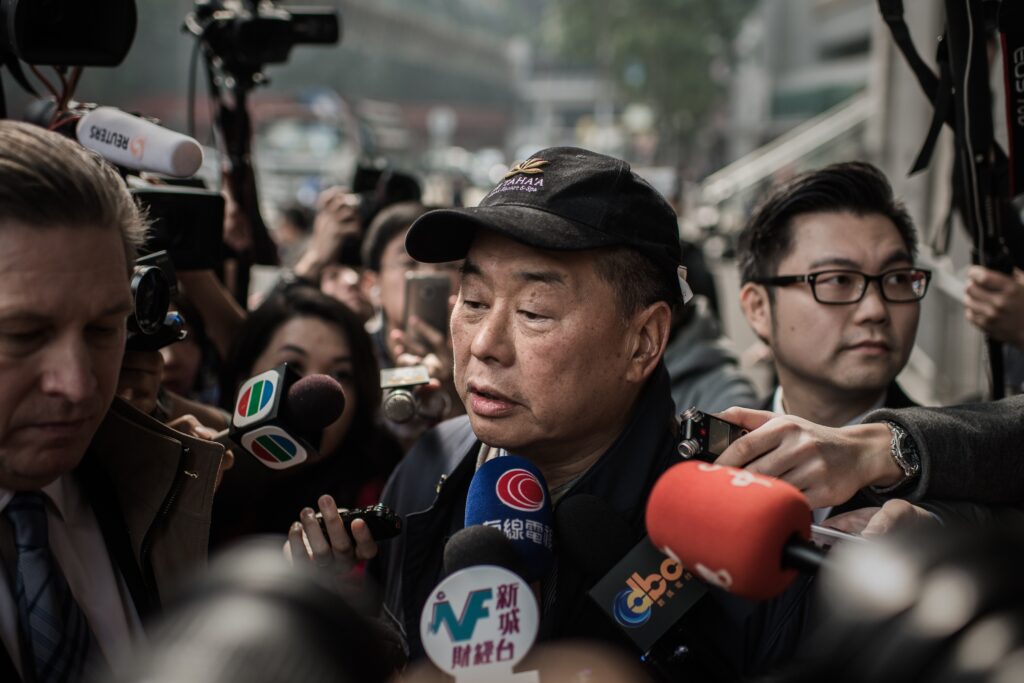
Hong Kong newspaper founder Jimmy Lai, a leading figure in the city’s pro-democracy movement and an ardent critic of the Chinese Communist Party, was on Monday found guilty of charges of sedition and collusion with foreign forces.
The case has become a symbolic test of Hong Kong’s national security law and its reach, exemplifying the Communist Party’s intense crackdown on the once-freewheeling territory. The 855-page verdict, handed down by three government-approved judges, will be seen as further proof that Beijing has swept away any last remaining press freedoms and judicial independence in the city.
The 78-year-old media mogul — who is a British citizen and does not hold any other citizenships, according to his family — could spend the rest of his life in jail. The sentence is expected at a later date.
Lai has been in detention since December 2020, almost all of it in solitary confinement. He was charged with national security violations, standing accused of using Apple Daily, the media outlet he founded, to call for sanctions on Hong Kong and Chinese officials as punishment for cracking down on pro-democracy movements in 2019. He was also accused of funding international campaigns to garner support for such sanctions.
Dozens of supporters sheltered under blankets and umbrellas in a long line outside the courthouse overnight in the hopes of attending the hearing. Armed police from Hong Kong’s counterterrorism unit patrolled nearby, local media reported.
A police car carrying Lai arrived at West Kowloon Magistrates’ Court before 7:30 a.m. local time. Members of Lai’s family, accompanied by Cardinal Joseph Zen, who served as bishop of Hong Kong until 2009, were seen entering the court later.
During the 156-day-long trial, which ended in August, the court went to great lengths in scrutinizing Lai’s previous social media posts, interviews and public remarks while also probing his ties with political leaders from the U.S., the U.K. and Taiwan. Prosecutors cited his connections with American and British politicians, including former vice president Mike Pence, to claim that Hong Kong’s unrest was engineered by outsiders.
Appearing in court in November last year, Lai described the idea he had been advocating for Hong Kong’s independence as “crazy.” In closing arguments in August, Lai’s defense attorney, Robert Pang, said that it was “not wrong to try to persuade the government to change its policy. Nor is it wrong not to love a particular administration or even the country.”
Sebastien Lai, Lai’s youngest son, said the prosecutors had tried to paint his father, a devout Catholic, as a violent person motivated by money. “But all they have uncovered is that he is a peaceful man who stands by his principles,” Sebastien Lai told The Washington Post before the verdict was released. “To incriminate him they have to make the very idea of wanting democracy a crime.”
Before his election in November last year, President Donald Trump pledged to free Lai. “100 percent I’ll get him out. He’ll be easy to get out,” Trump said in a podcast with Hugh Hewitt in October 2024. Trump raised concerns with Xi during their first face-to-face meeting of Trump’s second term, held in South Korea in October this year, according to a report by Reuters.
During his trial, Lai said he had never met, spoken to, or exchanged messages with Trump, but confirmed while giving testimony late last year that he had hoped the U.S. president could stop Hong Kong’s national security law from taking effect in 2020.
That year, Beijing imposed the national security law on Hong Kong, loosely defining terms including “inciting subversion” and “collusion” and allowing sentences of life in prison. Over the five years since, media outlets and civil organizations have been disbanded and critics of the government have gone silent.
Almost every prominent opposition figure in Hong Kong is either in jail or in exile now.
In addition to the national security charges, Lai has faced a raft of other charges. At the end of 2022, he was sentenced to more than five years in prison for violating terms of a lease contract, a punishment that human rights activists called “incredibly heavy.” He was also handed a prison term for attending an “unauthorized assembly” in 2021.
Lai pleaded not guilty to all charges and was denied bail, meaning he was held in custody during the repeated delays to his trial.
One reason for the delays: Lai has developed health problems, including high blood pressure, during his imprisonment, and the trial has been interrupted while he was sent to hospital for medical care. His lawyers in September launched an urgent appeal to the U.N., saying there was a risk to his life because of his continued detention.
Lai’s daughter, Claire Lai, this month told The Post that her father has lost significant weight, is experiencing heart problems and is not receiving proper medical care in detention. The Hong Kong government rejected the allegations and said that Lai has received appropriate treatment.
Another reason: Hong Kong’s China-backed legal authorities blocked Lai’s efforts to hire a British lawyer, banning foreign attorneys from acting in a case about national security.
Democracy advocate
Born in southern China in 1948, Lai arrived in Hong Kong as a 12-year-old stowaway and later founded the clothing brand Giordano. In 1989, he supported the Tiananmen Square pro-democracy protests by printing more than 200,000 T-shirts and banners, prompting Beijing to crack down on his business in China.
In 1995, he launched the pro-democracy newspaper Apple Daily, two years before Britain passed control of the territory back to China, although with the caveat that its freedoms under the “one country, two systems” framework must be respected for 50 years. The paper quickly became one of Hong Kong’s most-read publications and a thorn in Beijing’s side.
With calls for greater independence for Hong Kong growing during the 2000s, culminating in huge pro-democracy protests in 2019, Beijing swiftly moved to impose draconian controls in the territory, including on the media.
The shrinking civil liberties took a toll on the city’s annual Tiananmen vigil held at Victoria Park, which used to draw tens of thousands each year to remember those killed by the Chinese military on June 4, 1989. The park now hosts pro-China carnivals celebrating mainland culture around the anniversary date, while police arrest passersby who attempt to commemorate the incident.
Two months after the national security law took effect in 2020, 200 police officers raided Apple Daily’s headquarters, arresting Lai and several senior managers. Within a year, the newspaper was forced to shut down.
International condemnation
Lai’s trial has drawn condemnation from Western countries, including the United Kingdom, where he is a citizen.
Keir Starmer, the U.K. prime minister, raised Lai’s case during his meeting with Chinese leader Xi Jinping during their meeting at G-20 in November, saying that he’s “concerned by reports of Jimmy Lai’s deterioration [of] health in prison.”
Marco Rubio, the secretary of state, in March told Hewitt that getting Lai out of prison was “a priority.”
“We’ve raised it in every possible form and they know that it’s important to us, and I think there are other countries as well that are very involved in raising this issue,” Rubio said. “It’s not something we’ve forgotten about and that it remains a priority, and I think other countries around the world are making the same point as well to the Chinese.”
In August 2020, during the first Trump administration, the U.S. sanctioned 11 Hong Kong and mainland officials, including current Chief Executive John Lee, for undermining Hong Kong’s autonomy.
Lai’s friends and family say the media mogul remains committed to fighting for Hong Kong’s freedoms.
Chan Kin-man, a leader of the 2014 pro-democracy Umbrella Movement who was imprisoned for 16 months and now lives in Taiwan, said he urged Lai to leave the city before he was caught up in the tightening net.
“I told him that the National Security Law was tailor-made for him. He had a chance to leave,” he said, recalling that Lai told him during a prison visit: “My life belongs to Hong Kong. That’s why I am not willing to leave.”
Vic Chiang in Taipei, Taiwan, and Christian Shepherd and Shibani Mahtani in Singapore contributed to this report.
The post Hong Kong court convicts pro-democracy newspaper founder Jimmy Lai appeared first on Washington Post.