It was on an October flight from the Middle East to Miami that everything-envoy Steve Witkoff and Jared Kushner, the president’s son-in-law, decided it was time to turn to Ukraine.
Through sheer chutzpah, the duo had just clinched an unlikely cease-fire deal between Israel and Hamas just after the war’s second anniversary. Could the same tactic work on another seemingly intractable conflict? Soon after the flight, Russian and Ukrainian diplomats were shuttling to Florida, where Mr. Witkoff lives. “The president will give me a lot of space and discretion to get to the deal,” Mr. Witkoff told a Russian aide, in a leaked recording of their phone call. Within weeks, he and Mr. Kushner, just as they did with the Gaza cease-fire deal, put together a list of conditions they wanted the Russians and Ukrainians to sign onto.
This time, it didn’t work. Mr. Witkoff’s proposed deal angered the Ukrainians and alienated Europeans, who say it highly favors Russia, and President Vladimir Putin of Russia is already pushing to get even more out of the Americans. The peace deal President Trump said he could deliver 24 hours into his second presidency, then again by Thanksgiving, remains out of his grasp.
The president’s men may yet stumble onto a path to progress in a war that has been stuck in stalemate for years. After all, in a few short months, Mr. Witkoff — a New York landlord whose prior foreign policy bona fides included a string of lucrative luxury real estate deals and the distinction of being Mr. Trump’s golfing partner — has notched diplomatic successes that eluded President Biden’s most experienced envoys.
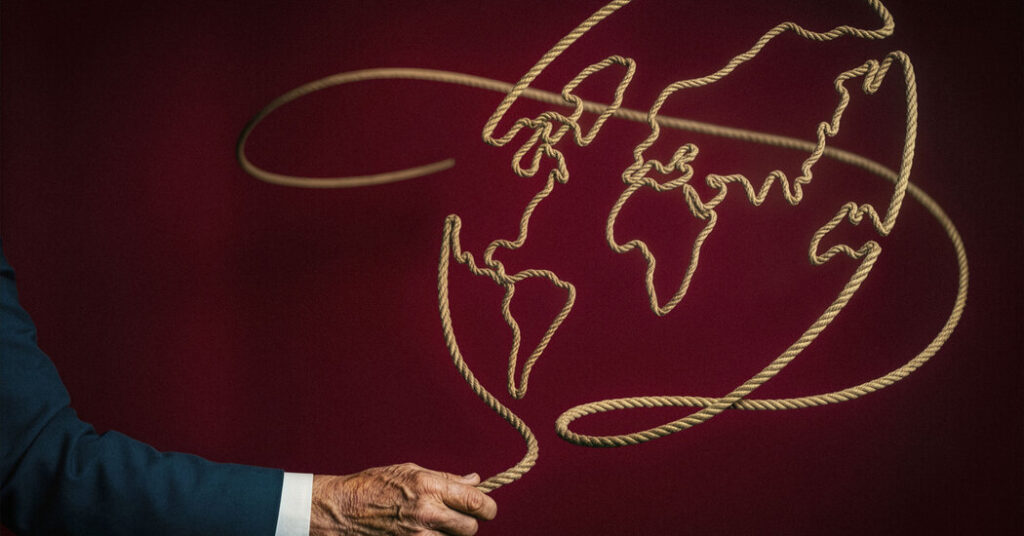
The administration’s critics say the deals in Ukraine and Gaza are half-baked; that they are built on the back of diplomatic work done by the Biden team; that they endanger our allies and long-term national security interests. All of that may be true, but the foreign policy establishment should not write off the Trump approach. Sometimes Mr. Trump’s unconventional foreign policy — let’s call it cowboy diplomacy — just works.
The traditional methods of American foreign policy, established after World War II as contemporary institutions of statecraft and national security took shape, are painstaking and methodical. The bureaucratic, interagency process of signoffs between offices and departments often left little room for principal American diplomats to act. Their job was to arrive at the end of a long process of talks and negotiations to seal the deal. By contrast, Mr. Trump’s cowboy diplomats are out front from the beginning. They speak bluntly. They seize opportunities and work out the details later.
This strategy has yielded impressive results. In the Middle East, Mr. Trump has shattered longstanding taboos: He dispatched envoys to engage with Hamas, a designated foreign terrorist organization, and lifted sanctions on Syria after the fall of the dictator Bashar al-Assad and last month welcomed its interim president, a former commander of a rebel group allied with Al Qaeda, in the White House. Mr. Trump’s envoys have accomplished tricky prisoner exchanges with Russia and made progress in enduring conflicts between Azerbaijan and Armenia and the Democratic Republic of Congo and Rwanda.
In typical Trump hyperbole, the administration has repeatedly claimed the president has ended “8 wars in just 8 months.” Those numbers don’t add up. But through conversations with more than a dozen current and former Trump and Biden appointees and career diplomats, I’ve learned that many seasoned foreign policy experts find a certain utility in Mr. Trump’s approach. The practitioners I spoke to said there are real benefits of operating outside of the strictures of diplomatic precedent, even if there are also serious risks of inexperienced envoys running policy. The problem, they said, is that after the evisceration of the State Department, there are not enough experienced professionals to finish the job after Mr. Trump’s envoys get back on their jets and go home. Cowboy diplomacy can be highly effective for the opening salvo, but if the experts aren’t around to step in to finalize the details, these flashy deals may soon fall to pieces.
A quick look at Mr. Trump’s foreign policy shop shows what a departure his team is from Bidenworld, where many appointees hailed from the usual handful of think tanks and law schools, or were former senior administration officials under President Obama. The appointees in Mr. Trump’s second term, as in his first, seem to share proximity to the president — via marriage or business dealings — as their primary qualification.
Massad Boulos, the father-in-law of the president’s daughter Tiffany, is a small-time truck salesman who, without having been confirmed by the Senate, effectively now runs Africa policy in the State Department. Mr. Kushner lacks a formal portfolio in this administration but has been orchestrating Middle East policy alongside Mr. Witkoff. (His father, Charles Kushner, is the U.S. ambassador to France and Monaco.) Tom Barrack, a Lebanese American investor close to Mr. Trump, who was indicted and later acquitted of being a foreign agent of the United Arab Emirates, serves as the U.S. ambassador to Turkey. He has leveraged the position into a much bigger Mideast portfolio, including a post-Assad Syria.
Each of these men’s ability to pick up the phone and speak to Mr. Trump, rather than go through a laborious interagency process, gives them direct access to presidential power. That in itself is not new. Foreign service officers say that ambassadors who are political appointees — in contrast to the ambassadors who rise through the ranks over decades of training and public service — have long had the ability to give their embassy more clout. And Mr. Trump is hardly the first president to rely on less experienced confidants.
“There’s a long tradition of American presidents having outsider friends who they trust far more than they do the people in the system,” said Alexander Gray, the chief of staff of the National Security Council in Mr. Trump’s first term. “Having that outsider with close presidential trust can be a very effective way to break logjams.”
But Mr. Trump’s envoys have far-reaching power relative to their inexperience. Mr. Boulos, officially a senior State Department adviser, has been received by multiple heads of state, despite the fact that he neither is in the cabinet nor has special envoy in his title. He helped broker a peace deal between the Democratic Republic of Congo and Rwanda; this month, they signed the agreement at the recently rebranded Donald J. Trump Institute of Peace. The treaty has not entirely shifted the reality on the ground, but it was a significant step for two countries that have been at war for three decades. “If you are trying to negotiate with a head of state and with the head of intelligence in Congo, they want to know that you have the president’s ear,” said a senior Biden diplomat who worked on Africa policy. “That is much more important to them than whether you’ve had 20 years of experience as a diplomat.”
In February, Mr. Witkoff worked to get an American teacher named Marc Fogel released from Russian prison. Special envoys have leveraged the president’s power to help secure the release of American detainees from Russia, Belarus and Afghanistan. Over the course of his term, Mr. Biden worked to free some 70 Americans held by foreign governments. Mr. Trump has already freed that many in the last year, yielding the kind of tough guy, telegenic diplomatic moments that this administration loves.
Some of the cowboy diplomats employ a folksy bluntness that stands out in the otherwise staid foreign policy setting. In October, Mr. Witkoff had lobbied Itamar Ben-Gvir, Israel’s extremist, pro-settler national security minister, to agree to a cease-fire in Gaza. “We just can’t play the victim all the time,” said Mr. Witkoff, who lost his son to an overdose and likened his pain to the national trauma of Oct. 7. “At some point,” he said, “you gotta let it go.” He used a similar vein of strategic empathy with the Hamas representative Khalil al-Hayya, whose son was killed in an Israeli airstrike on Qatar in September. After two years of nearly unrelenting warfare, Mr. Witkoff’s personal-first methods had helped secure a truce between Israel and Hamas.
Conflicts of interest abound. The Witkoff family, through its virtual currency company World Liberty Financial, co-founded by Mr. Witkoff’s sons and in which the Trump family also has a sizable stake, landed a $2 billion crypto investment from a firm backed by the United Arab Emirates. While holding a large financial stake in the company, Mr. Witkoff advocated giving the Emirates access to high-tech chips. Tiffany Trump socialized with an oil billionaire who stands to profit from her father-in-law’s statecraft. Jared Kushner’s investment firm is largely financed by the same petro-states that would be involved in the potential reconstruction of Gaza: Saudi Arabia, Qatar and the United Arab Emirates. “What people call conflicts of interests, Steve and I call experience and trusted relationships that we have throughout the world,” Mr. Kushner said recently.
The new envoys’ lack of experience also makes them more prone to insult their hosts (see Mr. Barrack’s referring to Lebanese journalists as “animalistic,” for which he later apologized), get played by savvy world leaders (see Mr. Witkoff’s meeting Mr. Putin with only a Kremlin interpreter), or simply be caught off guard. In a July meeting, the Tunisian president showed Mr. Boulos photos of starving Palestinian children and chastised him. The official stood and listened, almost unresponsive.
Among the toughest diplomatic feats that lie ahead for Mr. Trump would be a breakthrough with Iran. In April, there was an opening. Mr. Witkoff shook hands with Iran’s foreign minister, Abbas Araghchi, in Oman and then met him a week later in Rome, in a bid to renegotiate the nuclear deal that the president abrogated in his first term. Mr. Witkoff had suggested a deal in which Iran could continuing enriching some uranium as long as it didn’t present a threat, in exchange for offering Tehran economic relief. He left Oman happy, according to a senior Iranian official.
Then things got rocky. In May, Mr. Witkoff switched his tack: He said that Iran would have to agree to zero enrichment, perhaps as a result of criticism from more hawkish MAGA figures and right-wing media, who balked at allowing any enrichment. For the Iranians, that was a nonstarter — a jab at Iran’s national pride. The sudden change caused Mr. Witkoff to lose credibility with the Iranians. Then, days before Mr. Witkoff and Mr. Araghchi were due to meet again, Israel launched airstrikes against Iran, and Mr. Trump joined the attack, dropping bombs on three nuclear sites. Now diplomacy with Iran is on hold.
Not every deal is holding up. Intense fighting continued on the Congo-Rwanda border hours after Mr. Trump said he “ended” the war. A Trump-brokered cease-fire between Thailand and Cambodia fell apart in November; last week, Thailand conducted airstrikes on the Cambodian border. On Friday, Mr. Trump said both countries agreed to return to the terms of the original cease-fire. It will take concerted diplomacy to transform Mr. Trump’s initial, brief agreement between Azerbaijan and Armenia into a lasting peace. Throughout the Gaza cease-fire, Israel has killed at least 360 Palestinians; in Ukraine, Russia has conducted some of its deadliest strikes since the war began even as Mr. Trump’s team negotiates.
As quickly as these dramatic agreements were brokered, the risk for America — and for the millions of people whose fate hangs in the balance — is that they might collapse just as quickly. David Schenker, who served as one of Mr. Trump’s top Middle East officials in his first term, says this style of foreign policy is in line with the ethos of the administration. “There’s not a whole lot of appreciation for expertise,” he said. “It’s good to have a disruptive approach every now and then, but there’s a cost.”
Nothing will be more high-stakes than the deal-making between Russia and Ukraine. The MAGA coalition that elected Mr. Trump views him as a peacemaker and doesn’t want to continue paying for this war. Aspects of the peace plan under consideration today lay out difficult truths, including that Russian-occupied Ukrainian territories of Crimea and the Donbas are likely to stay that way. That reflects reality on the ground — and the perspective of many Americans — in a clearer way than any other presidential statement to date. Almost 75 percent of Republicans want NATO member countries to push for a negotiated settlement in Ukraine. Whether Mr. Trump can strong-arm Ukraine toward a breakthrough will be the ultimate test of his unorthodoxy.
Even if a deal does get done, it will be the true experts who work out the fine print — and make sure it lasts. Absent follow-through, the most grandiose efforts will not be enough to end the carnage. Getting two sides to a yes is only part one.
But who will be there to finish the job? The everyday work of career officials has dramatically diminished. The State Department’s annual human rights reports have been pared down to the point of futility. The staffing level of the National Security Council has been reduced so significantly that it has led to open dysfunction. Secretary of State Marco Rubio, now also the acting national security adviser, has fired hundreds of State Department experts and members of the senior diplomatic corps.
Mr. Trump’s cowboy diplomats, with their jets and ostentatious deal-making, may end up helping him stop the biggest wars he inherited. If his team manages to freeze in place the conflicts in Gaza and Ukraine, even if they are left largely unresolved, that would still be more than his predecessor was able to accomplish. If peace is built on hollow agreements, though — on single-spaced sheets of paper with bullet points waved on the White House lawn — peace may not last very long.
Jonathan Guyer is a foreign policy journalist and a program director at the Institute for Global Affairs at the Eurasia Group.
The Times is committed to publishing a diversity of letters to the editor. We’d like to hear what you think about this or any of our articles. Here are some tips. And here’s our email: [email protected].
Follow the New York Times Opinion section on Facebook, Instagram, TikTok, Bluesky, WhatsApp and Threads.
The post Donald Trump’s Cowboy Diplomacy