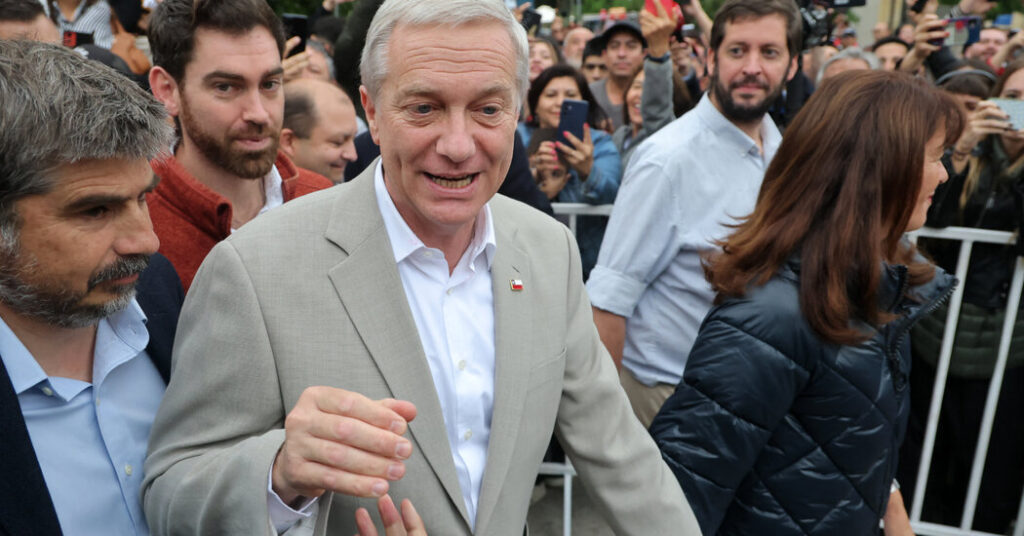
José Antonio Kast, a conservative candidate, was elected Chile’s president on Sunday, a sharp rightward swing for a country where voters have grown deeply concerned about security and illegal immigration.
Mr. Kast, 59, a father of nine with ideological roots in conservative Roman Catholicism and economic neoliberalism, had campaigned on a tough-on-crime platform with echoes of President Trump’s political approach, promising to deport undocumented migrants and build a barrier along Chile’s extensive northern border.
With over 98 percent of the ballots counted, Mr. Kast had more than 58 percent of the vote, a resounding victory over Jeannette Jara, the candidate for the center-left and a member of the Communist Party of Chile, who had about 42 percent.
“Chile will be free from crime again, free from anguish, free from fear,” Mr. Kast said in a victory speech on Sunday, outside his campaign’s headquarters in an upscale neighborhood of Santiago, adding that he would chase criminals and “lock them up.”
“Chile needs order,” Mr. Kast added as a large crowd of people, many of them wrapped in Chilean flags, let out cheers. Drivers honked in celebration, with banners billowing from some car windows that read “Bye-bye illegals” and “Play time is over.”
Mr. Kast’s election represents a clear reversal of the path of the left-wing administration of the current president, Gabriel Boric, and aligns Chile with other nations in the region, including Argentina and Bolivia, which have recently turned to the right.
“Congratulations to Chilean President-Elect José Antonio Kast on his victory,” Secretary of State Marco Rubio said on Sunday night. “The United States looks forward to partnering with his administration.”
In Chile, the shift was widely attributed to anti-incumbent sentiment, but it also reflected concerns about a surge in violent crime that has traumatized Chileans. Mr. Kast put the issue at the forefront of his campaign.
Ms. Jara, whom Mr. Kast defeated, had served as the labor minister in Mr. Boric’s government. Ms. Jara was widely seen as the candidate most likely to continue the policies of the incumbent government, which is quite unpopular.
Earlier in his political career, Mr. Kast, who has run for president twice before, was known for focusing on conservative Catholic values. In his speech on Sunday, he said, “Nothing would be possible if we didn’t have God.” But during this campaign, he largely avoided referring to divisive issues like abortion, which he opposes.
He has instead denounced the 50 percent increase in homicide victims in 2024 compared with 2018, largely attributed to the penetration of international criminal networks into the country. That emphasis resonated with Chileans, as nearly two-thirds of those questioned now consider crime their main concern, double the global average, according to a recent Ipsos survey.
Their second major concern, polls show, is controlling immigration, another issue that Mr. Kast has promised to vigorously crack down on. More than 300,000 undocumented migrants are living in the country, according to estimates by Chile’s National Statistics Institute. Many have come from Venezuela.
“Security, drug trafficking, uncontrolled illegal immigration and criminal organizations are the great concern of the citizenry,” said Pablo Longueira, a veteran right-wing politician and former Chilean government minister. “These are the issues that defined this election.”
Though people who have committed crimes are only a tiny fraction of the migrants who have come to Chile fleeing economic collapse at home, the Chilean police say the influx has also included gang members, whose victims are frequently other migrants.
Last month, Mr. Kast warned migrants that they had 111 days left to self-deport before he took office, or that they would be deported once he was sworn in next March, and he continued to update the countdown at later rallies. If they self-deport, he said, they will be able to bring their belongings with them, instead of being detained and expelled. His warnings have created tensions at Chile’s borders, with some migrants trying to cross into Peru and José Jerí, Peru’s president, declaring a state of emergency in the area bordering Chile.
Mr. Kast also promised to make illegal migration a crime in Chile and to build a “physical barrier” at the border, though local authorities near the frontier point out that the number of illegal entries has already significantly dropped.
“The issue of immigration must be resolved,” said Patricio Sepúlveda, 61, a Kast voter from Santiago. “If the solution needs to be one of greater force, so be it,” he added.
Mr. Sepúlveda said that he hoped the Kast government would re-establish Chile’s friendships with countries like the United States, Israel or Argentina, whose right-wing leaders Mr. Boric had criticized.
“One more step for our region in the defense of life, freedom, and private property,” President Javier Milei of Argentina said on social media Sunday night. “I am sure that we will work together so that America embraces the ideas of freedom and we can free ourselves from the oppression of twenty-first century socialism,” he said.
Mr. Milei also posted a map of Latin America highlighting that Chile, Argentina, Paraguay, Peru, Bolivia, Ecuador were all governed by the right, or center-right.
Colombia’s leftist president, Gustavo Petro, used Mr. Milei’s map as a warning ahead of elections next year, writing on X that “they are coming for us and we must resist.”
But in Chile, supporters celebrated Mr. Kast’s victory. “It was the change we needed,” said Braulio Valladares, 41, an engineer who voted for Mr. Kast as he stood outside his candidate’s headquarters on Sunday. “To go back to neoliberalism and capitalism.”
Mr. Kast is the son of German immigrants. His brother Miguel was a former minister during Chile’s military dictatorship under Gen. Augusto Pinochet.
Mr. Kast has expressed admiration for General Pinochet, who ruled the country for nearly two decades starting in the early 1970s. Though Mr. Kast condemned the human rights abuses of the regime, which was responsible for thousands of deaths and disappearances, he praised its economic achievements and once said that if Pinochet were alive today, he would vote for him.
Emma Bubola is a Times reporter based in Rome.
The post Conservative Wins Resoundingly in Chile’s Presidential Election appeared first on New York Times.