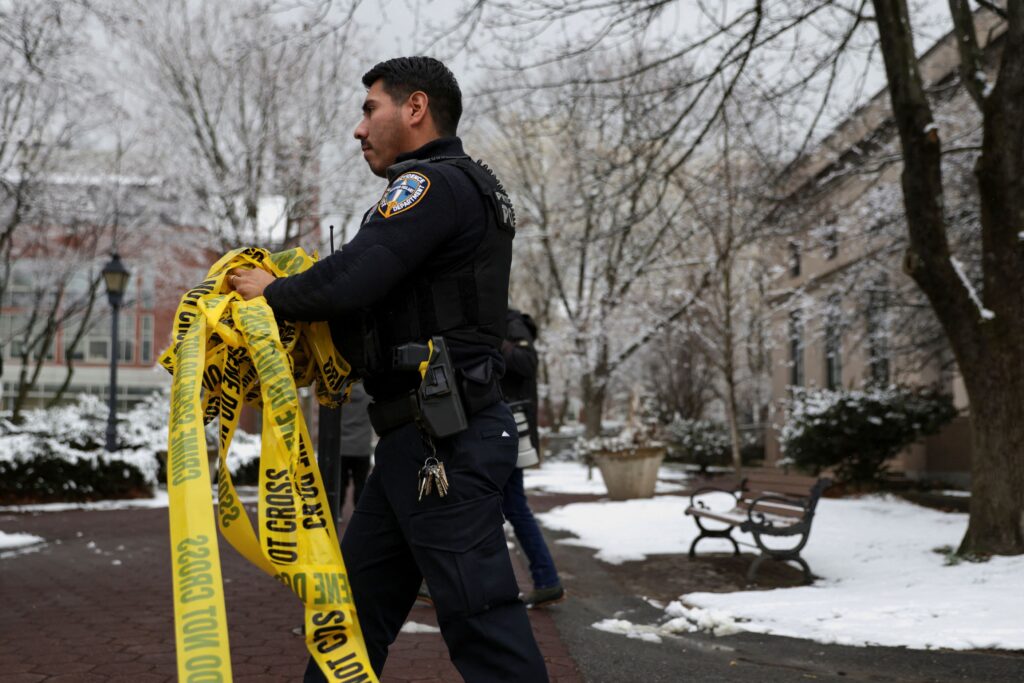
When a shooter burst into a Brown University study session on Saturday and opened fire, the doors to the building were unlocked.
Some students said the first alert from the university warning of an active shooter came too late — precious minutes after they had gotten texts from friends about rumors of a shooting. Some said later alerts gave conflicting information.
Shortly before 5:30 p.m., Brown’s campus public safety office warned of a report of shots fired at another location. About a half-hour later, a new alert said that reports of a second shooting had been unfounded.
While frightened students were barricaded or hiding in dorm rooms and libraries, President Donald Trump said on social media that a suspect was in custody. He later said that was not the case.
For some, the unlocked door at a busy campus building and the conflicting information surrounding Saturday’s shooting raised concerns about security at the Rhode Island school after the gunman killed two students and injured nine.
Ava Srivastava, a freshman at Brown, said it was challenging to deal with the conflicting alerts while she took shelter in her dorm with her lights off and door locked. “I thought we would be out of danger pretty quickly and then for it to extend as long as it did and be so uncertain … it was a scary feeling,” the Michigan native said. “I was really jumpy. Any noise in the hallway, my heart would start racing.”
But some public safety experts said they did not see red flags in the university’s response to the shooting, emphasizing that such situations change rapidly and praising the quick identification of a person of interest just hours after the shooting. That person was later released, authorities announced late Sunday night.
Brown, unlike some other urban universities, is not sealed off by fences or other barriers; it’s accessible to anyone who wants to walk onto the Providence campus. While some schools, such as Harvard and Columbia, locked their gates and restricted access to campus after contentious protests over the Israel-Gaza war, Brown remained open.
Rob Kilfoyle, president of the International Association of Campus Law Enforcement Administrators and director of public safety and emergency management at Humber Polytechnic in Toronto, said that while best practices suggest sending a first alert five to 10 minutes after learning of an emergency, university officials have been more careful to verify reports after a series of shooter hoaxes, or swatting incidents, earlier this fall. And the first priority is to alert law enforcement so they can get to the scene, he said, before officials issue a public warning.
Colleges must balance the need for security with the educational mission, Kilfoyle said. “That’s probably one of the toughest things that we have to do in campus public safety, is find that equilibrium between not wanting it to seem oppressive and too restrictive, but also providing sufficient security.”
In today’s politically charged climate, many universities have developed detailed protocol over access to campus buildings to protect students and faculty, officials at the Association of Threat Assessment Professionals said. “Nonetheless, there are certain types of activities during which doors are not typically locked, which can include anything from guest speakers to special events to final exams,” the association’s president, Dorian Van Horn, and spokeswoman Wendy Patrick wrote in an email.
Kilfoyle also said that the high volume of calls coming in can make the call center chaotic in such a situation.. Once an active shooter situation has been verified, he said, further reports would not be as carefully vetted before warnings are issued. It’s better to alert people to a potential danger that turns out not to be a problem, he said, than to not warn them of a potential active threat.
Rodney Chatman, Brown’s vice president for public safety and emergency management, and university spokespeople did not respond to questions Sunday. Chatman, who has many years of experience in the field, is the incoming president of the International Association of Campus Law Enforcement Administrators.
In a news conference that afternoon, officials said sirens had not sounded to alert the campus of the threat because law enforcement had responded immediately.
Talib Reddick, a senior who’s the student body president, said that he had heard from many students grateful for the school’s frequent updates — sent by text, call, email and social media — over the hours-long lockdown.
Some students expect to be haunted by the tragedy and feelings of vulnerability.
“I don’t know how I will adjust to coming back — I will come back for the spring semester,” graduate student Aboud Ashhab said. “So I don’t know how I feel about, like, sitting in a library or going to public spaces.”
Srivastava said she understands the reasons academic buildings are kept open, but expects discussion about how best to move forward.
“There are conflicting feelings,” she said. “I understand the want for security, but at the same time, given that it’s finals, people have to enter and exit. There is only so much that can be done.”
Anticipating conversations about security on campus, she said, “I am hopeful to see things put in place to prevent this from ever happening again.”
Alec Dent contributed to this report from Providence.
The post Brown University’s campus has always been open. The shooting raises concerns. appeared first on Washington Post.