Casey and Leah Garner wanted a big family. The Wisconsin couple had dreamed of having at least six children by the time they were in their 30s. But after years of struggling with infertility, they decided to adopt.
At the hospital three years ago, meeting the newborn who would become their daughter, Mr. Garner was the first to notice the tiny flaps of skin where her ears should be. Annie, the child they were adopting, was deaf.
Over the next few months, as they got to know their daughter, the Garners would discover more challenges, including poor vision, a developmental disability and weak muscles.
They were first-time parents, and they felt overwhelmed, thrown into an unfamiliar world they hadn’t expected. “I was out there looking for anything and everything that could help us,” said Mr. Garner, now 34.
He discovered the Wisconsin Deafblind Project, a state program for the families of children with combined vision and hearing loss. It made a tremendous difference as they learned to parent Annie, the Garners said.
They met other families experiencing the same thing. A mentor taught them sign language. Annie got sensory toys and Braille books. And she even made a best friend with a similar condition.
Then in September, the Trump administration canceled the five-year, $918,000 grant for the program, which supports about 170 children in Wisconsin like Annie. It also ended a $10.5 million grant used to recruit and retain special education teachers in the state.
The moves came at the same time that the administration cut similar programs for deafblind children across seven other states — all of which lean Democratic. In each case, the federal officials cited language in the programs’ grant applications related to goals for diversity, equity and inclusion.
Diversity efforts have been a point of attack for President Trump, who has attempted to quash them in both the public and private sectors. One of the first executive orders he signed after taking office targeted DEI initiatives throughout the government, including federal grants used to advanced DEI programs.
His administration has said it would not cut special education funding, although civil rights investigations into disability education have been curtailed, and other programs would be moved to new agencies as part of Mr. Trump’s wider goal to dismantle the Education Department.
By targeting diversity language, however, the administration has been able to make cuts to programs that benefit children with disabilities without specifically rolling back special education. In addition to the deafblind initiatives, the Education Department said it had slashed money for more than two dozen similar programs, including a school for the blind.
“Many of these use overt race preferences or perpetuate divisive concepts and stereotypes, which no student should be exposed to,” said Savannah Newhouse, an Education Department spokeswoman, in an emailed statement about the programs being cut.
The Garners said they were shocked that the government would cut off assistance for raising a deafblind daughter. “It seems like it should be a group of kids that everyone wants to help,” said Mr. Garner, a civil engineer. “Taking away help from deafblind kids? I don’t understand.”
The Wisconsin Deafblind Project was penalized for prioritizing “applicants from underrepresented and historically marginized groups,” according to a letter from the Trump administration, as well as its efforts to contract with women and minority business owners or disabled veterans.
Trump Administration: Live Updates
Updated
- House Republicans accuse D.C. police of manipulating crime statistics.
- Zelensky says he’d drop hopes of joining NATO in return for strong security guarantees.
- Appeals court says the Los Angeles National Guard deployment must end by Monday.
The deafblind programs in other states that lost funding had similar language or stated goals. Ms. Newhouse, the agency spokeswoman, said in her statement that the grant funds were being reinvested to “better serve special needs students.”
Appeals by Wisconsin and other states to restore funding were quickly denied by Trump officials. An umbrella organization, the National Center on Deafblindness, said it could provide enough money from its own Education Department funding for the programs to continue — but only for another year.
Some 10,000 children across the United States qualify as deafblind — a rare disability that occurs when someone has combined hearing and vision losses, often caused by complications at birth or genetic mutations. Most have additional disabilities.
“For this small number, these dollars meant the world,” said Jolene Gruber, the grant coordinator for the Wisconsin program.
Liam Anderson, 19, has been deafblind since he was 3, when he contracted meningitis and had a stroke. His mother, Jodi Anderson, remembers her first call with employees from the program, describing it “one of the best phone calls ever.”
They understood the challenges Mr. Anderson would face, she recalled, and those early conversations helped her to realize that her son could still live a happy, fulfilling life.
The program trained an interpreter in the school district to help Mr. Anderson communicate — a specialized role known as an “intervener” — and the intervener helped him learn to understand tactile sign language and read Braille.
Now, there are Braille books scattered around the Andersons’ home. Mr. Anderson is currently making his way through the book of Leviticus from the Bible.
In high school, with the intervener’s help, he was able to join the marching band, playing percussion, and now takes drum lessons.
The program was also a boon for Sid Miller, a 19-year-old in Belgium, Wis., who has hearing and vision impairments. It helped him learn to ask for accommodations, like live captions in his high school classes and a sighted guide.
Those tools are now helping him study graphic design at a technical college, and he’s picked up contract work for the program, creating objects using 3-D printing that help deafblind children. Before a recent adaptive sailing trip, he made them a model of a boat, so they could visualize the vessel before taking part.
He worries that the younger students won’t get the same opportunities that he did if the program’s funding is cut. “It’s kind of cruel,” he said.
For Annie Garner, the program has provided something her parents feared she might not find, because of her communication issues and other disabilities: A best friend.
The Garners met another family through the program with a deafblind daughter, Emma, who was born just nine days apart from Annie. At their first meeting, the two sat together for hours, and now have regular play dates.
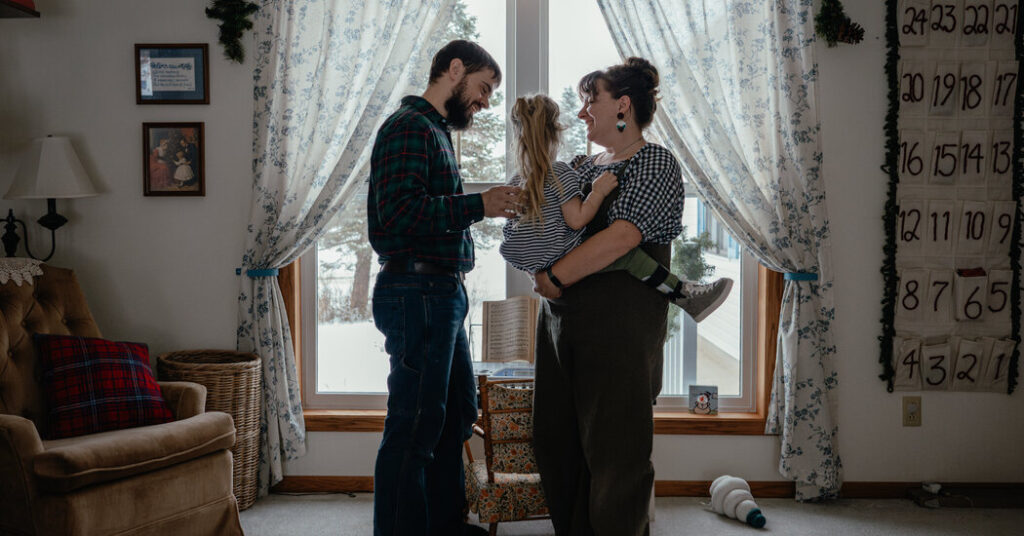
On a recent afternoon, Annie’s parents set up her feeding tube as she sat on the floor of her home in Reedsburg, a small town in a rural part of the state about an hour’s drive northwest of Madison.
A colorful headband held a hearing aid in place as Annie fiddled around with the electronic tablet that helps her to communicate — something she was taught to use by employees of the deafblind program.
She tapped several letters and symbols, until her message played: “I am a beautiful person who is the best.”
Sonia A. Rao reports on disability issues as a member of the 2025-26 Times Fellowship class, a program for early-career journalists.
The post Born Deaf and Blind, She’s Caught in Trump’s Anti-Diversity Crusade appeared first on New York Times.