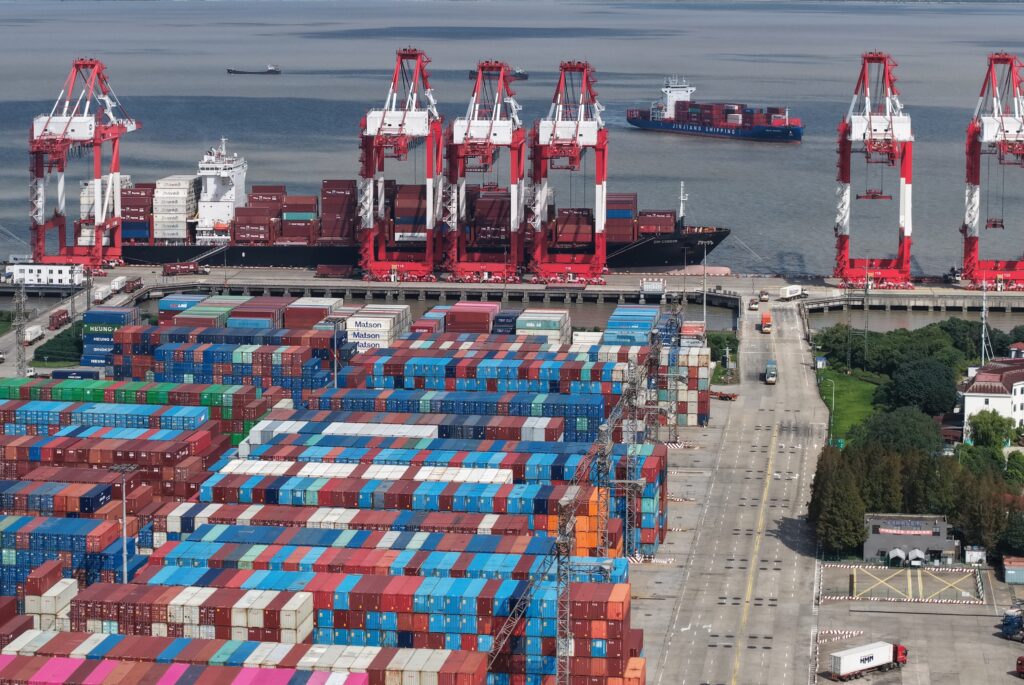
China was shifting away from an export-dominated economy before the United States first imposed tariffs seven years ago. Yet a trade war designed to undermine the Chinese Communist Party has coincided with a surging trade surplus. Central planners in the Democratic and Republican parties should take note.
Critics of free trade argue that China distorts the global economy because of its size. Adam Smith’s theories might be fine for dealing with Canada or the U.K., the argument goes, but the U.S. needs tariffs on China. Yet tariffs on China are no longer a thought experiment, and Americans can now study outcomes instead of theories.
For starters, there is space for some reasonable export controls; no one believes that the U.S. should sell its most advanced military technology to Beijing. But that’s not what has happened.
The U.S. has had high tariffs on Chinese goods since Trump began them in 2018. President Joe Biden largely kept them in place. Unlike Trump’s IEEPA tariffs, the China levies have been affirmed as legal by federal courts.
The latest evidence suggests they haven’t achieved their stated goals. China’s trade surplus, the evidence of its industrial overcapacity, cleared $1 trillion for the first time this year. China has more than compensated for its trade war with the U.S. by expanding exports to other countries.
The trade surplus was actually declining before U.S. tariffs, as China imported more goods from abroad to satisfy demand from its growing base of middle-class consumers. In fact, an International Monetary Fund paper from 2019 studied what would happen when China’s trade surplus disappeared.
President Xi Jinping’s totalitarian reassertion of greater government control amid the covid pandemic has coincided with that trend’s reversal. Industrial and construction firms closely connected to the ruling party have benefited at the expense of China’s overall economy. And China’s leaders can’t figure out what to do.
The continued reliance on exports and industrial capacity has been a problem for the Chinese economy, one that its government has been trying to resolve through fiscal and monetary policy designed to stimulate consumer demand. It has little to show after years of effort. Meanwhile, it has effectively been taking money from its own people to give the rest of the world a better deal on manufactured goods.
Elevated U.S. levies on Chinese goods have not significantly altered the amount of trade or the trade balance on a bilateral basis, with levels approximately the same in 2024 — the last full year for which data are available — as they were in the early 2010s.
In the absence of U.S. tariffs, the bilateral trade deficit would likely be even higher. But the U.S. has not done anything approaching cutting off trade with China. The record-setting year for total trade between the two countries was actually 2022.
Even for more discrete goals, which don’t show up in data, America’s ability to change China’s behavior appears limited. Last year, the U.S. trade representative issued a report reviewing whether U.S. tariffs were achieving their goals of reducing unfair Chinese trade practices. It found that their theft of intellectual property, coercion and misbehavior by state-owned enterprises, industrial planning and restrictions on foreign ownership have all persisted.
The counterintuitive truth is that trade policy doesn’t do much to change overall patterns of trade between countries. That has a lot more to do with savings rates and currency exchange rates.
Tariffs aren’t working to correct China’s economic misbehavior or reduce its industrial overcapacity. American policymakers have only fooled themselves into believing they can micromanage the Chinese economy by micromanaging the American economy through trade restrictions.
The post America cannot control China’s economic outcomes appeared first on Washington Post.