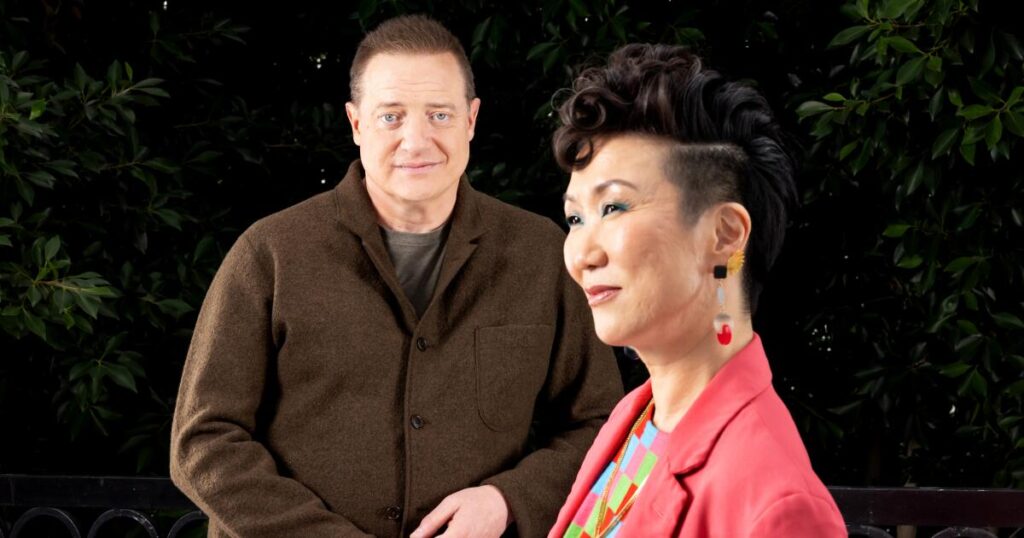
“Rental Family” is this season’s warmhearted contender that could. The charming drama has captivated audiences and critics alike since its premiere at the Toronto International Film Festival and was recently named one of the National Board of Review’s top films of the year.
“I haven’t met or heard anyone who has been disappointed,” says Brendan Fraser of the film, in which he plays an American actor living in Japan who stumbles into a gig working at a rental family agency, helping clients with their real-life issues and providing companionship. “Everyone seems to come away with something that has affected them in a way they were not anticipating.”
Director and co-writer Hikari, who was born in Osaka, says she’s received similarly positive feedback. She first learned about rental family businesses around 2018, when her co-writer Stephen Blahut discovered them. “People think the story is going to go one way and it takes them through a completely different journey emotionally.”
For Fraser, the project came at a perfect time, when he was mid-promotion for “The Whale” and technically unemployed. Hikari says she knew when she saw his Oscar-winning performance that he was her star. “I thought, ‘Wow, this man has such depth and he’s not afraid to be vulnerable,’” she recalls. “It was so clear to me. I kept thinking about my scenes in ‘Rental Family’ as I was watching ‘The Whale,’ and I was like, ‘There he is. Brendan works.’”
Fraser and Hikari joined The Envelope the morning after their L.A. premiere at the Directors Guild to discuss that first fruitful meeting, Fraser’s vulnerable, open-minded take on the film’s protagonist, Phillip, and learning and speaking Japanese for the role.
What was your first meeting like?
Brendan Fraser: Lengthy [laughs].
Hikari: I was so nervous! I went to New York because he read the script and said he’s interested. I was like, “Yes!” I wanted him to get to know me rather than just start talking about the movie. If he didn’t like me as a person, there’s no making the movie.
Fraser: I was looking for a job, to be honest. Seeking employment. This was before any of the award ceremonies that year. I was kind of hovering between the promotion [of “The Whale”], and I was even looking for representation. I was kind of a free agent at that moment. I didn’t have anything predetermined, but what I knew I wanted to do was something that was far removed from what I had done. You had me at the title: What is a rental family? And then to read on, I was delighted by the complex relationships and the depth of them and how it was written to not be sentimental. I thought it could fall into mawkishness, and I was a little concerned each time I turned the page. I was like, “Oh, he didn’t get together with Aiko. OK, phew.” “He’s not hooking up with a single mom, OK.” It felt authentic for that reason.
Can you talk about how you crafted the performance? What do you like about the type of acting you got to do?
Fraser: I’m going to reveal something to you, Hikari. I didn’t necessarily come up with a character per se. I just knew that I would go to Tokyo and do my darn best to play the scenes, and whatever it was that this guy did is what you get. So I was always hopeful that it was right or working in accord with what her vision of this was. I know there were guises of other characters that actors in a rental family could adopt, but I think what I did hope to do is just stay as close to what seemed authentic, and it didn’t have a patina to it.
Hikari: And I think that worked out perfectly. I tell everybody the way he was, was perfect. What I love about him was because of who he is, Brendan. And so it probably was best because he just came in so open.
How did you approach learning and speaking Japanese in the film?
Hikari: That was a really great thing. I was about to ask him if he would [learn]. He was like, “Hey, can I?” at almost exactly the same time. “Yes, I would love you to take Japanese lessons. Let me set you up with this teacher in New York City.”
What did or do you enjoy about the language?
Fraser: Its directness. Its ability to say more with less. Subject first and then fewer modifiers afterwards. It seems to be derived from larger meanings of concepts, ideas, art, poems. I like the cadence of it. I found it easier to pronounce than I anticipated, but having the right intonation was where I relied on Hikari to correct me. And luckily I have a skill for mimicry, so I can do that.
Hikari: He really nailed it with the language and the performance, in the way that [Phillip] really wants to belong in the country. He doesn’t want to be the big American, the way he sits or walks onto trains. He’s squeezing in, just really wants to belong.
How do you feel about the succession of these last few roles and what you’ve gotten to do?
Fraser: It makes me feel satisfied, personally, to know that I picked something that was almost a gotcha surprise. It didn’t stand out as an obvious choice. I didn’t have any kind of need or desire to exchange the energy or the attention that gets placed on an actor, as I’ve learned, after that award [the Oscar]. It’s like, “OK, you got this, but what will you do next?” And that’s underlined three times. My hope was to surprise people and to take that risk. I like the idea of people having a preconceived notion about what [“Rental Family”] is and should be, and knowing fully well, “You’re going to be surprised. It’s actually more interesting than what you thought.”
Have you relaxed into this part of promoting the film? Can you just enjoy the ride?
Fraser: For me, it’s an absolute pleasure because I know that those walking in the door with an open slate, something’s going to be imprinted on them that they weren’t anticipating, something good. I know that it’s giving people some sort of connection to the material that’s reminding them of something in their own life. And this was coming from even strangers. Those were hardened industry types there last night. I can’t say I know everybody, but I kind of understand the crowd, and it takes a lot to impress people at the DGA. So it seems like it’s disarming; it knocks the armor off of people’s desire to protect themselves.
Hikari: Don’t be afraid to feel, that’s what I always say, if you feel like tearing up. Don’t go in with expectations, just sit down and enjoy two hours of this journey with Phillip, two hours of Tokyo. Less than two hours, actually.
The post After ‘The Whale,’ Brendan Fraser was at a crossroads. Then he found ‘Rental Family’ appeared first on Los Angeles Times.