When Brown University junior Mia Tretta’s phone began buzzing with an emergency alert during finals week, she tried to convince herself it couldn’t be happening again.
In 2019, Tretta was shot in the abdomen during a mass shooting at Saugus High in Santa Clarita. Two students were killed, and she and two others were wounded. She was 15.
On Saturday, Tretta was studying in her dorm with a friend when the first message arrived, warning of an emergency at the university’s engineering building. Something must have happened, she thought, but surely it couldn’t be a shooting.
As more alerts poured in, urging people to lock down and stay away from windows, the familiarity of the language made clear what she had feared. By the end of the day, two people were dead and nine others injured in a shooting at her college campus in Providence, R.I.
“No one should ever have to go through one shooting, let alone two,” Tretta said in a phone interview Sunday. “And as someone who was shot at my high school when I was 15 years old, I never thought that this was something I’d have to go through again.”
Tretta’s experience captures a grim reality for a generation now in college: students who grew up rehearsing lockdowns and active-shooter drills, only to encounter the same violence again years later on campuses that once seemed like an escape from it.
In recent years, a number of students have endured multiple mass shootings at different stages of their education, including survivors of the 2018 massacre at Marjory Stoneman Douglas High School in Parkland, Fla., who experienced another deadly shooting at Florida State University in April.
Another Brown student, Zoe Weissman, reflected on social media about attending middle school in Parkland next door to the high school during the mass killing there. She said she was outside her school when the shooting happened. She heard gunshots and screams, saw first responders, then watched videos of what happened.
Ben Greenberg, the son of the mayor of Louisville, Ky., was in biology class at his high school in 2022 when the principal pulled him out of class and two police officers escorted him to meet his mother. She told him that his father, then a mayoral candidate, had just survived an assassination attempt. A gunman had stormed into his office and opened fire, and one bullet came so close to him it ripped a hole in his sweater.
Greenberg was often on edge after that, terrified that violence could take his family from him at any moment, he said. When he moved to Providence to attend Brown University, he finally felt he could relax a little.
Greenberg, now 20, lives directly across the street from the building where the shooting happened Saturday afternoon. He and his roommates were scared the gunman could be hiding in their house. They built a barricade at the top of the stairs with a mini fridge and a bookcase, and put bottles behind it, so if someone were to knock it over, at least the rattle of the bottles would alert them.
He talked to his parents on the phone all night, and they could hear the terror in his voice, said his father, Mayor Craig Greenberg. The assassination attempt changed their family forever, the mayor said. This shooting will, too.
“The impact of gun violence goes far beyond the individuals who are wounded or killed by bullets, to families, friends, entire communities. Those impacts are real; they’re not physical wounds, but they are traumatic wounds,” said Greenberg, a Democrat. “My hope is that eventually our nation will come together to take meaningful action; even if it’s small steps at first, we have to do something.”
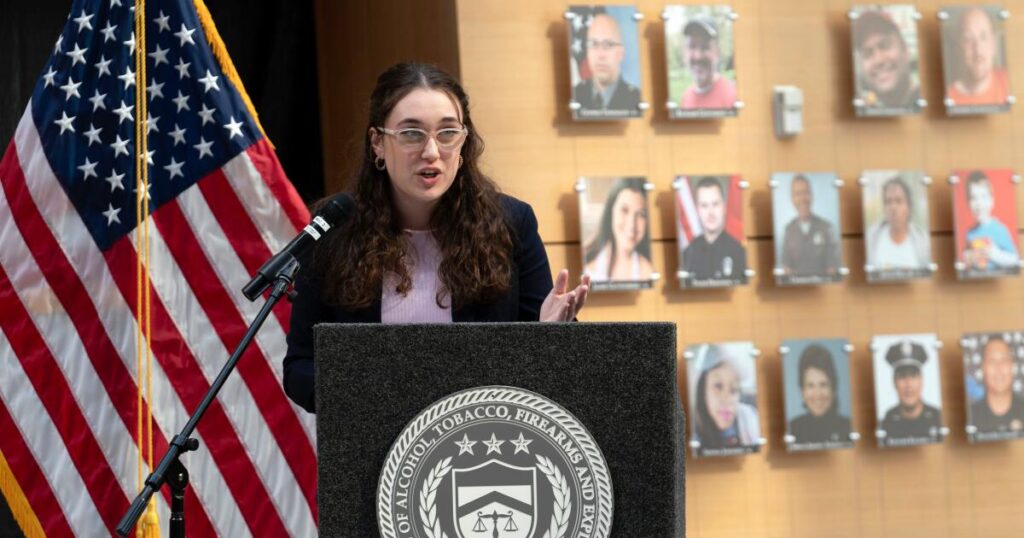
After Tretta was shot in high school, she pushed for tighter gun restrictions and rose to a leadership role with the group Students Demand Action. Her advocacy took her to the White House during the Biden administration, and she also met with then-Atty. Gen. Merrick Garland.
She has particularly focused on “ghost guns,” such as the one used at her high school, which can be built from parts and make it difficult to track or regulate owners.
And at Brown, Tretta had been working on a paper about the educational journeys of students who have lived through school shootings. The paper was due in a few days.
Tretta, who studies international and public affairs and education, said Saturday was the first time she’d gotten an active-shooter alert at Brown.
“I chose Brown, a place that I love, because it felt like somewhere I could finally be safe and finally, you know, be normal in this new normal that I live of a school shooting survivor,” she said. “And it’s happened again. And it didn’t have to.”
Mattise writes for the Associated Press. AP writer Claire Galofaro in Louisville contributed to this report.
The post A Saugus High shooting survivor, now at Brown University, endures campus tragedy again appeared first on Los Angeles Times.