The interstellar object 3I/ATLAS is expected to make its closest approach to Earth mere days from now, coming within just 167 million miles — a significant gulf, but a mere stone’s throw on the cosmic scale.
It’s an exciting moment that’ll give astronomers an unprecedented chance to point both ground- and space-based telescopes at the unusual visitor. They’ve been following the object, which is broadly believed to be a comet, for months now as it screams through the solar system.
Ever since NASA’s Hubble Space Telescope first gazed upon the object on July 21, scientists noticed a strange protrusion jutting out of the object, a second tail that counterintuitively points directly at the Sun, not away from it like the characteristic tails of familiar solar system comets.
This “anti-tail” could be the result of “enhanced mass loss in the Sun-facing side,” as Harvard astronomer Avi Loeb told Futurism earlier this year, which causes larger fragments to be broken off. These larger fragments are less susceptible to being affected by the Sun’s radiation pressure, causing them to move more slowly and accumulate on the Sun-facing side.
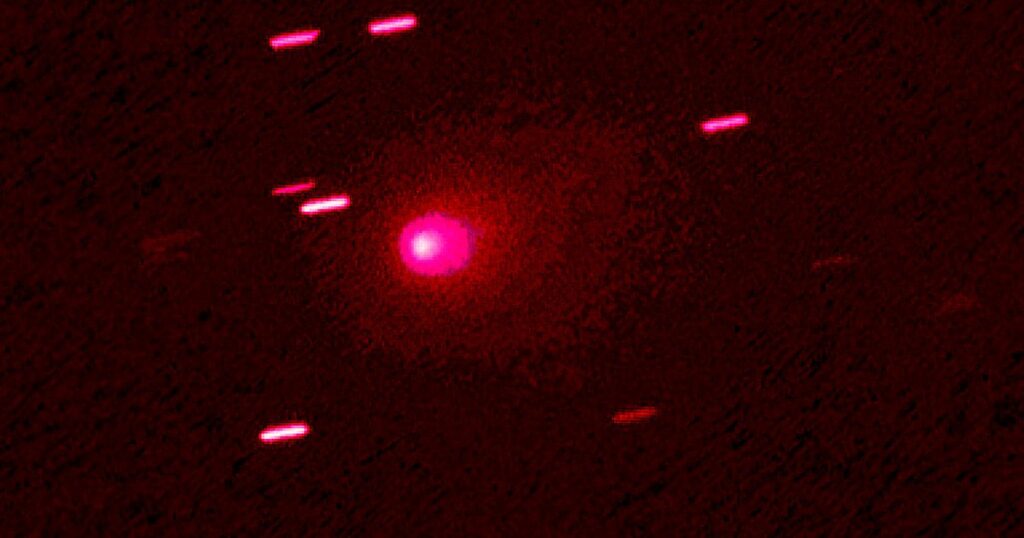
Over a month after its perihelion, or closest pass of the Sun, observations still clearly show 3I/ATLAS’ anti-tail, as Loeb noted in a new update on his blog. A December 13 image taken by the Teerasak Thaluang telescope in Rayong, Thailand “shows a prominent anti-tail, uncommon for comets, pointing in the direction of the Sun,” he wrote.
Judging by the “thousands of images” taken since Hubble’s July observations, which show 3I/ATLAS’ anti-tail, Loeb argued that it’s “not a perspective effect,” but a “real physical jet.”
“Its nature is a mystery because gas and micrometer-dust particles are expected to be pushed away from the Sun by solar radiation pressure and the solar wind, creating the appearance of a tail — as routinely seen in solar-system comets,” Loeb wrote.
As he tends to do, Loeb argued that there’s still a chance we could be looking at an alien spacecraft instead of a natural comet. He posited that the anti-tail could be a “swarm of objects that lag behind 3I/ATLAS because of its non-gravitational acceleration away from the Sun,” as he detailed in a yet-to-be-peer-reviewed paper.
However, others aren’t convinced of such a possibility, arguing the object’s two tails are nothing out of the ordinary, even despite 3I/ATLAS’ interstellar origins.
“It’s ejecting dust particles towards the Sun, because the day side of the nucleus is the hot side,” UCLA astronomy professor and comet expert David Jewitt told Sky and Telescope last month.
“All these things are consistent with a comet nucleus of typical size or smaller, sublimating in sunlight and blowing out dust particles,” he added. “Nothing really shocking there.”
In a September 29 blog post, Pennsylvania State University astronomer Jason Wright also criticized Loeb’s unusual conclusion that 3I/ATLAS could be an alien spacecraft, pointing out several previous observations of “similar sunward enhancement” caused by large, ejected dust grains that “don’t get swept up by the solar wind on the Sun-facing side of a comet.”
European Space Agency scientists have also suggested the secondary, observed tail could be a “dust tail” made up of tiny solid particles, which are typical for solar system comets.
Even Loeb himself is leaving every possibility open, authoring two other papers suggesting the anti-tail is the result of the “scattering of sunlight by fragments of ice shed from the sun-facing side of 3I/ATLAS.”
“These tiny ice particles evaporate before they get pushed back significantly by the solar radiation pressure and so they never appear as a conventional cometary tail,” he wrote in his latest blog.
Nonetheless, Loeb argued that we should be ready to expect the unexpected.
“By recognizing anomalies, we can learn something new,” he concluded. “By ignoring them, we remain ignorant.”
More on 3I/ATLAS: Mysterious Interstellar Object Now Approaching Earth
The post 3I/ATLAS Still Showing Strange Protrusion as It Approaches Earth appeared first on Futurism.