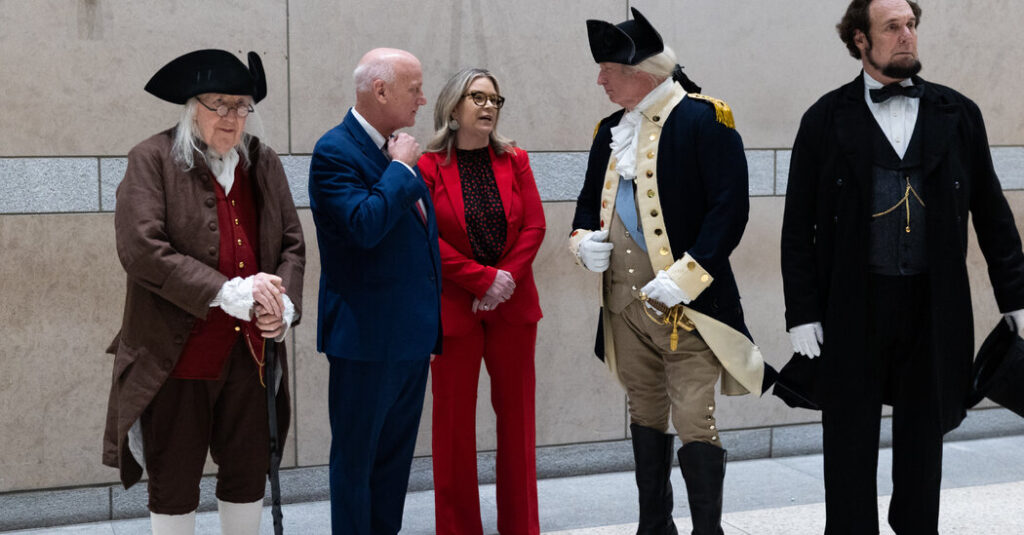
George Washington was there. And Benjamin Franklin. And even Abraham Lincoln, who joked that the last time he was in a theater it did not go so well.
These paid re-enactors and other dignitaries gathered the other evening in a Philadelphia auditorium for the unveiling of coins designed to celebrate the country’s 250th anniversary. They provided a traditional, even simple, take on the American journey, with Pilgrims and founding fathers and a stovepipe hat tip to the Gettysburg Address.
Left unmentioned amid the event’s fife-and-drum pageantry was that these coins also represented a rejection of a different set of designs — meant to commemorate certain other inspiring chapters of the nation’s history, including abolition, women’s suffrage and the civil rights movement.
An event largely unnoticed by anyone other than coin enthusiasts, then, wound up reflecting the national struggle over how the American story is told, as the Trump administration seeks to frame any focus on the knottier moments in the nation’s arc as “wokeness.”
The treasury secretary, Scott Bessent, is authorized by law to make final decisions about coin designs, including these 250th anniversary coins — a dime, a half-dollar and five quarters — which are both collectible and legal tender. But his choices ignored the more diverse recommendations for the quarters by the Citizens Coinage Advisory Committee, a bipartisan group mandated by Congress to review the U.S. Mint’s proposed designs for American coins.
To commemorate the abolition of slavery, the committee had recommended an image of Frederick Douglass on the obverse and shackled and unshackled hands on the reverse. To honor women’s suffrage, a World War I-era protester carrying a “Votes for Women” flag. And to evoke the civil rights movement, a 6-year-old Ruby Bridges, books in hand, helping to desegregate the New Orleans school system in 1960.
Mr. Bessent opted instead for the more general, and much whiter. For the Mayflower Compact, a Pilgrim couple staring into the distance. For the Revolutionary War, a profile of Washington. For the Declaration of Independence, a profile of Thomas Jefferson. For the Constitution, a profile of James Madison. And for the Gettysburg Address, a profile of Lincoln on the obverse, and on the reverse, a pair of interlocking hands. No shackles.
The rejection of its recommendations, along with the selection of designs it had not vetted, did not sit well with the committee, whose 11 members include numismatists, historians and members of the public. None attended the event last Wednesday, which served as a table setter for another divisive numismatic matter, also unmentioned: the administration’s plan to feature President Trump on a dollar coin.
Portraying a sitting president on a coin defies American tradition dating to the first president. Washington rejected proposals to feature his image on coins for fear of echoing the English monarchy from which the new country had just freed itself — a liberation sparked by the Declaration of Independence, which these coins, including one featuring Mr. Trump, are supposed to commemorate.
Several Democratic senators recently sent a letter to Mr. Bessent decrying a Trump coin as “un-American” and against the spirit of several laws. Senate Democrats also introduced a bill to prohibit “the likeness of a living or sitting president” from appearing on U.S. currency.
A spokeswoman for the Mint said in an email that “there was no prohibition on placing living persons on the obverse (front) of coins redesigned under the Semiquincentennial authority.” She did not answer questions about the appropriateness of featuring a sitting president on a coin.
Brandon Beach, the treasurer and a leading promoter of the Trump coin, said in a statement that Senate Democrats were “so triggered by the proposed coin celebrating our nation’s 250th anniversary that they are trying to recklessly change law to block it.” He added, “The American people deserve a commemorative coin celebrating our great nation.”
At this stage, the Trump coin seems certain to join other efforts by the president to celebrate himself; this month alone, the Institute of Peace was renamed the Donald J. Trump Institute of Peace and the National Park Service added Flag Day, which it noted was also Mr. Trump’s birthday, to its list of free entrance days (while cutting Martin Luther King Jr.’s birthday and Juneteenth). Proposed designs for the coin appear on the U.S. Mint’s website, even though the advisory committee has yet to review them, as required by law.
Donald Scarinci, a New Jersey lawyer and the longest-serving member of the advisory committee, called Wednesday night’s unveiling “another sad day for America,” because it marked the first time since the board’s establishment in 2003 that “the United State Mint announced coin designs that the committee never reviewed.”
“The guardrails that Congress created, so that all American coins and medals get reviewed by a citizens’ committee, have been removed,” Mr. Scarinci said.
But Kristie McNally, the Mint’s acting director, said in a brief interview that the treasury secretary had final say.
This latest skirmish over how the United States sees and presents itself is rooted in the little-known Circulating Collectible Coin Redesign Act of 2020, signed by Mr. Trump on Jan. 13. 2021, one week after the Capitol riot. The act authorized the production of coins celebrating the country’s 250th anniversary, including quarters of up to five different designs, with the specification that one of the five be emblematic of women’s contribution “to the birth of the Nation or the Declaration of Independence” or any other monumental American moment.
In keeping with this mandate, the Mint staff conducted historical research, consulted with the Smithsonian and other federal entities, and developed various options. Then, after review, the advisory committee and the Commission of Fine Arts developed separate recommendations for several designs meant to convey the promise of the Declaration of Independence, including those images of Frederick Douglass, a suffragist and the young Ruby Bridges.
The advisory committee forwarded its recommendations in October 2024 to the treasury secretary at the time, Janet Yellen. Mr. Trump took office two months later, after which the president, in his campaign against diversity efforts, issued an executive order “restoring truth and sanity to American history,” in part by “reversing the spread of divisive ideology.”
The committee heard nothing for months. And then: images of Pilgrims, long-dead presidents — and the president currently in office.
As for the requirement that one of the coin designs celebrate the contributions of women to the great American experiment, the Mint cited the image of a Pilgrim holding the hand of, and being embraced by, her protective male partner.
“The Mayflower Compact Quarter fulfills this legislative requirement,” a Mint official said in a statement. “The women of the Plymouth colony were essential for the colony’s survival by making medicines from native plants, preserving food, and educating children. It’s likely the women formed early connections with the Native American Wampanoag community, collecting knowledge about farming and food preparation.”
The unveiling of the Mayflower Compact quarter and other coins was held in the blond-wooded auditorium in the National Constitution Center, near Independence Hall. About 100 guests filed in, including Washington, who believed that coins should promote ideals, not individuals.
After several speeches and a performance by the U.S. Army Old Guard Fife and Drum Corps, a brief video flashed on a screen to reveal Mr. Bessent’s choices. Anyone looking for nods to civil rights and suffrage had to go downstairs to the Constitution Center’s display about the Nineteenth Amendment, which recognized women’s right to vote, or to its gift shop, where a children’s book about the civil rights movement, with a smiling Ruby Bridges on the cover, was on sale.
The moment the event ended, Mr. Beach, the treasurer, rushed toward the exit. He had less than a half-hour to catch a train back to Washington.
Before disappearing into an elevator, Mr. Beach said that the Trump dollar coin would be unveiled soon, but that the final design needed to be shown to “him.”
Asked whom “him” referred to, he said: The president.
Dan Barry is a longtime reporter and columnist, having written both the “This Land” and “About New York” columns. The author of several books, he writes on myriad topics, including New York City, sports, culture and the nation.
The post The War on ‘Wokeness’ Comes to the U.S. Mint appeared first on New York Times.