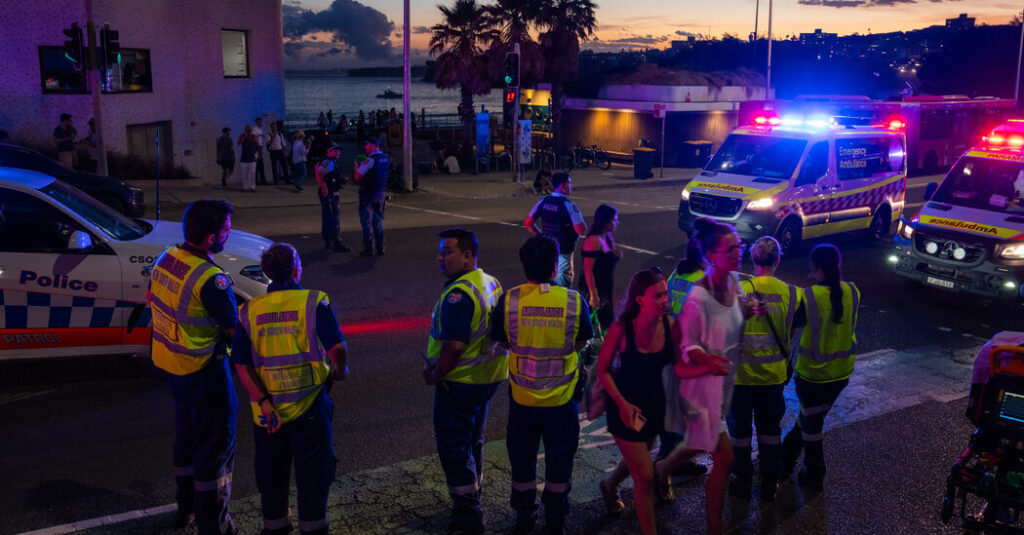
In Montana and Maine, in Houston and Chicago, in Schenectady, N.Y., and snowy Manhattan, rabbis awoke on Sunday and reached for their phones, only to learn of an attack on a Hanukkah celebration in Sydney, Australia, that left at least 15 people dead.
And with the first evening of the holiday still approaching in the United States, they were left to determine how to respond, both spiritually and practically, to violence that several said was shocking — but not particularly surprising.
“It’s not a new thing to wake up and read stories like this. It feels almost normalized,” said Rabbi Rachel Simmons, 38, of Temple Beth El in Portland, Maine, who said preparations were already underway to protect a communitywide Hanukkah party later this week. “We will definitely have armed guards, and we’ve spoken with local police about increasing their presence.”
Antisemitic hate crimes have risen swiftly in the United States since 2021. Attacks in Boulder, Colo., and Washington this year stoked anxiety among Jews around the country, and the violence in Australia seemed likely to escalate the tension.
By noon on Sunday, many of the rabbis contacted by The New York Times had communicated with congregants, sending messages of sadness and hope, and drawing connections between the attack and Hanukkah, a holiday that celebrates the Jewish people’s resilience in the face of adversity.
Rabbi Rafi Spitzer, 35, of Schenectady, was up late on Saturday when he learned the news. His wife was set to return from a weeklong trip, and at 11:30 p.m. the rabbi was cleaning the kitchen, where dishes had piled up over the course of the Shabbat holiday.
“It’s hard to ignore the feeling of being under siege,” Rabbi Spizter said. His Conservative synagogue, Congregation Agudat Achim, is already in touch with local law enforcement officials and the F.B.I. about its scheduled holiday events.
“We already had a security plan that was more extensive than anything we’d done before,” he said, “because it already was the case that that felt necessary.”
Rabbi Robbie Schaefer of the Har Shalom synagogue in Missoula, Mont., expressed concern about his own slate of holiday events, though he said there would be an armed guard at the synagogue, as there is every time his congregation gathers.
“Given the small size of the community and the small size of the town, we don’t have much of an option to increase security on short notice,” he said.
New York City’s police commissioner, Jessica Tisch, said at a news conference Sunday afternoon that there would be increased security for Hanukkah-related gatherings in the city.
“This is not an isolated incident,” she said of the Australia attack. “It is part of a wider assault on Jewish life. Jewish communities are being forced to confront a threat that is persistent, adaptive and, as evidenced yet again today, global in scope.”
Several rabbis were eager to talk about the broader political context of the attack, connecting it to Hamas’s attack on Israel on Oct. 7, 2023, and Israel’s subsequent war in Gaza, which over the course of two years has ignited fierce protest around the world. Some of the rabbis said that the political atmosphere in the United States, and the increasing acceptance of slogans that they saw as calling for the destruction of Israel, had paved the way for attacks like the one at Bondi Beach in Sydney.
Rabbi Ammiel Hirsch, 66, of the Stephen Wise Free Synagogue, a reform congregation on the Upper West Side of Manhattan, said that while criticism of Israel was entirely legitimate, calls for abolishing the Jewish state had led to “increased hostility toward Jews and Jewish institutions.”
“We have to agree on certain basic red lines,” he said. “We cannot normalize and tolerate the destruction of Israel.”
But others urged caution and careful analysis when asked to situate the attack in a broader global context.
Rabbi Daniel Kirzane, 40, who leads the reform synagogue of KAM Isaiah Israel in the Hyde Park neighborhood of Chicago, said that while there was often a temptation to paint all antisemitic acts as fundamentally similar, there were key differences that could lead to broader understanding. He noted, for example, that earlier this year, Australia accused Iran of directing arson attacks on Jewish institutions in the country.
State-sponsored antisemitism, he said, was a world away from what he experienced “in diverse, sleepy Hyde Park,” where this year there have been several instances of anti-Jewish graffiti that have demanded a very different response.
KAM Isaiah Israel was scheduled to hold a rededication ceremony Sunday evening for its newly restored sanctuary. Four hundred people had registered to attend, and the synagogue had already planned to have heightened security and a major police presence.
“I wonder if some people will choose not to come, and I wonder if some people will make a point to come,” Rabbi Kirzane said.
Almost every rabbi interviewed dwelt on the resonance between the attack and Hanukkah itself and emphasized the importance of celebrating the Jewish people, even in dark times.
Sarah Fort, a rabbi at Congregation Beth Yeshurun in Houston, which she said was the largest Conservative synagogue in the country, said that the holiday was a time when “we have to be publicly Jewish.”
“We are commanded to bring light to the darkness,” she said. “And the time when Jews feel most scared to do so is a time like now.”
Chelsia Rose Marcius contributed reporting.
Jonah E. Bromwich covers criminal justice in the New York region for The Times. He is focused on political influence and its effect on the rule of law in the area’s federal and state courts.
The post ‘The Feeling of Being Under Siege’: U.S. Rabbis React to Sydney Attack appeared first on New York Times.