One far-right lawmaker demanded that the German authorities reveal the exact routes used by the German military to take supplies to Ukraine.
A second pushed the government to disclose whether it had provided Ukraine with a long-range rocket system capable of striking deep inside Russia.
A third wanted officials to reveal if the German Army used drones to patrol its eastern border.
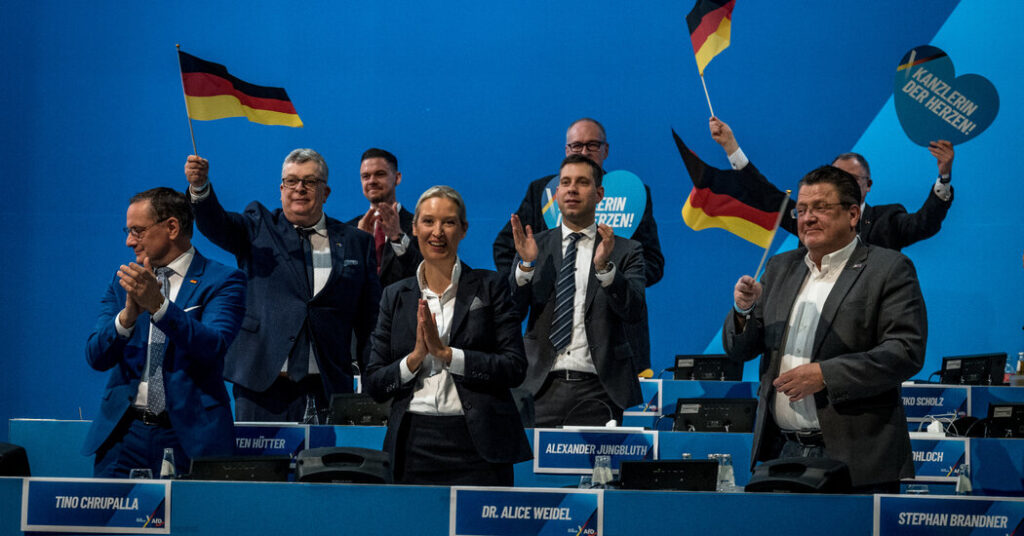
Lawmakers from the far-right Alternative for Germany, or AfD, have set off a political furor in Germany by repeatedly using their constitutional powers to press government agencies to publish sensitive details related to national security. The party’s members have made more than 7,000 attempts in the past five years to unseal this kind of secret information, according to one analysis.
The group’s opponents say the publication of such secret information, parts of which relate to Germany’s support for Ukraine, could benefit Russian military planning. These claims, which the party strongly denies, have heightened concerns about the AfD’s relationship with Russia. The party’s lawmakers have praised Russia’s president, Vladimir V. Putin, often; visited counterparts in Russia or at the Russian Embassy in Berlin; and questioned Germany’s support for Ukraine.
The outcry over the AfD’s demands for information has touched a national nerve as Germans debate how to respond to the threat Moscow poses to European and German security. It also comes as the AfD runs neck and neck in the polls with the governing Christian Democratic Party, edging it closer to power.
Mainstream parties have long refused to work with the AfD, keeping it in a form of political quarantine. The stronger the party’s perform, the likelier it is to finally be allowed to join a governing coalition at either the federal or state level.
The AfD’s leaders say the outrage is confected by political opponents who fear losing power and popularity to the far right. Its leaders have previously described the requests as a routine activity for an opposition party seeking to ready itself for power and familiarize itself with the nuances of government. The party’s interest in military infrastructure “stems from our platform as a party committed to internal and external security,” Beatrix von Storch, the AfD’s deputy leader in Parliament, said in statement. “Our questions serve to expose problems, criticize the government and develop our own proposals for solutions.”
The scale of the AfD’s inquiries was first brought to light in October by Georg Maier, the interior minister in Thuringia, a state in eastern Germany.
Mr. Maier had kept a low profile in regional politics, leading the state’s Interior Ministry and the local branch of the Social Democrats, a center-left party. As interior minister, Mr. Maier must sign off on lawmakers’ requests for information that touch on his expertise, like those related to the police or homeland security — including requests from his political opponents in the AfD.
Mr. Maier told the national news media last month that AfD members had made dozens of security-related queries in Thuringia alone, some of which contained dozens of detailed questions, and that the questions looked as if they had been provided by the Kremlin.
Mr. Maier repeated that assertion in an interview with The New York Times at the statehouse in Erfurt, Thuringia, but he provided no evidence of Russian influence over the queries and stopped short of leveling the accusation of espionage.
“I am responsible for ensuring the safety of the people here,” Mr. Maier said, noting that if he saw “anything unusual affecting our critical infrastructure,” he needed to address the issue.
Mr. Maier’s statements set off a frenzy, thrust him onto the national stage and led other mainstream politicians and national news outlets to sift through tens of thousands of questions submitted by the AfD over the past decade to agencies and authorities across Germany, including the federal Parliament in Berlin.
The Greens, another center-left party, soon produced a list of the AfD’s questions in Brandenburg, a state that surrounds Berlin and abuts the German-Polish border. These included questions about civil defense and drones — responses to which, the AfD’s opponents said, might benefit Russia.
Then, a third list of security-related questions — this time posed by the AfD in the federal Parliament — was leaked to journalists, increasing the outcry. As well as asking about Germany’s long-range missiles, the AfD’s federal lawmakers sought to reveal information about the army’s drone program and defensive plans.
Der Spiegel, a national newsmagazine, later produced the most systematic analysis of the inquiries. Its journalists spent three weeks combing through government archives to find 7,000 questions submitted by the AfD that the reporters deemed suspicious.
The AfD denied that it was working for the Kremlin and brought libel suits against both Mr. Maier, who denies that he libeled the AfD, and the Handelsblatt, a business newspaper that printed the first interview with him on the matter. A judge threw out the case against Handelsblatt, but the case against Mr. Maier continues.
“Smearing us as Nazis no longer works; now they are trying to portray us as agents of Russia,” Tino Chrupalla, a chair of the party, said on public television in October after the parliamentary questions first came to light.
The AfD said its critics had misinterpreted its questions, some of which had nothing to do with Russia, or exaggerated their content for political reasons.
One question Mr. Maier had listed as suspicious was actually related to road construction in Thuringia. Another, flagged by the Green Party, focused on an incident in which an easyJet plane hit a bird and made an emergency landing at an airport in Berlin, asking how such incidents might be avoided.
The AfD’s supporters pointed out that government officials can refuse — and have refused — to release information they think is too sensitive, meaning that the questions do not in themselves pose a security risk. None of the questions resulted in the release of what the state authorities considered sensitive information. And asking for it was not illegal.
Analysts also said there could be legitimate reasons for AfD lawmakers to seek security-related information, for example to highlight government actions that the party deems harmful to the national interest. And the AfD is not the only party to ask for such sensitive information, even if it employs the practice far more often and conspicuously than its rivals.
The Left Party, for example, used the same parliamentary tool in 2023 to press the government to outline its economic strategy on China; critics said the revelation would help China counter the strategy.
The AfD’s critics were unconvinced. They said that a party with such clear affinity with Russia must have had an ulterior motive in asking such sensitive questions. The German Parliament held a debate early last month about the AfD’s questions, during which mainstream lawmakers made rancorous accusations about their far-right colleagues.
Jens Spahn, a senior lawmaker from the governing Christian Democrat party, said during a later parliamentary debate that Alice Weidel, the other AfD chair, sounded like “a fifth column for Putin.”
Trying to defuse the fallout, some senior AfD leaders tried to distance the party from Russia, criticizing AfD colleagues who had planned trips to meet Russian officials, highlighting a divide within the party on the issue. Last month, at the height of the dispute, senior AfD lawmakers persuaded colleagues to cancel a meeting with Dmitri Medvedev, the former Russian president, during their visit to Russia.
But the actions of other leaders fueled further criticism.
When Mr. Chrupalla, the senior AfD official, went on public TV last month to try to clear up the AfD’s view of Russia, he ended up downplaying the risk that President Vladimir V. Putin of Russia posed to Germany. Mr. Chrupalla suggested that Poland, one of Germany’s closest allies, was also a threat.
About Mr. Putin, he said, “He’s never done anything to me.”
Christopher F. Schuetze is a reporter for The Times based in Berlin, covering politics, society and culture in Germany, Austria and Switzerland.
The post The Far Right in Germany Keeps Trying to Unseal National Secrets appeared first on New York Times.