Snow is the most reliable time machine we’ve got. You wake up in your bed, and you know, just from the very particular silence in the room, that it snowed overnight. By the time you get to the window, you’re 5 or 6 or 7 years old again. You look outside, and the whole world has come to a halt. Everything is pure and blindingly white. For a little while, you can actually feel the inner stillness that all those people on all those meditation podcasts swear exists.
When a heavy snow comes, you may also remember hearing that thrilling sentence you sometimes heard as a kid: “They’re closing the schools.”
We associate colossal TV audiences with things like the Apollo 11 moon landing, Princess Diana’s funeral and the Super Bowl, but did anyone ever watch the television as obsessively as generations of children checking the school cancellations ticker at the bottom of the screen? The Kool-Aid man could have burst through the living room wall, and we wouldn’t have looked up.
Deciding whether or not to close schools was often guesswork. More superintendents were fired for misjudging the weather than were axed for anything else. Mayor Bill de Blasio got flak both for leaving schools open in severe snowstorms and for closing them for a couple inches of slush.
Snow days are no more — in New York City, at least. After Covid, the Department of Education announced that cancellations would be replaced with remote learning, proving that the virus was the horrible gift that kept giving. But even before the pandemic, the magic had been vanishing: Between 1978 and 2013, only 11 snow days had been called in New York.
The first thing that the little boy in Ezra Jack Keats’s children’s book “The Snowy Day” says is a simple statement of wonder: “It’s covered everything, as far as I can see!” The book has been checked out of the New York Public Library 485,000 times, making it the most popular thing they’ve got.
Just to state the obvious, winter in New York is not always a sleigh ride. The city has survived some horrific storms. Even as you read this essay about winter wonderlands, you may be shouting, What about 2016 and 2006? What about 1947? For Pete’s sake, what about 1888?
A blizzard in January 2016, known to some as Winter Storm Jonas, holds the record for snowfall, having deposited 27.5 inches on the city. (The Weather Channel started asking Montana schoolchildren for names for winter storms in 2012, which annoyed hurricane purists; the year Jonas hit, the kids had also suggested Regis and Yolo.) The Great Blizzard of 1888 only dropped 20 inches, but contemporaneous accounts are hard to forget.
The Cuban-born writer José Martí covered the action for the Latin American newspapers of the day: “The angry wind nipped at the hands of pedestrians, knifed through their clothing, froze their noses and ears, blinded them, hurled them backward into the slippery snow, its fury making it impossible for them to get to their feet, flung them hatless and groping for support against the walls, or left them to sleep, to sleep forever, under the snow.”
The mayhem of 1888 ultimately helped convince the city that the trains and utility wires should run underground. Lesson learned — the hardest possible way.
These days, because of climate change, we get less snow and, paradoxically, more severe snowstorms. In recent years, Central Park went an astounding 701 days without measurable snowfall, smashing a previous record of 400, which ended in 1998.
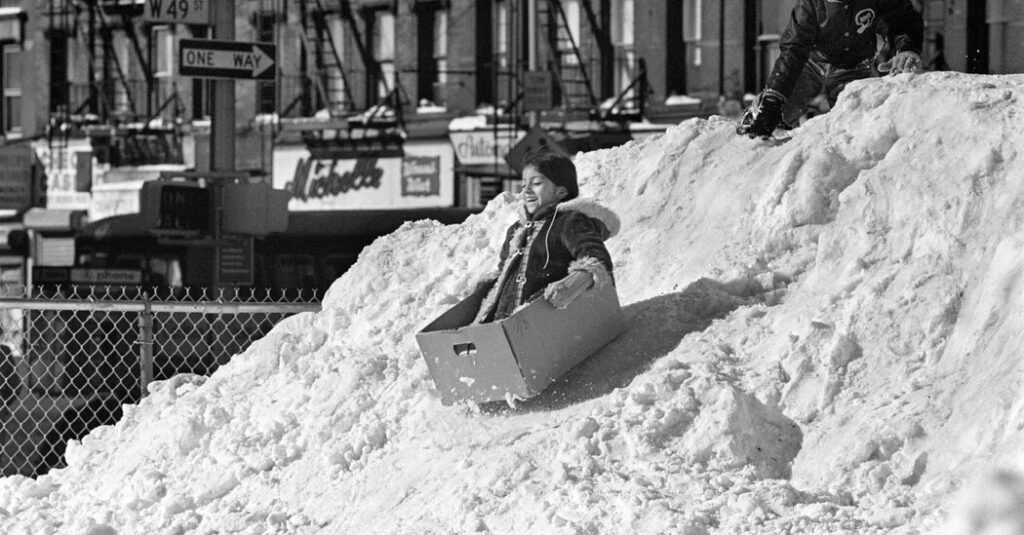
Most of the photos here capture much shorter stretches between snowfalls that allowed for inventiveness and abandon: Boy Scouts letting loose in 1965; a couple in 1976 engaging in what, at the time, was known as “necking” while a statue of Christopher Columbus looks shyly away; a girl sledding in a cardboard box in a Hell’s Kitchen parking lot in 1978.
Serious question: Who can claim to be a truer New Yorker than a girl who sledded in a cardboard box in a Hell’s Kitchen parking lot?
Writers have always loved packing snow into metaphors. In 1914, James Joyce likened it to death in that legendarily cinematic paragraph that ends, “His soul swooned slowly as he heard the snow falling faintly through the universe and faintly falling, like the descent of their last end, upon all the living and the dead.” E.E. Cummings arrived at a similar conclusion: “The snow doesn’t give a soft white damn whom it touches.”
Even in 1888, this newspaper took pains to emphasize the solidarity it witnessed in the middle of the Great Blizzard. How can people — unless they’re spattered with slush and already 90 minutes late for work — not bond when they’re all in awe of this fearsome thing the universe just did? “There was little or no profanity, even among the men,” The Times wrote. “Stories were told, jokes were cracked, and jovial good-fellowship prevailed. Nobody put on any airs. The aristocratic banker and merchant was ‘halo fellow well met’ with the artisan, helpful to the shopgirl, and kind to the inevitable old lady whom even the blizzard couldn’t keep at home.”
That “inevitable old lady” may have just stepped out of a time machine and back into her childhood. In 1990, The Times interviewed a breathlessly happy 10-year-old girl sledding in Riverside Park at West 82nd Street. What had she been doing when she first learned that snow was drifting down? “I was in bed reading ‘Anne of Green Gables,’” she said. “My brother came in and said, ‘It’s snowing!’ I started screaming, ‘It’s snowing, at last!’”
The post Remember Snow Days? appeared first on New York Times.