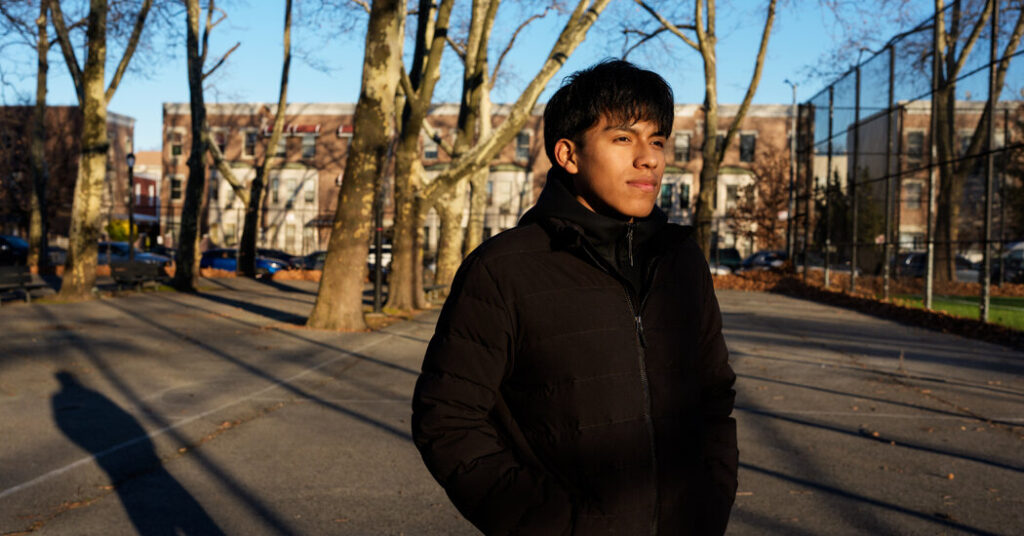
On a crisp November morning in White Plains, N.Y., six lawyers spent hours in a federal courtroom arguing about the government’s plan to deport a teenager from the Bronx.
Agents had detained the boy, Joel Camas, 16, during a routine check-in at 26 Federal Plaza, the New York City headquarters for Immigration and Customs Enforcement. They held him at a shelter for three weeks while the New York Civil Liberties Union fought for his release, arguing that Joel had followed orders and that forcing him to return to his native Ecuador would put him in danger.
When the hearing ended, Judge Cathy Seibel ordered that Joel be freed while she considered the merits of his case. But his future in the United States remains uncertain. Joel, like thousands of other young migrants, has become a target of the Trump administration’s deportation crackdown, and immigration officials are working to dissolve long-established protections meant to help young people like him stay.
Joel is a recipient of a decades-old designation known as special immigrant juvenile status, which, until recently, had shielded some undocumented young migrants who could prove that they had been abused or neglected by at least one parent. Beginning in 2022 under President Joe Biden, migrants who were granted this status were immediately told whether they would be protected from deportation through an immigration classification known as deferred action. Those who received the deferred action designation were eligible to apply for a work permit while awaiting a pathway to permanent residency.
But in April, Trump administration officials quietly stopped granting deferred action designations and instead began to deport S.I.J. status holders with little notice and no chance to appeal, alarming immigration lawyers.
A coalition of immigrant advocates filed a federal lawsuit in the Eastern District of New York seeking class-action status to challenge the new policy. In late November — two days after Joel’s hearing — a judge granted the plaintiffs a partial victory by ordering the government to temporarily halt its new policy, though it did not set a deadline to comply. A final decision has not been made.
“People with S.I.J. or in the process of getting S.I.J. are being ordered removed, and they are not able to access this relief that as a child or young person they would have,” said Beth Baltimore, Joel’s lawyer. “We’re just so concerned about this happening with more and more people.”
Immigration officials did not immediately respond to requests for comment.
Joel had fled South America with his mother, Elvia Chafla, about three years ago, making the arduous journey through the Darién Gap on foot in search of a safer place to live, away from gang violence. In the United States, he dreamed of becoming an auto mechanic or Army soldier. The government determined he was eligible for S.I.J. status because he had been abandoned by his father.
Ms. Chafla had appeared at 26 Federal Plaza in September for a check-in similar to her son’s, and at the urging of ICE officials, she decided to fly home to Ecuador to avoid being arrested and to give Joel a better chance of staying in the United States. She thought her departure would satisfy the ICE agents who had told her to self-deport, and that they would leave Joel alone because he had a path to lawful permanent residency, while she did not.
He had been without his mother for about four weeks, staying with relatives and attending Gotham Collaborative High School, when he was detained by immigration officials. His detention in October stunned his lawyer, Ms. Baltimore, who emerged from the federal building with tears in her eyes. She had believed his S.I.J. status and his age would spare him.
Instead, he was placed in a shelter in the Bronx, where Ms. Baltimore and the rest of his legal team argued that he was falling behind in school because the classes at the shelter were not guaranteed to be accepted for credit by the public education system. A family court later granted Joel’s uncle legal guardianship over him, clearing a way for his release.
At his hearing, Judge Seibel criticized what she described as superfluous bureaucracy that had kept Joel confined longer than necessary. She lamented that migrant children were being held even when they had a safe place to go, but she stopped short of criticizing the Trump administration’s effort to deport Joel.
“It’s not my place to decide whether what the government is doing is heartless or an inexplicable expenditure of resources,” Judge Seibel said. “My job is to decide whether they’re allowed to do what they’re doing.”
The federal law establishing special immigrant juvenile status was enacted in 1990 and then expanded in 2008. It does not grant legal status, but it allows recipients to apply for a visa to become legal permanent residents and to obtain a work permit.
The Biden-era policy to protect S.I.J. recipients from deportation has helped about 200,000 migrants, according to the National Immigration Project, which is representing plaintiffs in the lawsuit. Roughly 150,000 migrants who have been approved for special immigrant juvenile status could be affected by the government’s decision to stop the policy, according to court documents.
The group argued that the government violated the law by ending the policy without proper notice or justification, leaving thousands of immigrant youth in legal limbo and at risk of deportation.
Despite the uncertainty, young migrants like Mamadou Mouctar Diallo, 20, are still applying for special immigrant juvenile status in hopes that it will help them secure a place in the United States. Mr. Diallo was arrested in Lower Manhattan in August and detained for about three months before he was released in November upon being granted asylum from Guinea.
Young people living in New York make up the largest portion of recipients of special immigrant juvenile status who are waiting for a green card compared with other states, at about 20 percent, followed by those in California, who made up 15 percent, according to data obtained and analyzed by the End SIJS Backlog Coalition, an advocacy group.
From Mr. Trump’s inauguration in January through mid-October, ICE has arrested about 2,600 children younger than 18 across the country, according to federal data obtained by the Deportation Data Project at the University of California, Berkeley. In the New York City area, it has arrested at least 140 minors.
This year, ICE has sent 600 immigrant children into the federal shelter system — more than in the previous four years combined, according to an investigation by ProPublica. It is the highest number since record-keeping began a decade ago.
Raj Saha contributed reporting.
Ana Ley is a Times reporter covering immigration in New York City.
The post Officials Target Youth Immigration Program, Speeding Up Deportations appeared first on New York Times.