In 2011, Anne Schramm left a note on a supermarket bulletin board in Berlin seeking “a reliable and experienced knitter” for her fashion label, Wommelsdorff. She had founded the label three years earlier, selling knitted and crocheted hats and scarves in upscale stores such as Barneys New York, and now she wanted to extend the line to cashmere sweaters.
But she needed the help of specialists who could knit on circular needles, producing seamless garments of consistent quality: “To knit like this for a production is completely different than to knit for the neighbors,” Ms. Schramm said.
Heike Schelchen’s husband discovered the note. “He thought it could be something for me,” Mrs. Schelchen, 63, said in a recent interview.
The women met at Ms. Schramm’s apartment, and the designer asked Mrs. Schelchen, who had been knitting since childhood, to create a sample then and there. “I nearly had a heart attack,” Mrs. Schelchen recalled. “I was so nervous to knit in front of a stranger.”
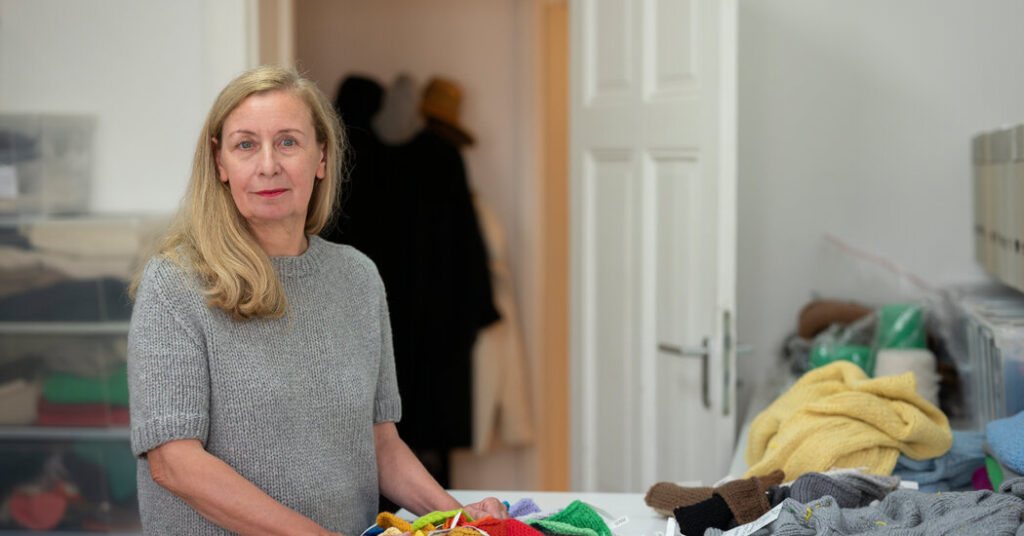
On a Saturday in early autumn, the pair were sitting in front of a stack of clear plastic boxes in Wommelsdorff’s small combined office, atelier and showroom in central Berlin. The boxes contained samples, many created by Mrs. Schelchen, who now is one of the two senior knitters on the business’s team of 30 women.
She is also responsible for turning Ms. Schramm’s designs into patterns and creating prototypes of the cashmere sweaters that are now sold at high-end boutiques such as 10 Corso Como in Milan, La Garçonne in New York and Arts & Science in Tokyo. In Europe, the sweaters sell for 1,300 to 2,500 euros ($1,500 to $2,880); hats and scarves are €300 to €600.
Ms. Schramm said her knitters live all over Germany and come from all walks of life — “a librarian, a mother of eight, a former medical assistant” — and range in age from 25 to 80. Some work full time; others are available only occasionally. Wool and finished products are mailed back and forth from Berlin, and Mrs. Schelchen uses WhatsApp video calls to help her colleagues when they are struggling with specific problems.
Ms. Schramm stressed that the business’s two collections each year, timed for introduction at showrooms during Paris Fashion Weeks, generate orders that are then “knitted by hand — not just handmade.”
“Handmade is a vague term,” she said, “which means you only need to do one small thing by hand. It doesn’t mean the item was hand knitted; it could be knitted on a machine, which is operated by hand.”
Knitting machines are never used at Wommelsdorff. “It’s a little bit crazy,” Ms. Schramm said. “My approach has not been determined by business acumen, but by the striving for beauty and perfection in every sense. Mindfulness is our luxury; everything we do takes a lot of time.”
Every knitter, she added, “knits in their own tempo; some take days and others need a week or so.” All this has to be considered when she makes seasonal production plans.
Mrs. Schelchen said a sweater takes her an average of three days to knit, working with what she described as “a fixed daily rhythm” to achieve her best results. “You can tell in a knitting pattern if someone was tired,” she added. “Often then the stitch definition becomes too loose.”
The team developed a system that makes a single knitter responsible for everything in a given client’s order, so every look within that order is “absolutely consistent, because each knitting style is like a personal handwriting with variations,” Ms. Schramm said. It also ensures that each sweater can be traced to its creator, so any needed repairs can be done by the same person.
“We are like an orchestra,” Ms. Schramm said. “Our individual skills amount to a beautiful body of work.”
The business uses only cashmere yarn from the Italian manufacturer Cariaggi, which works with Ms. Schramm to develop proprietary colors to offer clients. The range includes such shades as New Wave Pink, Mimosa Yellow and Berlin Blue, which has a dash of copper “so the tone is iridescent according to incidence of light,” Ms. Schramm said.
Knitters work with unwashed yarn, which Ms. Schramm said feels coarse and is “hollow on the inside, comparable to a macaroni.” When each sweater is completed, it arrives in oversize to the atelier in Berlin. There, it is machine washed separately and dried in various ways so the cashmere softens and the sweater’s form shrinks to the desired size.
“It’s like baking,” Ms. Schramm said. “You need experience and know all the exact timings. They differ from style to style and from color to color in order to receive the perfect size and fit, and the feeling of little weight but lots of volume.”
Over the years, she said, she has developed some designs that have become classics. For example, the Tonka — “my equivalent to 501 jeans” — is a boxy mock turtleneck. “It suits everyone, whether you are short and skinny or tall and busty.” (She noted that a client in London owns “20 Tonkas, in different colors.”)
And the Pina, a high-neck cardigan with patch pockets, can be worn “like a jacket,” she said.
Ms. Schramm said it was her mother who taught her to knit, crochet and sew. And for her business, she used the last name of her paternal grandmother, a “free spirit who left a lasting impression on me,” she said. “She was unflappable and her craft work was an extension of herself.”
In 1981, after Ms. Schramm completed a tailoring apprenticeship in her hometown, Gelsenkirchen, in western Germany, she moved to Paris to work as a patternmaker at Christian Dior for three years and to study fashion design. A decades-long career as a designer and consultant in Paris, London, New York and Munich for brands such as J.Crew and Escada followed, before she finally settled in Berlin in 2008.
“I like many things about Berlin,” she said. “One of them is that fashion doesn’t really matter much here. I can work unbothered.”
The Wommelsdorff label was “never planned,” she said, but rather happened after “people kept complimenting me on the hats and scarves that I had knitted for my daughter.” After an acquaintance suggested that she establish a business, Ms. Schramm knitted a collection and brought it to Paris, where Martin Grant, a designer and friend, used some pieces in his catwalk show.
“Barneys New York was the first to order,” she said.
Andreas Murkudis, the owner of a namesake concept store in Berlin, said the Wommelsdorff sweaters “are the most expensive knits that we offer, but we sell them all — even though most people have never heard of the label Wommelsdorff. But once you touch one of their sweater, feel it, then you know it’s something else.”
Ms. Schramm declined to disclose the business’s annual revenue, noting that demand has been high “but I am growing the company deliberately slow.”
She said that she is “in no rush, most importantly not on the backs of my knitters,” adding, “Everyone always wants more and more; I just want to be better and better.”
The post ‘Knitted by Hand’ Is Important to This German Brand appeared first on New York Times.