Incense sticks and potpourri, made by Japanese specialists using centuries-old techniques, are the initial products from À La, a brand scheduled to debut this week.
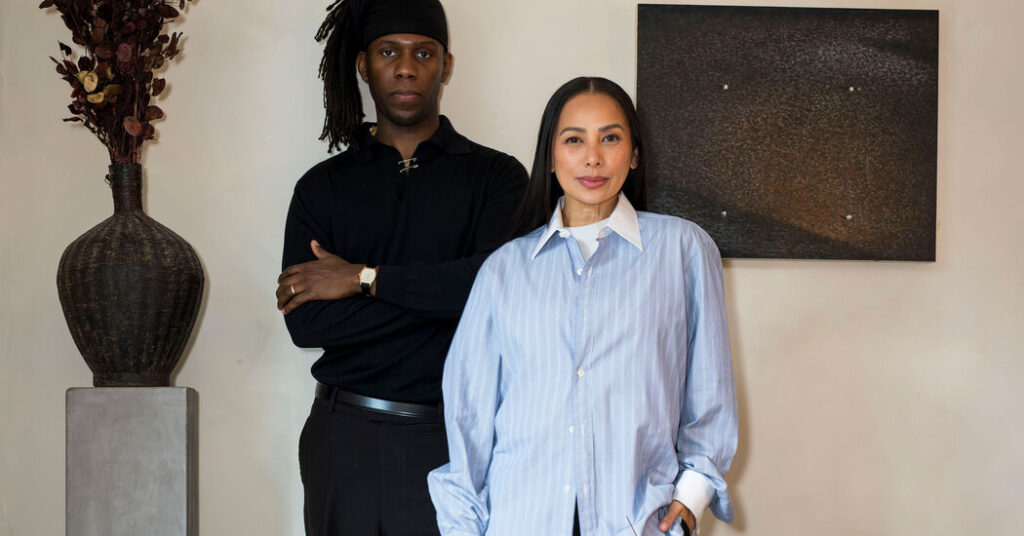
“Our goal with À La was to create a brand that really emanated a sense of timelessness through the celebration of the craft and tradition of fragrance-making and decorative objects,” said Karl Cyprien, a chunky ceramic teacup from Kyoto, Japan, in his hand, during a recent interview at the Brooklyn home he shares with Meg Cuna Cyprien, his wife and the brand’s co-creator.
Both the incense, redolent of agarwood and Korean mint, and the finely ground potpourri, scented with notes such as myrrh and sandalwood, are made on Awaji Island, in Japan’s Seto Inland Sea, where incense has been a specialty since the 6th century.
The incense, which Mr. Cyprien said has been made by a family business for six generations, can be purchased alone or in a porcelain box made by what he described as a four-century-old family-run atelier in Arita, the town known as the birthplace of Japanese porcelain.
Prices will range from $46 for a 40-gram (1.4-ounce) box of potpourri to $650 for a decorative box made in Kyoto of urushi lacquer, another heritage technique. The products may be purchased on À La’s website or at retailers including Gem Home in New York City, Chiarastella Cattana in Venice and SKP Select in Beijing. (Mr. Cyprien, 35, the vice president of special projects for the artist Daniel Arsham, said more products are being developed, including eau-de-parfum, candles, shower gel and body lotion. Ms. Cuna Cyprien, 42, previously was a style director for Urban Outfitters and Nike.)
The Cypriens said they have been thinking about starting À La for about a decade. Their shared appreciation of home fragrance started at a young age: There was potpourri and incense in Mr. Cyprien’s childhood home near Coney Island, and Ms. Cuna Cyprien’s mother kept a bowl of dried rose petals on a coffee table.
Industry executives who know the couple say Mr. Cyprien’s inquisitiveness helped establish the brand.
“He’s curious about everything,” said Ramdane Touhami, a designer and a founder of Officine Universelle Buly, the French beauty brand that offers products such as artisan-made Japanese combs of minebari wood. He has known Mr. Cyprien for about a decade.
“He’s always like that,” Mr. Touhami added. “He’s a guy who’s always asking, asking, asking, like he’s in school.”
During an interview, the Cypriens discussed how À La products are made, their love of Japan and its traditions and the challenges of starting a business while raising two young sons.
The conversation has been edited and condensed.
Japan and its traditions are integral to your brand. What attracts you to the country and its aesthetic?
Karl Cyprien When I was young, the clothing I loved happened to be Japanese, the visuals that I loved, Japanese photographers — so many different things. It’s something that sort of followed me and has just been there. I’d always had that dream to go to Japan and actually realize it.
Meg Cuna Cyprien I find the refinement, the restraint, all of it, so elegant. I think I’ve always been drawn to that.
I grew up in the Philippines, where it’s quite noisy and quite busy. Being in Japan, and around that culture, everything feels, at the core, much like our brand — it’s just very pared back. That was one of the things that really spoke to me about that culture.
We have this in common: As co-founders and as partners, we just want things to be simple and beautiful. We don’t want to overcomplicate anything.
Why is your brand’s name, À La, in French, rather than Japanese or English?
Mr. Cyprien I’m also cognizant of France and its role in the fragrance world — that was a nod to that history, which in a way reflects back on the Japanese sort of obsession with France. And these are probably my two favorite countries to visit: Japan and France.
Ms. Cuna Cyprien And Karl does speak French. He’s Haitian Creole, so his whole family speaks French.
How is your incense made?
Mr. Cyprien The predominant material is a paste that is used like a bonding agent. The ingredients are added and mixed over the course of a day, then that paste is pushed through this machine that basically spits it out like spaghetti onto a tray.
Ms. Cuna Cyprien It’s meticulously put onto a tray!
Mr. Cyprien That tray would be put onto a table, and one person is really ensuring that the sticks, which are in paste form, are very much aligned and straight. They let it dry for a day within the atelier where they’re made.
They’re inspecting it — they’re looking for any nuance in the shapes — and once the sticks are ready, they’re then moved to a space that’s usually higher, where a wind can flow through. The incense sticks will be brought to a very dark and cool place with shutters that line the entire west side of the building.
It’s the westerly winds that will actually dry the incense over the course of three weeks.
How is the potpourri made?
Mr. Cyprien The potpourri is a bit more simplified. You would have the raw ingredients, which would be ground in this case. Essential oils would be poured over the raw ingredients and then effectively be baked, not by heat, but they would just soak there for weeks. It’s that same raw ingredient that’s then used in the incense.
As foreigners with a new brand, was it hard to convince the craftspeople to take on the project?
Mr. Cyprien They wanted to know our goals and in what direction we wanted to develop this brand. There definitely was a bit of resistance, because they were like, “No one ever just contacts us out of the blue …
Ms. Cuna Cyprien … “and comes to Awaji Island, which is difficult to arrive to …
Mr. Cyprien … “a number of times!”
You have two sons under the age of 2. When do you work on the brand?
Mr. Cyprien In the meantime, between time.
Ms. Cuna Cyprien It’s always on our mind. And late nights are normal here.
The post Japanese Heritage Skills Shape a New Brand appeared first on New York Times.