When James Cameron swept the Oscars in 1998 for “Titanic” — the epic he called “Romeo and Juliet,” but wet — he got up onstage and crowed that he was “the King of the World.”
“That was a big eye-roll on the part of the audience,” he recalled with a rueful smile.
Going overboard is Mr. Cameron’s modus vivendi. Many in Hollywood had expected his shipwreck movie to be Fox’s new “Cleopatra,” a sodden $200 million bust. A year before it came out, Time magazine augured in a cover headline, “GLUB, GLUB, GLUB …”
The naysayers were wrong. In a rave for The New York Times, Janet Maslin called “Titanic” a “spectacle as sweeping as the sea.” She also noted that Mr. Cameron was telling his own story in the film — “a presumptuous reach for greatness against all reasonable odds,” arrogance run amok, Icarus redux.
Sitting in his Lightstorm Entertainment museum at Manhattan Beach Studios, south of Hollywood, the director, writer, artist and explorer drolly rebutted the Icarus comparison, telling me that “the wings would have worked” if he had engineered them.
“I wouldn’t have used wax,” he said.
Besides, he subscribes to Nikolai Gogol’s philosophy: “Obstacles are our wings.”
“Hubris and arrogance precede a fall,” Mr. Cameron continued. “And I’m very, very conscious of that. I’m actually very cautious. I’m a very, very detailed planner. I surround myself with the best people. I encourage them and require them to do the deep levels of planning that I do.”
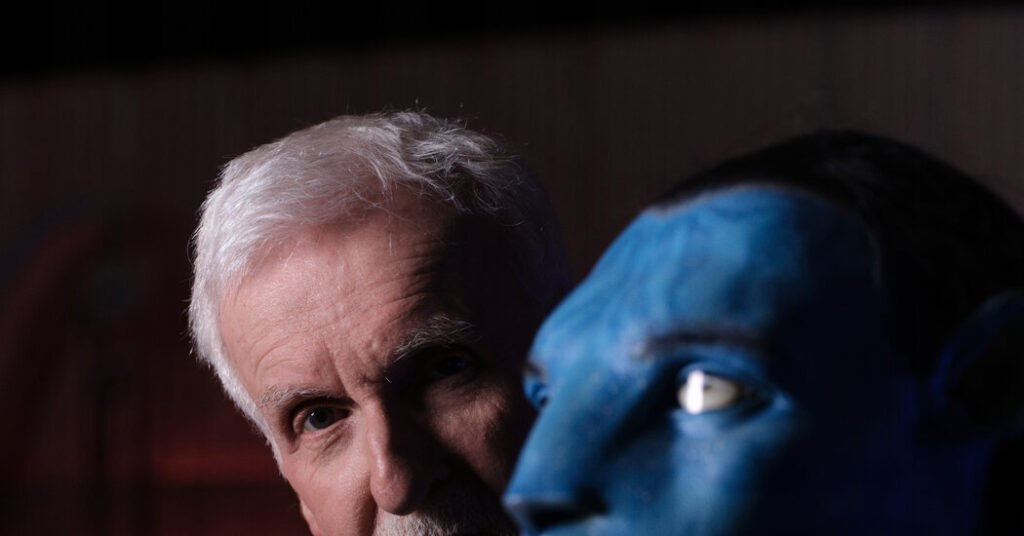
We are surrounded by models of what he calls his “tech noir” creations. Here’s Arnold Schwarzenegger as the title character of Mr. Cameron’s 1984 breakthrough, “The Terminator”; here’s the slimy alien queen who tangles with the fierce Ripley, played by Sigourney Weaver, in the 1986 sci-fi blockbuster “Aliens”; here are models for the blue Na’vi warriors on the luminescent moon Pandora in “Avatar,” the romantic leads played by Sam Worthington and Zoe Saldaña.
Before the first “Avatar” appeared in 2009, “South Park” satirized it as “Dances With Smurfs.” But as the third installment in the megahit series rolls out this month, clocking in at 3 hours and 17 minutes — a mere 3 hours and 7 minutes without the credits, he assures me — Mr. Cameron is having the last laugh.
He may “despise the glitz and glamour of Hollywood,” as he says. But he is indeed the King of the World here. Faith in his commercial prowess is so great that the Golden Globes nominated “Avatar: Fire and Ash” for “best cinematic and box office achievement” before its Dec. 19 release.
As screens shrink and theaters disappear, Mr. Cameron goes bigger. As retreads and mediocre streaming content proliferate, he grows more singular and phantasmagoric.
Before he proved he could deliver his epics, he had plenty of tangles with nervous studio heads. But now Robert Iger, the C.E.O. of Disney, which oversees the franchise, says that he is “in awe” of Mr. Cameron. “He’s the most ambitious filmmaker I’ve ever met,” Mr. Iger said, adding that he meant that in the “most positive of ways.” “He thinks big and he executes big.”
At 71, Mr. Cameron boasts three of the four top-grossing movies of all time: “Avatar” ($2.9 billion), “Avatar: The Way of Water” ($2.3 billion) and “Titanic” ($2.3 billion). With “Avatar: Fire and Ash,” he could soon have four of the top five. (“Avengers: Endgame,” second on the list, breaks up the Cameron monopoly.) He has plans for two more installments of love and war on Pandora — and he has promised that No. 4, scheduled for a 2029 release, will be “a corker.”
He thinks of “Avatar” as a family saga, like “The Godfather,” with intergenerational drama and warring clans.
The films are set in the 22nd century but have a classic cowboys vs. Indians theme, with the human colonizers as the bad guys, and the Indigenous people — the hissing, catlike Na’vi, who are skilled in the use of bow and arrow — as the good guys.
“Obviously, we took a lot from feline anatomy and feline behavior,” Mr. Cameron said. “We have a whole vocabulary for Neytiri’s tail.” Neytiri, played by Ms. Saldaña, or “the blue chick,” as the director has called her, is the clan princess who falls in love with the strapping avatar of Jake Sully (Mr. Worthington), whose human form is a paraplegic Marine.
Mr. Cameron says his themes are the darkness and light within us, and how callously we behave toward our planet. “Why are we treating Earth like a toilet?” he asked.
He recalled pitching “Avatar” to suits in Hollywood, who were reluctant and wanted him to take out “all the tree-hugging crap,” as Mr. Cameron recalled.
“No,” he said he told them. “That’s why I’m making the film.”
He explained to me: “I think of it more as an allegorical fantasy more than a hard science fiction story, where the Na’vi are our better selves and the rapacious corporate humans are our worst selves.”
Why did he make the Na’vi blue?
“Well,” he replied dryly, “because yellow was taken by ‘The Simpsons.’”
A 2009 New Yorker profile noted that Mr. Cameron had “an uncanny ability to make people want to see him fail.” As it turns out, the man is too big to fail. And too talented. He’s at once an old-fashioned storyteller and a gung-ho futurist who will, if he must, create the tech he needs to conjure the worlds of his febrile imagination.
He likes to advise other filmmakers, “Don’t get high on your own supply.” But you have to be flying pretty high to create your own universe, species and language.
Mr. Cameron said he never could have written the “Avatar” sequels if he hadn’t been a father of five (all adults now). Parenthood gave him a flashback to “my own anxious teenage years.”
He said: “I never got hissed at by my youngest, but they have their own way of acting out. I got a lot of door slamming, eye rolling.” His attempts to be more authoritarian failed miserably. “The first thing you learn when you have kids is you don’t get to be the director,” he said.
For “Avatar,” he pioneered spectacular visual effects and motion-capture technology, developing a sort of pentimento in which actors perform in spandex leotard-like suits with dots applied by a makeup pen to their faces. The cameras strapped to their helmets track their facial movements. With his special effects team, Mr. Cameron feeds all that data into software to make the computer-generated characters’ muscles match the actors’ movements and expressions.
The close-ups, said Joe Letteri, the Academy-award-winning visual effects artist on the movies, are “where you live and die”: If the emotions of the Na’vi don’t match the actors’, “you’ve got to go back and figure out what’s wrong.”
Mr. Cameron may be a tech pioneer, but he confesses that “the simplest apps that my youngest kids use, I wouldn’t know where to begin.”
He was obsessed with sci-fi from the time he was a child, drawing creatures from horror, like Dracula, and aliens from other worlds. He was inspired by his mother, who painted watercolors and took him to art and natural history museums to sketch for hours on end. (An exhibit of his surrealistic art is now traveling the world.)
His mother inspired him to write some of the strongest and most vivid female characters in movie history. His father, he said, “was a pragmatic engineer, seeing the world through a lens of Cartesian order,” and had a hard time with his son’s temperament as an “an artist, an introvert, an imaginer.”
“That was always a bit of a schism between us,” he said, revealing later: “He never understood or accepted my creativity. He literally would confiscate my science fiction books and throw them in the trash.”
Mr. Cameron poured that side of himself into writing the teenage Na’vi boy, Lo’ak, who struggles to be “seen” by his father. Kiri, the teenage girl played by Ms. Weaver, also reflects Mr. Cameron as a teen, “living in my head, in a world of imagination, more at home with the forest than with people.”
As a boy, he had two lessons in how precarious and treacherous the word is. The first came when he found his father’s plans for a fallout shelter. Then there was the time his dad took the family on the Niagara River in a small boat, which ran out of gas as it floated dangerously close to Niagara Falls.
Mr. Cameron conducted experiments as a child. “Once he built a mini bathysphere with a mayonnaise jar and a paint bucket, put a mouse in the jar in the bucket, and lowered the bucket off a bridge to the bottom of Chippawa Creek,” wrote Rebecca Keegan, his biographer. The mouse got a good shock but lived.
His scientific know-how and brainy answers — he skipped two grades — did not make him a favorite of the jocks. “They’d just wait until I got out in the hall and then dump my books down the stairwell and pound the crap out of me,” he recalled. But he turned into a jock himself, gleefully free-diving past scuba divers.
A relentless adventurer who belongs to the Explorers’ Club and the Mars Society (though he calls Mars “a crap planet”), Mr. Cameron took submersibles to the final resting place of the Titanic for “Titanic” and the 2005 documentary “Last Mysteries of the Titanic.” Later, he took a submersible — which he helped design — down to the Mariana Trench in the Pacific, east of the Mariana Islands, for the 2012 documentary “James Cameron: Voyage to the Bottom of the Earth.”
“He’s as insatiably curious as a mongoose,” said Stephen Lang, who plays the villainous Col. Miles Quaritch in the “Avatar” films.
In contrast with his scientific bent, Mr. Cameron said that dreams inspired “Terminator” and “Avatar,” and he wants to create the sense that the audience is dreaming with his latest series.
“I had this dream when I was 19 of a bioluminescent forest, and creatures, and things that would react to the touch and light up, these little spinning lizards, and it’s all in the movie,” he said. “I was very excited when I woke up. I drew an oil pastel sketch.” Although Pandora looks hallucinogenic, he wasn’t on drugs when he visualized it. “Look, I had a little acid in college, but it’s not part of my life,” he said. “I have these dreams that are insanely vivid. Sometimes, they’re so compelling or so emotional, I’ll wake up shaken, not necessarily even in a nightmare mode. Sometimes, I wake up from the beauty.”
Born in Kapuskasing, Ontario, he moved to California when he was in high school, after his dad got an engineering job there. He worked as a tool-and-die machinist to pay for Fullerton College (now called California State University, Fullerton), only to drop out after a year and take jobs as a truck driver and a janitor.
“I was completely an autodidact,” he said of his film studies. “I just went to U.S.C. and studied on my own time. I wasn’t enrolled. I just snuck in, went to the library and studied it all.”
The first patrons of his cinematic ambitions were a bunch of Orange County dentists who needed a tax shelter. He founded a visual effects technology firm in 1993 and wrote a treatment for “Avatar” as its potential first project. But the grand 3-D movie he envisioned lay beyond its technological capabilities at that point.
After “Titanic” became the first film to gross more than $1 billion in the first year of its release, he largely turned his back on Hollywood to go exploring and deep-sea diving. He finally came back in 2005, nearly eight years after the “Titanic” premiere.
He picked up his “Avatar” treatment. “I had forgotten about it, to tell you the truth,” he said. “I reread it, and I thought, ‘Damn, it’s not bad.’”
By then, he said, the technology necessary to make the film “was within striking distance.” But he still had to pioneer improvements in the 3-D viewing experience so that viewers wouldn’t get headaches during the three-hour-plus run time.
“We learned a lot of things about how the mind perceives 3-D,” he said. Then he put on his scientist hat to explain a bit more: “We make 3-D in our visual cortex. Back in the Cambrian explosion, when all the different phyla diverged 540 million years ago, everything from that point onward had two eyes. Every trilobite, every amphibian that crawled out onto the land, every fish, everything had two eyes. Nature doesn’t waste energy, so what’s the second eye for if we don’t really need it, if it isn’t really hard-wired into our consciousness? I keep saying that 540 million years of evolution tells me that 3-D is ultimately going to be the way we consume our entertainment.”
He wants to take the audience on a Disneyland ride — to make it worth it, as he says, for a couple to hire a babysitter and pay for parking.
.op-aside { display: none; border-top: 1px solid var(–color-stroke-tertiary,#C7C7C7); border-bottom: 1px solid var(–color-stroke-tertiary,#C7C7C7); font-family: nyt-franklin, helvetica, sans-serif; flex-direction: row; justify-content: space-between; padding-top: 1.25rem; padding-bottom: 1.25rem; position: relative; max-width: 600px; margin: 2rem 20px; }
.op-aside p { margin: 0; font-family: nyt-franklin, helvetica, sans-serif; font-size: 1rem; line-height: 1.3rem; margin-top: 0.4rem; margin-right: 2rem; font-weight: 600; flex-grow: 1; }
.SHA_opinionPrompt_0325_1_Prompt .op-aside { display: flex; }
@media (min-width: 640px) { .op-aside { margin: 2rem auto; } }
.op-buttonWrap { visibility: hidden; display: flex; right: 42px; position: absolute; background: var(–color-background-inverseSecondary, hsla(0,0%,21.18%,1)); border-radius: 3px; height: 25px; padding: 0 10px; align-items: center; justify-content: center; top: calc((100% – 25px) / 2); }
.op-copiedText { font-size: 0.75rem; line-height: 0.75rem; color: var(–color-content-inversePrimary, #fff); white-space: pre; margin-top: 1px; }
.op-button { display: flex; border: 1px solid var(–color-stroke-tertiary, #C7C7C7); height: 2rem; width: 2rem; background: transparent; border-radius: 50%; cursor: pointer; margin: auto; padding-inline: 6px; flex-direction: column; justify-content: center; flex-shrink: 0; }
.op-button:hover { background-color: var(–color-background-tertiary, #EBEBEB); }
.op-button path { fill: var(–color-content-primary,#121212); }
Know someone who would want to read this? Share the column.
“It’s a little thing I like to call entertainment,” he said.
As he became a player, his home life was often as difficult and exciting as his work life. Unlike a lot of Hollywood moguls, he likes his relationships at eye-level; he was never afraid to fall for forceful women.
He was married first to Sharon Williams. He met her when she was a waitress at Bob’s Big Boy, and she helped inspire Sarah Connor, the heroine of “The Terminator.” Then came three marriages to some of the strongest women in Hollywood: the producer Gale Anne Hurd, his fellow writer on “The Terminator”; the director Kathryn Bigelow, whom he worked with on “Strange Days” and “Point Break”; and Linda Hamilton, the muscly star of the “Terminator” movies. Since 2000, Mr. Cameron has been married to the actress and activist Suzy Amis Cameron, who played Rose’s granddaughter in “Titanic.”
He freely admits he was an “asshole” and “a tinpot dictator” at the start of his career. He had a reputation for being sarcastic and biting, especially to his crews, with what The Guardian called “baroque put-downs.”
He would yell at anyone — even Mr. Schwarzenegger, when he left the “True Lies” set in Washington, D.C., to take some of the other actors sightseeing at the Capitol.
Tales of hardships and blowups on his fourth film as director, “The Abyss” — a technically challenging underwater saga that the crew christened “The Abuse” — were harrowing. It was made in a tank with 7.5 million gallons of water. “It potentially could have been very dangerous for people,” Mr. Cameron conceded, adding that he almost drowned when his safety diver gave him the wrong regulator for an oxygen tank. “He’s one of the two people I’ve ever fired,” he said.
But he claimed there were no serious physical injuries because he had learned on earlier films how quickly things “could go pear-shaped” unless he was “a preparedness freak.”
“I saw a number of close calls on ‘The Terminator’ and ‘Aliens,’ and realized I needed to take direct responsibility for the safety of everyone on my set, not just take the word of a stunt coordinator or a practical effects supervisor or an assistant director,” he said.
To this day, Mr. Cameron is known for being able to do any job on the set, right down to makeup touch-ups. Of the famous love scene on the bow of the Titanic with Rose and Jack, he said: “It was a very rehearsed kiss. I remember drawing lips on my thumb and knuckle. I said, ‘OK, we were going to do this, and then there’ll be a little exploration, and then there would be this.’ It was like a football play.”
He was tough on those who weren’t doing their jobs up to his standards. His crews began wearing T-shirts that said: “You can’t scare me. I work for Jim Cameron.” And the not-so-mild-mannered Canadian accrued a lot of nicknames: Captain Bligh, Iron Jim, the Scariest Man in Hollywood.
The howls of pain and outrage from people working on his films were heard throughout Hollywood. At the 2013 Golden Globes, the co-host Amy Poehler drew gasps and laughter from the crowd with a joke she made at his expense after noting that Ms. Bigelow had been nominated for “Zero Dark Thirty,” a film set in Pakistan that included scenes of torture.
“When it comes to torture,” Ms. Poehler said with her usual cheery delivery, “I trust the lady who spent three years married to James Cameron.”
Mr. Cameron was not there that night, but he says now: “Amy Poehler’s remark was an ignorant dig, at an event which is supposed to be a celebration of cinema and filmmakers, not a roast. I’m pretty thick-skinned, and happy to be the butt of a good-natured joke, but that went too far. The fact that people found it funny shows exactly what they think of me, even though they have no idea who I am or how I work.”
Mr. Cameron and Ms. Bigelow had gone up against each other in 2010, in the best director category at the Oscars. Mr. Cameron was nominated for “Avatar,” but Ms. Bigelow triumphed with “The Hurt Locker,” becoming the first woman to win the directing prize.
“I was the first one on my feet applauding,” Mr. Cameron said, although he wished the Academy had “shared the love” and given Ms. Bigelow best director and “Avatar” best picture. (“The Hurt Locker” won six Oscars in all, including for best picture.)
“Kathryn and I thought the whole meta-narrative around us was pretty funny,” he said. “I was a little concerned that it would just take away from her credibility as a filmmaker. It started to turn into a conversation that wasn’t about her film, and that bothered both of us.” He said they still advise each other on projects, calling her a “remarkable person.”
Kate Winslet, who spoke after the release of “Titanic” about Mr. Cameron’s temper and his challenging requests — twice during filming, she said, she felt like she was drowning — now speaks glowingly about working with him on the “Avatar” movies.
“Being really honest,” she said of the “Titanic” shoot, “there were moments when he would yell, and there were moments that were difficult for people.” But, she added, “I don’t know that I really actually felt that I almost died.”
Mr. Cameron, who adores the bawdy Ms. Winslet and her passion for preparation, said, “She was never in danger, but she may have felt she was.”
Early in filming, joined by Leonardo DiCaprio, she suggested to the director that he add a bit of sexy conflict to the Rose and Jack relationship.
“And I do remember Jim struggling with hearing that from two kids, basically, but he did put it in the script,” said Ms. Winslet, who was 20 at the time. “But since then, he’s much more open, much less resistant to someone trying to offer up an idea of how something might be better.”
Mr. Cameron’s longtime trusted producer, Jon Landau, died last year, and when Ms. Winslet offered to be a sounding board, the director agreed, asking her to watch an early cut of “Avatar: Fire and Ash” and advise him.
“Now that’s a different Jim,” Ms. Winslet said.
Ms. Weaver, another regular in the director’s company, is also an admirer. After “Aliens,” during the Venice Film Festival, she found herself having dinner with a charming guy she barely recognized.
“He hadn’t been like that directing,” she said. “He was wildly funny, witty. I can understand why that guy couldn’t come out during ‘Aliens,’ because that was a tough shoot, especially for him. Let’s put it this way: I’m glad I wasn’t shooting ‘The Abyss’ with him.”
As an English major, she said, she is “a monster” about scripts, but she has never given Mr. Cameron a note. “He’s the best writer of any writer-director I know.”
When she saw him being hard on a young actor in “Aliens” who was having trouble with unwieldy props, “I sort of trundled up to him and I said, ‘You know, when you yell at an actor, you yell at all of us, so understand that what she was doing actually was very hard. Maybe shoot something else while she gets used to doing this stuff the way you want it.’”
He took her advice. “He’s a good guy,” Ms. Weaver said, adding, “I really do think Jim has mellowed.”
Mr. Lang, who plays the villainous Colonel Quaritch, said he sees a lot of Mr. Cameron in the character he plays. Like the director, he said, Quaritch is “sharp as a knife, with a great edge to him.” Mr. Lang, who kick-boxed with the director at dawn before the day’s filming began, said he had noticed some changes in Mr. Cameron.
“I would say there’s a part of Jim that has leavened and lightened much over the years,” Mr. Lang said. “I think he embarked upon a course of self-improvement, and I don’t say that this is actually necessarily a conscious thing that he did; I just think that he’s kind of geared that way.”
Mr. Cameron isn’t sure he’s mellowing.
“Marinating, maybe, is a good term, right?” he said. “It’s not like I was a screamer all day long. But every once in a while. Everybody’s entitled to a bad day. If you’re not doing the job, then get out of my way.”
In his early films, he said, he got positive reinforcement “for losing my temper to get something to happen” quickly or correctly, he said. But after he had spent years on underwater expeditions, bonding with his comrades in life-or-death situations, he realized he needed the respect of the team to solve problems.
“Going into ‘Avatar,’ I just looked at everything differently,” he said. “It’s like, OK, the movie’s not the most important thing. The way you are with people and the creative process is the most important thing. Chances are, a better movie will come out of that because you’re not yelling at people, you’re encouraging them to bring their best.”
Mr. Cameron had another epiphany when he visited Ron Howard on the set of a movie: “You’re like, wow, he’s being nice to people,” he said. “I’ve spent two decades since then trying to get in touch with my inner Ron Howard.”
I asked the director what he had learned from being married five times.
In his first four marriages, he said, he was in “the judgmental phase.” His old attitude was, “All right, I’m going to do this as long as it’s satisfying, and then, when it’s not, then forget it, we’re done.”
He added: “I actually had a couple therapists — including one of the best in the business — give me something that I will tell any married man, which is: You can be right or you can be married.” He added, “Men are actually trainable.”
He has been with Ms. Amis Cameron for 25 years. When he realized she didn’t like his reacting to serious moments with brusque humor, he changed. “I find it satisfying to see Suzy really enjoy our interactions, because I’m a little more thoughtful,” he said.
He said he remains in touch with his exes. He has a daughter with Ms. Hamilton and two daughters and a son with Ms. Amis Cameron. They became permanent guardians of a third teenage girl, a friend of their daughter’s.
I asked Mr. Cameron about the Hollywood freakout over the titanic battle between David Ellison at Paramount Skydance and Ted Sarandos at Netflix to see who will acquire most of Warner Brothers Discovery — with President Trump looming over it all.
Mr. Cameron is not fond of corporations swallowing each other and losing sight of creativity. But he praised Mr. Ellison, who was a co-producer of the 2019 sequel “Terminator: Dark Fate.” “I never felt that I had to silently roll my eyes and push back against the studio head’s ideas,” Mr. Cameron said. “His ideas were very solid.”
Mr. Sarandos has said he is “deeply committed” to sticking with theatrical releases. But Mr. Cameron disagreed with Mr. Sarandos’s contention last year that big films, like “Barbie” and “Oppenheimer,” would have done just as well on small screens. (Mr. Sarandos sent a shock wave through the industry when he said that his son, a film editor, had first watched “Lawrence of Arabia” on his phone.)
For Mr. Cameron, the big screen is his canvas, and the movie theater is his venue of choice.
“You can’t deny people the depth of experience that you have in a cinema where you’re not in control,” he said. “You don’t have a remote. You can’t pause it. A family member can’t pause it so they can go to the bathroom or go order a pizza. Or continue the next night. Then it’s a fragmented, fractured experience, like all of the other experiences that we go through in our lives, scrolling all day long.”
Mr. Cameron is on the board of Stability AI, a generative A.I. company that works with film companies. But he is worried about the dawn of artificial superintelligence.
“The fact that so many billions of dollars are being put toward a goal of doing something that might be suicidal for the human race is insane to me,” he said.
We talked about Sam Altman’s OpenAI getting into “erotica” and Elon Musk’s highly sexualized xAI companions. “Any new technology either gets weaponized or used for sex — not necessarily in that order,” Mr. Cameron said.
How about Tilly Norwood, the first A.I. actress, a young beauty who needs no Botox or bathroom breaks?
“The thing is, an actor doesn’t just play a role,” Mr. Cameron said. “They infuse a role with their own life experience.”
He believes “utterly in the power of science, as the one and only path to truth,” and worries we are “turning our backs on science and shuffling into a new dark age of division and superstition,” he said. So I asked if he had seen the Atlantic cover featuring Robert F. Kennedy Jr. as “The Most Powerful Man in Science.”
“He’s an important anti-scientist who’s taking us down the path to another dark age,” Mr. Cameron said, adding: “Now, kids are dying of measles. They’ll be dying of polio. The next time we have a crisis like Covid, and you’ve just suppressed all funding on mRNA vaccines?”
He had already sold his house west of Malibu when it burned down in the Franklin fire, and he had decided to move to New Zealand back in 1994. “I have everything I need to make a movie there, and I’m at a sufficient distance from Hollywood that I don’t have to buy into the bullshit, but I can take advantage of the amazingly creative people that are here in Los Angeles.”
He may be worth $800 million, but he said he tries to live simply, inspired by Pandorans. “It would be utter hypocrisy to be seeking a life of balance, and a gentler footprint upon the natural world, while living a profligate life of conspicuous consumption,” he noted.
He said that he and Suzy, both vegans, own a farm in the Wairapapa Valley in New Zealand. “Last time I checked, we were the largest provider of organically grown brassicas, cauliflower, broccoli, kale, romanescu, in New Zealand,” he said. “We do not own livestock.” They have a place in Wellington, too, he says, “a modest house on a suburban street.” He bought a used 2012 Kia Rio, four-cylinder. “No Mercedes, no Lamborghini.” He also has a house in Austin.
He withdrew his application for American citizenship after George W. Bush was re-elected, and he’s no fan of Mr. Trump. “I’m not missing being in America right now until things change,” he said.
He has made some famously violent movies, so I asked him what he thinks about the level of violence in American society now.
“I am appalled by the gun violence in the U.S., and now take a more measured approach to guns in my filmmaking,” he said, noting that he “took a lot of the gun stuff out” in the second and third films in the “Avatar” series, including a scene where Jake Sully arms the Na’vi clans.
In the 90s, Mr. Cameron trained in shooting for three years to research for his movies and “to be a highly responsible owner of firearms for self-defense. I believe in the right to own firearms, but believe that American gun laws are absurdly lax.” New Zealand has much better gun safety laws, he said.
Mr. Cameron says he is an agnostic and “technically” an atheist. But has anything he has seen exploring the depths of the planet and conjuring fantastic worlds made him wonder about a higher power?
“I can’t rule out the existence of a God, but my understanding of science is such that I don’t see the necessity.” He added: “That doesn’t mean I haven’t seen or experienced things I can’t explain and that science can’t explain. But that’s just because science isn’t done. Science will never be done.”
Intrigued by the question, and mystified that no one had ever asked him why, even though he doesn’t believe in a creator, he has devoted two decades to a saga celebrating a spiritual relationship with nature, he took time out from China’s premiere of “Avatar: Fire and Ash” at the Hainan Island International Film Festival to write me a long email.
“Everything I’ve ever witnessed in the natural world seems to have an almost religious power, in its beauty and infinite complexity, from the wonders of the microscopic world (DNA, as an example, and even down to quantum mechanics) to the vastness of the observable universe,” he wrote. When he went to the deepest part of the Earth, he revealed, “I was overwhelmed by a sense of deep time, beyond our human grasp.”
He said that the design of “Avatar” came from mixing and matching, distorting, reshaping and resizing the natural wonders of our own planet.
“The patterns on the backs of tiny Amazon tree frogs are writ large on the wings of our flying creatures,” he wrote “Whenever we think we’ve come up with a new idea, we always find that nature has beat us to the punch by hundreds of millions of years.”
He jokes, “Maybe I was a Druid in a past life.”
After our interview in the museum, we took a stroll around to say good night to the alien queen and Arnold and the nine-foot-tall blue Na’vi. Then Mr. Cameron left for that most exotic of all worlds: a happy marriage.
“I’m going to go home and a have a glass of chardonnay with my lovely wife,” he said, as he sauntered off.
If you’d like to go deeper with James Cameron, dubbed “the deepest man in the world” by National Geographic, check out his edition of “Confirm or Deny.”
Maureen Dowd is an Opinion columnist for The Times. She won the 1999 Pulitzer Prize for distinguished commentary. She is the author, most recently, of “Notorious.”
The post James Cameron Tempers His Temper and Channels His Inner Na’vi appeared first on New York Times.