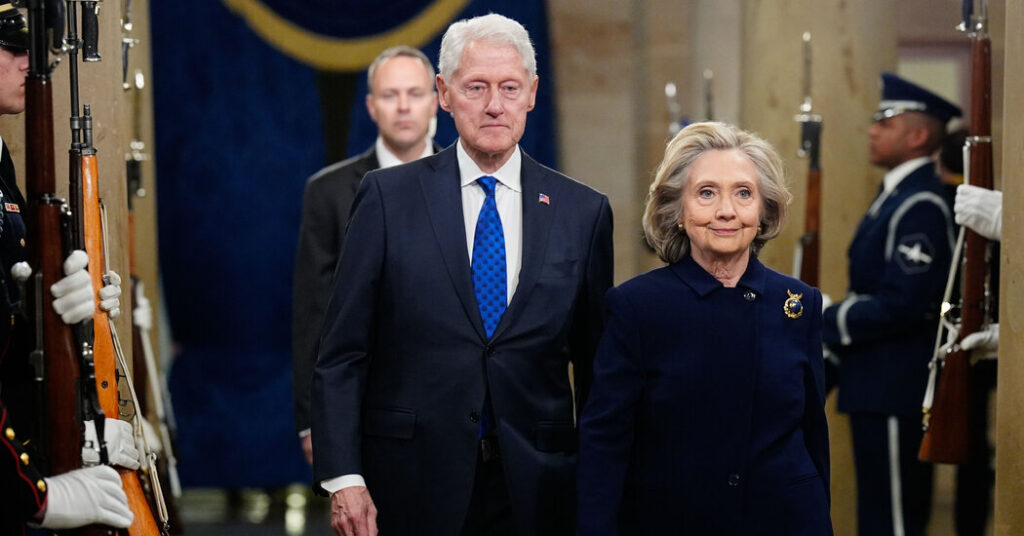
A quiet, monthslong battle between Representative James R. Comer of Kentucky, the Republican chairman of the Oversight Committee, and Bill and Hillary Clinton over the panel’s Jeffrey Epstein investigation could come to a head this week. Mr. Comer has threatened to begin contempt of Congress proceedings against them if they fail to appear in person for depositions.
The threat is the starkest example yet of the attempt by House Republicans to shift the focus of the Epstein affair away from President Trump and his administration and onto prominent Democrats who once associated with the convicted sex offender and his longtime companion, Ghislaine Maxwell.
After Democrats on his panel effectively forced him to subpoena the Justice Department for its files, Mr. Comer also issued subpoenas in August to the Clintons, as well as to eight former top law enforcement officials. Since then, the chairman has withdrawn the subpoenas for five former attorneys general who wrote in statements to the panel that they had no knowledge relevant to the investigation. The committee also excused former F.B.I. Directors James B. Comey and Robert S. Mueller III from giving live depositions. Only one person, former Attorney General William P. Barr, has appeared to testify.
But Mr. Comer has refused to excuse the Clintons, even though they have repeatedly offered to provide the same kind of sworn statement to the committee.
Instead, Mr. Comer has falsely accused them of ignoring his subpoenas and continued to demand that they appear for live depositions or face the possibility of being held in contempt, typically a first step in referring someone to the Justice Department for prosecution.
For months, the Clintons have been engaging with Mr. Comer far more than was previously known to respond to his requests and avoid having to appear on Capitol Hill. Their longtime attorney, David Kendall, has sent three letters explaining in detail his argument that the Clintons should be required only to provide sworn statements to the committee. On Sept. 30, Mr. Kendall met in person with Mr. Comer’s staff to discuss the requests.
Mr. Comer, in response, has only amped up his threats to penalize the Clintons if they fail to show up in person.
“The former president and former secretary of state have delayed, obstructed and largely ignored the committee staff’s efforts to schedule their testimony,” Mr. Comer said in a statement on Friday night. He again threatened to start contempt proceedings against them if they did not appear before his committee on Dec. 17 and 18, or schedule a date in early January to do so.
In a letter last week, Mr. Kendall accused Mr. Comer of going after the Clintons with “weaponized legislative investigations and targeted criminal prosecutions,” and said that it was neither appropriate or tenable for them to appear and be held to a different standard than others who had been excused.
“President Trump has consistently sought to divert attention from his own relationship with Mr. Epstein and unfortunately the committee appears to be complicit,” Mr. Kendall wrote in the letter, one of three that were provided to The New York Times by a Democratic lawmaker and have not been previously disclosed. He said that Mr. Comer’s only reason for targeting the Clintons was “to catalyze a public spectacle for partisan purposes.”
Mr. Clinton was acquainted with Mr. Epstein — an association the former president described in his memoir — but never visited his private island and cut off contact with him two decades ago. Mr. Clinton took four international trips on Mr. Epstein’s private jet in 2002 and 2003, according to flight logs, and an undated photograph of Mr. Clinton and Mr. Epstein signed by the former president was part of a batch of images released by House Democrats last week highlighting Mr. Epstein’s ties to powerful men.
“Given what came to light much after,” Mr. Kendall wrote to Mr. Comer in one of his letters, “he has expressed regret for even that limited association.”
Angel Urena, a spokesman for Mr. Clinton, said that “for months, we’ve been offering the same exact thing he accepted from the rest, but he refuses and won’t explain why.”
He added, “Make of that what you will.”
Nick Merrill, a spokesman for Mrs. Clinton, said that “since this started, we’ve been asking what the hell Hillary Clinton has to do with this, and he hasn’t been able to come up with an answer.”
Criminal contempt charges carry a maximum sentence of one year in prison, as well as a fine of up to $100,000. Not every witness who defies a congressional subpoena is referred for contempt. Representative Jim Jordan of Ohio, the chairman of the judiciary panel, for instance, was among the Republican members of Congress who received a subpoena but did not cooperate with the committee investigating the Jan. 6, 2021, mob attack on the Capitol. He was not held in contempt.
For Mr. Clinton to appear on Capitol Hill to testify in the Epstein case would be nearly unprecedented. No former president has appeared before Congress since 1983, when President Gerald Ford did so to discuss the celebration of the 1987 bicentennial of the enactment of the Constitution. When Mr. Trump was subpoenaed by the Jan. 6 select committee in 2022, while he was out of office, he sued the panel to try and block it. The panel ultimately withdrew the subpoena.
In an Oct. 6 letter, Mr. Kendall wrote to Mr. Comer that the Clintons should be treated the same way as the five former attorneys general who were excused from his subpoenas because they said they had no information pertaining to the investigation.
“We submit that the Clintons likewise do not have knowledge relevant to the committee’s investigation,” Mr. Kendall wrote in that letter.
Mr. Kendall added, “There is simply no reasonable justification for compelling a former president and secretary of state to appear personally, given that their time and roles in government had no connection to the matter at hand.”
The request for information from Mrs. Clinton, the former secretary of state and Mr. Trump’s 2016 presidential campaign rival, appeared to be the more perplexing of the two. Mrs. Clinton had “no personal knowledge of Epstein or Maxwell’s criminal activities, never flew on his aircraft, never visited his island and cannot recall ever speaking to Epstein,” Mr. Kendall wrote.
Her connection to Ms. Maxwell, he said, involved “limited contact” during a time when Ms. Maxwell was in a relationship with a mutual friend.
Mr. Comer’s subpoena cited a nephew of Ms. Maxwell’s who had previously worked for Mrs. Clinton during her 2008 presidential campaign and then at the State Department. But Mr. Kendall asserted that Mrs. Clinton never knew that the employee, Alexander Djerassi, was related to Ms. Maxwell.
In a follow-up letter he sent on Nov. 3, Mr. Kendall wrote that “subpoenaing former Secretary Clinton is on its face both purposeless and harassing.”
When he met with Mr. Comer’s staff to discuss the subpoena in person, he added, no reason was given for wanting to question Mrs. Clinton “beyond wanting to ask if she had ever spoken with her husband about this matter.” (Any conversations the two of them might have had, he noted as an aside, would be protected by marital privilege.)
Mr. Kendall said that the focus on the Clintons as “fact witnesses” when others had been allowed decline to testify raised questions about the neutrality of what was supposed to be a nonpartisan committee.
“To date,” Mr. Kendall wrote in his Nov. 3 letter, “the committee has elected to forego deposing seven of the eight individuals, all of whom are not named Clinton.”
The only former official who was subpoenaed and testified live was Mr. Barr, who served as attorney general when Mr. Epstein was investigated, indicted and died by suicide while in federal custody.
Mr. Kendall’s most recent letter was sent on Dec. 10. His tone and language had become more aggressive.
“We urge you to acknowledge that we are asking for nothing more than the same basic fairness offered to the attorneys general who ran the D.O.J. while the Epstein investigations were being conducted,” Mr. Kendall wrote. “We remain ready, as we have been for months, to provide sworn statements to satisfy the committee’s oversight efforts.”
Two days after the letter was sent, Mr. Comer again threatened to hold the Clintons in contempt if they did not appear in person.
Philippe Reines, who worked for Mrs. Clinton when she was forced to testify before Congress during the Benghazi hearings, said Republicans would pay a political price in the midterm elections for targeting the Clintons in this case.
Even a first-year law student “knows finding someone politically contemptible isn’t the basis for legal contempt,” he said. “But if Republicans want to spend 2026 fixated on their endless vendetta against the Clintons rather than runaway prices, we’ll happily take the extra House seats.”
Annie Karni is a congressional correspondent for The Times.
The post Inside the Clintons’ Fight to Avoid Testifying in the House Epstein Inquiry appeared first on New York Times.