It was almost 100 years ago that Clyde W. Tombaugh discovered Pluto. That was the last planet found until 1992, when humans found another one. But this new planet wasn’t in our solar system—it was orbiting another star. We call this an extrasolar planet, or “exoplanet” for short.
Since then, astronomers have cataloged more than 6,000 exoplanets. If you thought it was hard to remember the names of our own planets, try all the planets, with names like HD 189733b. (A jolly place where it rains molten glass and the wind blows 9,000 kilometers per hour.)
Even the closest exoplanets are more than 4 light years away (36 trillion miles), which makes it doubtful that we’ll ever visit one—so why bother? The reason is, it helps us answer an age-old question: Are we alone in the universe? As far as we understand, you need a planet to have life, and the race is on to locate one with Earth-like qualities.
Why Are They Hard to Find?
The problem is, you can’t just take your best telescope and start looking around the sky. Telescopes have a limited resolving power—the smallest angular size they can “see.” For the Hubble Space Telescope that’s 0.05 arc second, which is incredibly tiny—about 1/72,000th of a degree. The HST could make out a giant, Jupiter-size planet at a distance of 590 billion kilometers. That’s amazing, but it’s just 0.06 light year, and the nearest star, Proxima Centauri, is 4.25 light years away.
Another problem is the dimness of planets. Sure, Jupiter is easy to see in our own night sky, because of the sunlight reflecting off its surface. But you can’t see Jupiter at all during the day, because that reflected light is much dimmer than direct sunlight. It’s the same for exoplanets. When we’re looking at the light from a star, the planets around it just aren’t bright enough to be discernable.
Luckily, there are other methods, and I’m going to explain the two that were used to find most of the exoplanets we know today. There’s a bunch of cool physics here, so let’s go!
Orbits, Jiggly Stars, and Blue Shifts
What happens when a planet moves around a star? First, there’s a gravitational interaction that pulls the planet in the direction of the star. The magnitude of this force (FG) depends on the mass of the star (M) and the planet (m), as well as the distance (r) between them:
(G is a gravitational constant, which we can ignore.) It’s possible to use this force to make an object move in a circular path. Remember from Newton’s second law, when a force acts on an object, the object accelerates, and we define acceleration as the change in the object’s velocity.
However, velocity is speed in a certain direction, so changing direction is itself a type of acceleration. In orbital motion, we call this centripetal (center-pointing) acceleration, and it depends on both the radius (r) of the circular path and the speed of the object (v). Putting this together with the gravitational force from above, we get the following equation:
Yes, some stuff (like the planet’s mass and the radius) cancel, but let’s not worry about that now. You can see that there’s a relation between the orbital radius and speed of the planet. Let’s go ahead and model the motion of a planet as it moves around a star.
Oh! Do you see that? The star isn’t stationary! I didn’t tell you the whole story. If the star pulls on the planet, the planet also pulls back on the star. This is because forces are always an interaction between two objects (Newton again, third law). Since there’s a gravitational pull on the star, it also moves in a circular orbit.
Obviously nothing in the simulation above is drawn to scale. A real star has vastly more mass than the planet, so the effect is tiny. Basically, the star just “jiggles.” We can’t see the movement, but we can still detect it. How? From the Doppler effect.
This is something you already know about, even if you don’t know you know it. When a speeding train goes by, its sound changes in pitch, from high to low. It’s like NEEEEEEERrrrraawww … Right? Here’s an animation to help you understand what’s going on. Imagine a ball that emits sound waves at regular intervals. These waves then expand from their starting location. Now, if the ball is moving toward you, this is what happens:
See how the wave fronts get squished together? This means more waves hit your ear per second—i.e., they have a higher frequency, and we hear that as a higher pitch. Also, on the back side the waves get unsquished. If the ball moved away from you, the pitch would drop.
That’s the Doppler effect, and it works with all wave phenomena—including, notably, light. When a light source is moving toward you, the frequency increases. For visible light, this means the color changes—it’s shifted toward the blue end of the spectrum. We call that a blue shift. When it moves away, the color moves toward the red end—that’s a red shift.
Voilà! Even though astronomers can’t see a star wobbling, they can tell if it’s moving by using a spectroscope to see how the light changes. But wait! There’s more. If you know the original frequency, you can tell how fast the star is moving based on the frequency shift.
The only problem with this technique is that the amount of color shift depends on the speed of light and the speed of the source. Light moves really fast (3 x 10⁸ meters per second), so that in most cases the Doppler shift is really hard to detect. Hard doesn’t mean impossible, though.
So here’s how you find an exoplanet: Observe a star for several years and look for small shifts in its color spectrum. Then use this to determine the speed at which the star moves toward and away from Earth. If we can estimate the mass of the star (we can), then using its velocity and period of oscillation (how long one oscillation takes), we can calculate the mass and orbital distance of the planet. Hurrah!
That’s kind of a big deal. If you’re hoping to find extraterrestrial life, you probably want to find an Earth-like planet in an Earth-like orbit—not too close to the sun and not too far, so that water can exist in a liquid state. It’s a small window.
The Transit Method
OK, here’s the second way of detecting an exoplanet. Let’s start by thinking about something familiar: a solar eclipse. This is when the moon passes in front of the sun, causing the moon’s shadow to fall on Earth. In a total eclipse, the amount of light reaching Earth can be about 1,000 times less than normal. It looks like those “day-for-night” scenes in old movies.
Venus and Mercury also sometimes pass between the sun and Earth. We call these solar transits. They don’t cast a shadow on Earth, but they do slightly decrease the overall solar brightness. (Fun fact: In the 1700s, the transit of Venus was used to calculate the distance from Earth to the sun.)
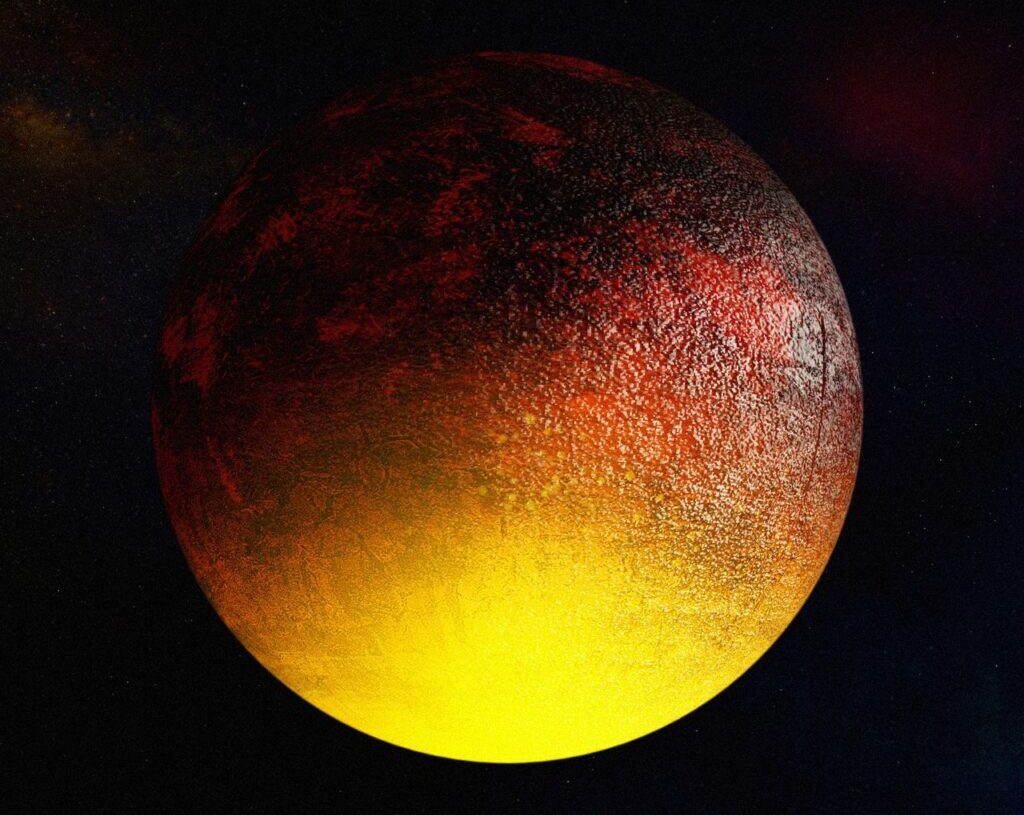
We can also get an exoplanet transit, when an extrasolar planet comes between its local star and our observation point on Earth. When that happens, the brightness of the star will decrease by just a tiny bit. Sensitive instruments can detect this change and figure out that there is an exoplanet around that star. This is how Kepler-10 b, the planet in the illustration up top was first discovered. (It was later confirmed by the stellar wobble and Doppler shift.)
If you could see this transit (which you totally can not see), it would look like this:
Now suppose you plotted the star’s brightness, or intensity, as a function of time. During a transit, it might look something like this:
This is called a light curve, and there’s a bunch of stuff we can figure out from it. The flat bottom of the depression is the part where the planet is fully in front of the star. The depth of the dip tells us the size of the planet. Bigger planets block more light.
Second, the length of the depression tells us how long the planet is in front of the star. We can use that to determine the orbital period (how long it takes to complete a full circle). If we know the mass of the star and the orbital velocity, then we can calculate the orbital distance.
Finally, we keep watching to see if this dip happens on a regular schedule—that’s how we know we’ve got a legit exoplanet. It’s even possible to get transits from multiple planets, and we can identify them from their signature light curves.
Of course, both methods have limits. Doppler effects get harder to suss out the farther away you’re looking. And both require a specific favorable alignment. For example, if a distant planet system is perpendicular to our view from Earth, the star’s wobble won’t move it nearer and farther from us, so there’d be no Doppler shift.
For the transit method, the exoplanet has to orbit its star in a plane that includes Earth. If everything doesn’t line up, we won’t get a transit at all. Only a tiny percentage of solar systems will satisfy that condition.
Also, both detection methods are strongly biased toward finding large planets orbiting close to their stars—so-called “hot Jupiters”—because they cause bigger, more frequent signals. For Earth-like planets, you’d have to spend three years to get a minimally acceptable three-transit observation. And no one’s going to detect an extrasolar version of Pluto, with its 250-year orbit.
Now think of the 6,000 exoplanets found so far. All but one are in the Milky Way, which leaves aside the “billions and billions” (more like trillions) of other galaxies. And almost all known exoplanets are larger than Earth, even though Earth-size planets are believed to be common. And each of the 6,000 were cases where the planets were aligned just right for us to detect them.
Then … how many planets are really out there? Current guesses put it in the vicinity of 100 sextillion (1 followed by 23 zeroes). So what do you think? Are we alone in the universe?
The post How Do Astronomers Find Planets in Other Solar Systems? appeared first on Wired.