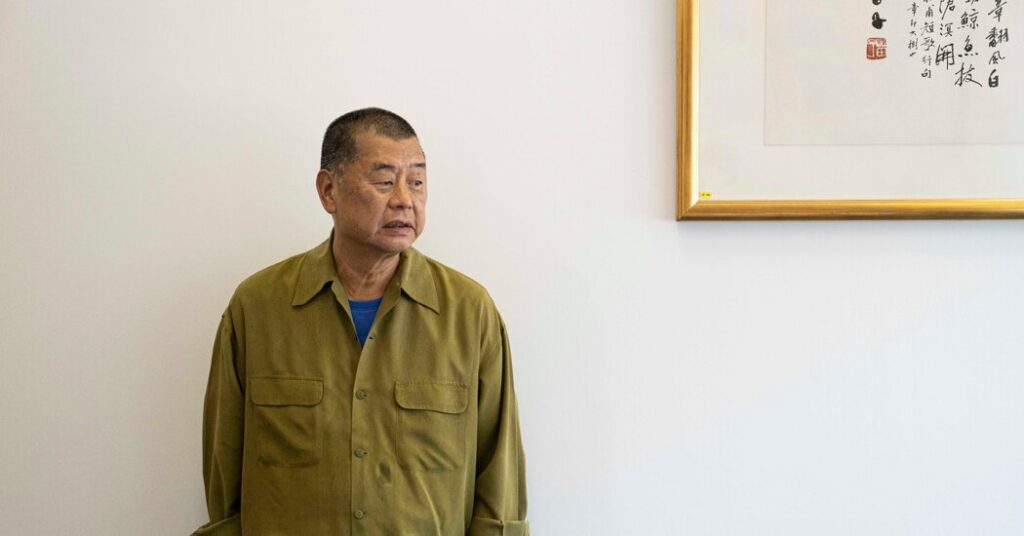
Judges in Hong Kong will hand down a verdict in the landmark national security trial of the media tycoon and pro-democracy activist Jimmy Lai on Monday, bringing to a close a five-year-old case that has come to symbolize the sweeping political changes in the city.
Mr. Lai, 78, has pleaded not guilty to two counts of “conspiracy to collude with foreign forces,” an offense that can be punished by up to life in prison, in part over meetings he held with politicians in the United States. The U.S. government imposed sanctions on the city after the authorities had suppressed monthslong mass antigovernment protests that erupted in 2019.
He has also pleaded not guilty to a separate count of conspiracy to publish seditious material in Apple Daily, the now shuttered Chinese-language newspaper he founded in 1995 that was a persistent critic of Beijing, especially after China resumed sovereignty over the former British colony two years later.
Mr. Lai has been behind bars for five years, having previously been convicted of fraud for violating the terms of a lease agreement. Known for his robust physical stature, he is now thin and frail, his health deteriorating from being held in solitary confinement, his family said.
“My heart breaks thinking of his enduring five sweltering Hong Kong summers in a tiny, airless concrete box with a bed as tough as a wooden plank,” wrote Mr. Lai’s daughter, Claire Lai, in an editorial the Washington Post published last week, in which she pleaded for her father’s release. She said that Mr. Lai was suffering from diabetes and hypertension and that his hearing and vision were failing.
Hong Kong officials say Mr. Lai is receiving “adequate and comprehensive” medical care and that he had requested to be held in solitary confinement.
Mr. Lai’s verdict comes as Hong Kong is still contending with the aftermath of its most deadly fire in decades, an apartment complex blaze that killed at least 160 people last month. The national security police have made at least a dozen arrests since the fire and have been on heightened alert for what they say are “anti-China forces” looking to exploit the disaster to undermine social stability. Critics have said the authorities are targeting people merely calling for greater government accountability.
Mr. Lai’s verdict will again focus attention on what analysts say is Hong Kong’s shrinking tolerance for dissent against the government and free speech, as well as the continued erosion of the “one country two systems” framework that is supposed to guarantee the city some autonomy from Beijing until 2047.
Those changes have been accelerated by two national security laws, one imposed by Beijing in 2020 and another introduced by the Hong Kong government in 2024 that expanded its scope and specifically targets treason, secession, subversion and sedition. Both laws were largely a response to the widespread and sometimes violent demonstrations that engulfed the Asian financial center in 2019, one of the most serious challenges to Beijing’s authority.
The Chinese and Hong Kong governments have cast Mr. Lai as the mastermind of those protests. In their case, prosecutors accused Mr. Lai of colluding with foreign governments to target China and Hong Kong with sanctions. They cited meetings between Mr. Lai and foreign diplomats and other officials in the United States, Britain and Japan.
Mr. Lai’s legal team argued that his calls for sanctions ended once the 2020 national security law took effect. Some of Mr. Lai’s former colleagues testified against him in exchange for a reduction in their sentences.
Human rights groups have called Mr. Lai’s trial a sham, describing it as political persecution. His case was not heard by a jury, but by three judges appointed by Hong Kong’s leader to hear national security cases.
Foreign governments, including the United States and Britain (Mr. Lai is a British citizen), have condemned the prosecution and called for Mr. Lai’s release. President Trump has said that he would try to “save” Mr. Lai, and during a summit in South Korea in October he appealed directly to China’s top leader, Xi Jinping, for the media mogul’s release, Mr. Lai’s foreign legal team said.
Mr. Trump may be more reluctant now to press Mr. Xi about Mr. Lai, having softened his posture toward China in recent months. For the first time in more than 30 years, the White House released a national security strategy that did not criticize China’s authoritarian rule or press Beijing on human rights.
It is unclear if China is interested in brokering a diplomatic deal for Mr. Lai’s release, potentially on medical grounds. Chinese and Hong Kong officials say privately that Mr. Lai must be made an example of and are concerned that he would use his freedom to renew his opposition to Beijing if he lived in exile abroad.
Claire Lai said her father would “pose no threat to the regime” if he left Hong Kong.
“His crusading days are over, and he wishes only to live out his remaining time in peace with family, joining us around the dinner table again,” she wrote in the Washington Post.
David Pierson covers Chinese foreign policy and China’s economic and cultural engagement with the world. He has been a journalist for more than two decades.
The post Hong Kong Court to Give Verdict on Media Mogul Who Took on China appeared first on New York Times.